


Wydawcy
Katalog tematyczny
- Archeologia (109)
- Ekonomia, finanse, business (13704)
- Filozofia (1445)
- Historia (3040)
- Języki i językoznawstwo (2356)
- Lifestyle, hobby i rozrywka (475)
- Medycyna (9704)
- Nauki humanistyczne (4)
- Nauki o Ziemi i środowisku (2638)
- Nauki ścisłe (20412)
- Astronomia (294)
- Biologia (5119)
- Chemia (6540)
- Fizyka (3309)
- Matematyka (4574)
- Algebra (171)
- Analiza matematyczna (902)
- Filozofia matematyki (1)
- Geometria (237)
- Historia matematyki (57)
- Kombinatoryka, teoria grafów (67)
- Matematyka dyskretna (35)
- Matematyka stosowana (555)
- Optymalizacja (104)
- Podstawy matematyki (129)
- Statystyka, prawdopodobieństwo (296)
- Teoria grup (63)
- Teoria liczb (77)
- Topologia (66)
- Nauki ścisłe, ogólnie (503)
- Nauki społeczne (8486)
- Nauki techniczne (13450)
- Prawo (1696)
- Publikacje informacyjne i interdyscyplinarne (1288)
- Religia i wierzenia (917)
- Technika komputerowa (4067)
- Zdrowie, relacje międzyludzkie i rozwój osobisty (657)





Informacje szczegółowe o książce
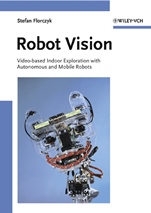
Robot Vision: Video–based Indoor Exploration with Autonomous and Mobile Robots
ISBN 9783527405442
Autor: Stefan Florczyk
Wydawca: Wiley
Dostępność: 3-6 tygodni
Cena: 1 098,30 zł
Przed złożeniem zamówienia prosimy o kontakt mailowy celem potwierdzenia ceny.
ISBN13: |
9783527405442 |
ISBN10: |
3527405445 |
Autor: |
Stefan Florczyk |
Oprawa: |
Hardback |
Rok Wydania: |
2005-11-08 |
Ilość stron: |
216 |
Wymiary: |
249x171 |
Tematy: |
PB |
The book is intended for advanced students in physics, mathematics, computer science, electrical engineering, robotics, engine engineering and for specialists in computer vision and robotics on the techniques for the development of vision–based robot projects. It focusses on autonomous and mobile service robots for indoor work, and teaches the techniques for the development of vision–based robot projects. A basic knowledge of informatics is assumed, but the basic introduction helps to adjust the knowledge of the reader accordingly.
A practical treatment of the material enables a comprehensive understanding of how to handle specific problems, such as inhomogeneous illumination or occlusion. With this book, the reader should be able to develop object–oriented programs and show mathematical basic understanding. Such topics as image processing, navigation, camera types and camera calibration structure the described steps of developing further applications of vision–based robot projects.
Spis treści:
List of Figures.
Symbols and Abbreviations.
1 Introduction.
2 Image Processing.
2.1 Color Models.
2.2 Filtering.
2.3 Morphological Image Processing.
2.4 Edge Detection.
2.5 Skeleton Procedure.
2.6 The Segmentation of Image Regions.
2.7 Threshold.
3 Navigation.
3.1 Coordinate Systems.
3.2 Representation Forms.
3.3 Path Planning.
3.4 The Architecture of a Multilevel Map Representation.
3.5 Self–localization.
4 Vision Systems.
4.1 The Human Visual Apparatus.
4.2 The Human Visual Apparatus as Model for Technical Vision Systems.
4.3 Camera Types.
5 CAD.
5.1 Constructive Solid Geometry.
5.2 Boundary–representation Schema (B–rep).
5.3 Approximate Models.
5.4 Hybrid Models.
5.5 Procedures to Convert the Models.
5.6 The Use of CAD in Computer Vision.
5.7 Three–dimensional Reconstruction with Al
ternative Approaches.
6 Stereo Vision.
6.1 Stereo Geometry.
6.2 The Projection of the Scene Point.
6.3 The Relative Motion of the Camera.
6.4 The Estimation of the Fundamental Matrix B.
6.5 Image Rectification.
6.6 Ego–motion Estimation.
6.7 Three–dimensional Reconstruction by Known Internal Parameters.
6.8 Three–dimensional Reconstruction by Unknown Internal and External Parameters.
6.9 Stereo Correspondence.
6.10 Image–sequence Analysis.
6.11 Three–dimensional Reconstruction from Image Sequences with the Kalman Filter.
7 Camera Calibration.
7.1 The Calibration of One Camera from a Known Scene.
7.2 Calibration of Cameras in Robot–vision Systems.
8 Self–learning Algorithms.
8.1 Semantic Maps.
8.2 Classificators for Self–organizing Neural Networks.
9 OCR.
10 Redundancy in Robot–vision Scenarios.
10.1 Redundant Programs for Robot–vision Applications.
10.2 The Program.
10.3 The Program Flow.
10.4 Experiment.
10.5 Conclusion.
11 Algorithm Evaluation of Robot–vision Systems for Autonomous Robots.
11.1 Algorithms for Indoor Exploration.
11.2 Experiments.
11.3 Conclusion.
12 Calibration for Autonomous Video–based Robot Systems.
12.1 Camera Calibration for Indoor Exploration.
12.2 Simple Calibration with SICAST.
12.3 Experiments.
12.4 Conclusion.
13 Redundant Robot–vision Program for CAD Modeling.
13.1 New CAD Modeling Method for Robot–vision Applications.
13.2 Experiment.
13.3 Conclusion.
Bibliography.
Index.
Koszyk
Książek w koszyku: 0 szt.
Wartość zakupów: 0,00 zł
Informacje


Kontakt
Gambit
Centrum Oprogramowania
i Szkoleń Sp. z o.o.
Al. Pokoju 29b/22-24
31-564 Kraków
Siedziba Księgarni
ul. Kordylewskiego 1
31-542 Kraków
+48 12 410 5991
+48 12 410 5987
+48 12 410 5989
Subskrypcje
Administratorem danych osobowych jest firma Gambit COiS Sp. z o.o. Na podany adres będzie wysyłany wyłącznie biuletyn informacyjny.
Autoryzacja płatności

Informacje na temat autoryzacji płatności poprzez PayU.

© Copyright 2012: GAMBIT COiS Sp. z o.o. Wszelkie prawa zastrzeżone.
Projekt i wykonanie: Alchemia Studio Reklamy