


Wydawcy
Katalog tematyczny
- Archeologia (109)
- Ekonomia, finanse, business (13704)
- Filozofia (1445)
- Historia (3040)
- Języki i językoznawstwo (2356)
- Lifestyle, hobby i rozrywka (475)
- Medycyna (9704)
- Nauki humanistyczne (4)
- Nauki o Ziemi i środowisku (2638)
- Nauki ścisłe (20412)
- Astronomia (294)
- Biologia (5119)
- Chemia (6540)
- Fizyka (3309)
- Matematyka (4574)
- Algebra (171)
- Analiza matematyczna (902)
- Filozofia matematyki (1)
- Geometria (237)
- Historia matematyki (57)
- Kombinatoryka, teoria grafów (67)
- Matematyka dyskretna (35)
- Matematyka stosowana (555)
- Optymalizacja (104)
- Podstawy matematyki (129)
- Statystyka, prawdopodobieństwo (296)
- Teoria grup (63)
- Teoria liczb (77)
- Topologia (66)
- Nauki ścisłe, ogólnie (503)
- Nauki społeczne (8486)
- Nauki techniczne (13450)
- Prawo (1696)
- Publikacje informacyjne i interdyscyplinarne (1288)
- Religia i wierzenia (917)
- Technika komputerowa (4067)
- Zdrowie, relacje międzyludzkie i rozwój osobisty (657)





Informacje szczegółowe o książce
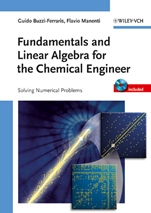
Fundamentals and Linear Algebra for the Chemical Engineer: Solving Numerical Problems
ISBN 9783527325528
Autor: Guido Buzzi–Ferraris, Flavio Manenti
Wydawca: Wiley
Dostępność: 3-6 tygodni
Cena: 584,85 zł
Przed złożeniem zamówienia prosimy o kontakt mailowy celem potwierdzenia ceny.
ISBN13: |
9783527325528 |
ISBN10: |
3527325522 |
Autor: |
Guido Buzzi–Ferraris, Flavio Manenti |
Oprawa: |
Hardback |
Rok Wydania: |
2010-03-24 |
Ilość stron: |
375 |
Wymiary: |
244x175 |
Tematy: |
PB |
Engineers and other applied scientists are frequently faced with models of complex systems for which no rigorous mathematical solution can be calculated. Numerical approximations are thus frequently used to predict the behavior of such systems, either based on real–life measurements or on the behavior of simpler models.
This is the engineer′s companion to using numerical methods for the solution of complex mathematical problems. It enables readers to use and implement standard numerical tools in their work, explaining the theory behind the various functions and problem–solvers, while showcasing applications in diverse scientific and engineering fields.
The material is based on several tried–and–tested courses for scientists and engineers taught by the authors, and all the exercises and problems are classroom–tested.
The software needed is freeware developed and maintained by the authors, included on the accompanying CD–ROM, together with an installation tutorial, all the examples and sample codes described in the book, as well as a host of additional examples.
An essential tool made transparent for chemical, process and electrical engineers, as well as applied mathematicians in their daily work.
Spis treści:
INTRODUCTION
Notation –
Why C++? –
BzzMath Library Style
Basic Requirements for Using BzzMath Library
Topics of Volume I –
Topics of Companion Volumes
BASIC CONCEPTS
Modeling Physical Phenomena
What is an Algorithm?
Representatino of Real Numbers
Elementary Operations
Error Sources
Error Analysis
Local Error and Propagation
Well–posed Problems
Well–conditioned Formulation
Algorithm Stability
Algorithm Selection
Questions –
Excercises –
References
UTILITIES IN BZZMATH LIBRARY
Integer Algebra
Complex Numbers
Questions –
Excercises –
References
LINEAR A
LGEBRA
Vectors
Dense Matrices
Diagonal Matrices
Band Matrices
Left Matrices
Right Matrices
Staircase Matrices
Sparse Matrices
Block Matrices
Vectors of Vectors
Questions –
Excercises –
References
SQUARE LINEAR SYSTEMS
Conditioning of a Linear System
Matrix Balancing
Gaussian Transformation
Classical Gaussian Factorization
Alternative Methods for Gaussian Factorization
Questions –
Excercises –
References
TAILORED LINEAR SYSTEMS
Matrices That Do Not Require Any Factorization
Symmetric Matrices
Sparse Matrices
Symmetric Sparse Matrices
Band Matrices
Staircase Matrices
Partially Structured Matrices
Iterative Methods
Questions –
Excercises –
References
OVERDIMENSIONED LINEAR SYSTEMS
Orthogonal Matrices
Orthogonal Transformation
QR Factorization
SVD Factorization
Questions –
Excercises –
References
UNDERDIMENSIONED LINEAR SYSTEMS
LQ Factorization
Questions –
Excercises –
References
EIGENVALUES AND EIGENVECTORS FOR SYMMETRIC MATRICES
Eigenvalues of Symmetric Matrices
Power Method
Jacobi Method
QR Algorithm
Eigenvalues of Rank–2 Matrices
Questions –
Excercises –
References
ITERATIVE PROCESSES
Convergence of an Iterative Algorithm
Convergence Speed
Convergence Accelerators
Extrapolation
Questions –
Excercises –
References
USER–PROGRAM INTERFACE
Procedural Type –
Object–oriented Type
APPENDICES
Graphical Tools –
Entertainments –
How to Learn Learning
Nota biograficzna:
Guido Buzzi–Ferraris is full professor of process systems engineering at Politecnico die Milano, Italy, where he holds two courses: "Methods and Numerical Applications in Chemical Engineering" and "Regression Models and Statistics". He works on numerical analys
is, statistics, differential systems, and optimization. He has authored books of international relevance on numerical analysis, such as "Scientific C++" edited by Addison–Wesley, and over than 200 papers on international magazines. He is the inventor and the developer of BzzMath library, which is currently adopted by academies, R&D groups, and industries. He is permanent member of the "EFCE Working Party – Computer Aided Process Engineering" since 1969 and editorial advisory board of "Computers & Chemical Engineering" since 1987.
Flavio Manenti is assistant professor of process systems engineering at Politecnico di Milano, Italy. He obtained his academic degree and PhD at Politecnico di Milano, where he currently collaborates with Professor Buzzi–Ferraris. He holds courses on "Process Dynamics and Control of Industrial Processes" and "Supply Chain Optimization" and he works on numerical analysis, process control and optimization. He has also received international scientific awards, such as Memorial Burianec (Prague, CZ) and Excellence in Simulation (Lake Forest, CA, USA), for his research activities and scientific publications.
Okładka tylna:
Engineers and other applied scientists are frequently faced with models of complex systems for which no rigorous mathematical solution can be calculated. Numerical approximations are thus frequently used to predict the behavior of such systems, either based on real–life measurements or on the behavior of simpler models.
This is the engineer′s companion to using numerical methods for the solution of complex mathematical problems. It enables readers to use and implement standard numerical tools in their work, explaining the theory behind the various functions and problem–solvers, while showcasing applications in diverse scientific and engineering fields.
The material is based on several tried–and–tested courses for scientists and enginee
rs taught by the authors, and all the exercises and problems are classroom–tested.
The software needed is freeware developed and maintained by the authors, included on the accompanying CD–ROM, together with an installation tutorial, all the examples and sample codes described in the book, as well as a host of additional examples.
An essential tool made transparent for chemical, process and electrical engineers, as well as applied mathematicians in their daily work.
Koszyk
Książek w koszyku: 0 szt.
Wartość zakupów: 0,00 zł
Informacje


Kontakt
Gambit
Centrum Oprogramowania
i Szkoleń Sp. z o.o.
Al. Pokoju 29b/22-24
31-564 Kraków
Siedziba Księgarni
ul. Kordylewskiego 1
31-542 Kraków
+48 12 410 5991
+48 12 410 5987
+48 12 410 5989
Subskrypcje
Administratorem danych osobowych jest firma Gambit COiS Sp. z o.o. Na podany adres będzie wysyłany wyłącznie biuletyn informacyjny.
Autoryzacja płatności

Informacje na temat autoryzacji płatności poprzez PayU.

© Copyright 2012: GAMBIT COiS Sp. z o.o. Wszelkie prawa zastrzeżone.
Projekt i wykonanie: Alchemia Studio Reklamy