


Wydawcy
Katalog tematyczny
- Archeologia (109)
- Ekonomia, finanse, business (13704)
- Filozofia (1445)
- Historia (3040)
- Języki i językoznawstwo (2356)
- Lifestyle, hobby i rozrywka (475)
- Medycyna (9704)
- Nauki humanistyczne (4)
- Nauki o Ziemi i środowisku (2638)
- Nauki ścisłe (20412)
- Nauki społeczne (8486)
- Nauki techniczne (13450)
- Prawo (1696)
- Publikacje informacyjne i interdyscyplinarne (1288)
- Religia i wierzenia (917)
- Technika komputerowa (4067)
- Bazy danych (75)
- Bezpieczeństwo komputerowe (454)
- Certyfikacja komputerowa (1)
- Grafika i media cyfrowe (32)
- Informatyka (779)
- Komputery, ogólnie (74)
- Programowanie (351)
- Programy komercyjne (49)
- Sieci komputerowe (350)
- Sprzęt komputerowy (4)
- Systemy operacyjne (32)
- Technika cyfrowa na co dzień (7)
- Zdrowie, relacje międzyludzkie i rozwój osobisty (657)





Informacje szczegółowe o książce
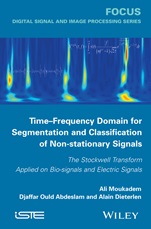
Time-Frequency Domain for Segmentation and Classification of Non-stationary Signals: The Stockwell T
ISBN 9781848216136
Autor: Ali Moukadem
Wydawca: Wiley
Dostępność: 3-6 tygodni
Cena: 301,35 zł
Przed złożeniem zamówienia prosimy o kontakt mailowy celem potwierdzenia ceny.
ISBN13: |
9781848216136 |
ISBN10: |
1848216130 |
Autor: |
Ali Moukadem |
Oprawa: |
Hardback |
Rok Wydania: |
2014-02-28 |
Ilość stron: |
160 |
This book focuses on signal processing algorithms based on the timefrequency domain. Original methods and algorithms are presented which are able to extract information from non–stationary signals such as heart sounds and power electric signals. The methods proposed focus on the time–frequency domain, and most notably the Stockwell Transform for the feature extraction process and to identify signatures. For the classification method, the Adaline Neural Network is used and compared with other common classifiers. Theory enhancement, original applications and concrete implementation on FPGA for real–time processing are also covered in this book.
Preface ix Chapter 1. The Need for Time–Frequency Analysis 1 1.1. Introduction 1 1.2. Stationary and non–stationary concepts 2 1.2.1. Stationarity 2 1.2.2. Non–stationarity 4 1.3. Temporal representations 5 1.4. Frequency representations of signals 6 1.4.1. Fourier transform 7 1.4.2. Mean frequency, bandwidth and frequency average 10 1.5. Uncertainty principle 12 1.6. Limitation of time analysis and frequency analysis: the need for time–frequency representation 15 1.6.1. Instantaneous frequency 15 1.7. Conclusion 18 1.8. Bibliography 19 Chapter 2. Time–Frequency Analysis: The S–Transform 21 2.1. Introduction 21 2.2. Synthetic signals 22 2.3. The STFT 22 2.4. The WT 24 2.5. The Wigner–Ville distribution 25 2.5.1. The pseudo–WVD 27 2.5.2. The smoothed PWVD 27 2.6. Cohen’s class 28 2.7. The S–transform 29 2.7.1. Properties of the S–transform 30 2.7.2. The discrete S–transform 38 2.7.3. The improvement of the S–transform energy concentration 41 2.7.4. The ST–spectrogram 51 2.8. Conclusion 56 2.9. Bibliography 56 Chapter 3. Segmentation and Classification of Heart Sounds Based on the S–Transform 61 3.1. Introduction 61 3.2. Methods and materials 64 3.2.1. Data sets 64 3.2.2. Localization and segmentation of heart sounds 65 3.2.3. Classification of heart sounds 70 3.3. Results and discussion 73 3.3.1. Localization and segmentation results 73 3.3.2. S1 and S2 classification results 77 3.3.3. Murmur detection results 80 3.4. Conclusion 82 3.5. Bibliography 83 Chapter 4. Adaline for the Detection of Electrical Events in Electrical Signals 87 4.1. Introduction 87 4.2. Electric events 88 4.2.1. Power quality 88 4.2.2. Electric events 89 4.3. Adaline 90 4.4. Adaline for frequency estimation 91 4.4.1. Adaline method 91 4.4.2. Results 94 4.5. Adaline for voltage component extraction in unbalanced system 97 4.5.1. Model of the unbalanced voltage system 98 4.5.2. Extraction of the voltage components in the DQ–space 99 4.5.3. Online estimation of the instantaneous phases θd and θi 100 4.5.4. Filtering the AC components in the DQ–space 101 4.5.5. Results 104 4.6. Adaline for harmonic current identification and compensation 108 4.6.1. Adaline method 110 4.6.2. Results 115 4.7. Conclusion 117 4.8. Bibliography 118 Chapter 5. FPGA Implementation of the Adaline 121 5.1. Introduction 121 5.2. Instantaneous power theory (IPT) in the APF 122 5.3. Adaline for the computing of the IPT in the PLL 123 5.3.1. Adaline–based PLL 123 5.3.2. A multiplexing approach for hardware consumption reduction 126 5.4. Results 129 5.4.1. Simulation 129 5.4.2. FPGA implementation results 130 5.5. Conclusion 132 5.6. Bibliography 133 Index 135
Koszyk
Książek w koszyku: 0 szt.
Wartość zakupów: 0,00 zł
Informacje


Kontakt
Gambit
Centrum Oprogramowania
i Szkoleń Sp. z o.o.
Al. Pokoju 29b/22-24
31-564 Kraków
Siedziba Księgarni
ul. Kordylewskiego 1
31-542 Kraków
+48 12 410 5991
+48 12 410 5987
+48 12 410 5989
Subskrypcje
Administratorem danych osobowych jest firma Gambit COiS Sp. z o.o. Na podany adres będzie wysyłany wyłącznie biuletyn informacyjny.
Autoryzacja płatności

Informacje na temat autoryzacji płatności poprzez PayU.

© Copyright 2012: GAMBIT COiS Sp. z o.o. Wszelkie prawa zastrzeżone.
Projekt i wykonanie: Alchemia Studio Reklamy