


Wydawcy
Katalog tematyczny
- Archeologia (109)
- Ekonomia, finanse, business (13704)
- Filozofia (1445)
- Historia (3040)
- Języki i językoznawstwo (2356)
- Lifestyle, hobby i rozrywka (475)
- Medycyna (9704)
- Nauki humanistyczne (4)
- Nauki o Ziemi i środowisku (2638)
- Nauki ścisłe (20412)
- Astronomia (294)
- Biologia (5119)
- Chemia (6540)
- Fizyka (3309)
- Matematyka (4574)
- Algebra (171)
- Analiza matematyczna (902)
- Filozofia matematyki (1)
- Geometria (237)
- Historia matematyki (57)
- Kombinatoryka, teoria grafów (67)
- Matematyka dyskretna (35)
- Matematyka stosowana (555)
- Optymalizacja (104)
- Podstawy matematyki (129)
- Statystyka, prawdopodobieństwo (296)
- Teoria grup (63)
- Teoria liczb (77)
- Topologia (66)
- Nauki ścisłe, ogólnie (503)
- Nauki społeczne (8486)
- Nauki techniczne (13450)
- Prawo (1696)
- Publikacje informacyjne i interdyscyplinarne (1288)
- Religia i wierzenia (917)
- Technika komputerowa (4067)
- Zdrowie, relacje międzyludzkie i rozwój osobisty (657)





Informacje szczegółowe o książce
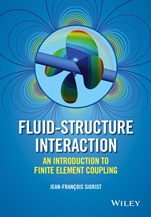
Fluid–Structure Interaction: An Introduction to Finite Element Coupling
ISBN 9781119952275
Autor: Jean–François Sigrist
Wydawca: Wiley
Dostępność: 3-6 tygodni
Cena: 471,45 zł
Przed złożeniem zamówienia prosimy o kontakt mailowy celem potwierdzenia ceny.
ISBN13: |
9781119952275 |
ISBN10: |
1119952271 |
Autor: |
Jean–François Sigrist |
Oprawa: |
Hardback |
Rok Wydania: |
2015-10-09 |
Ilość stron: |
304 |
Wymiary: |
251x173 |
Tematy: |
PB |
Fluid Structure Interaction: An Introduction to Finite Element Coupling fulfils the need for an introductory approach to the general concepts of Finite and Boundary Element Methods (FEM and BEM) for FSI (fluid structure interaction), from the mathematical formulation to the physical interpretation of numerical simulations. Composed of six chapters, the book progresses logically from formulations and applications involving structure and fluid dynamics, fluid and structure interactions and opens to reduced–order modelling for vibro–acoustic coupling. The author describes simple yet fundamental illustrative examples in detail, using analytical and/or semi–analytical formulations, designed to both illustrate each numerical method and to highlight a physical aspect of FSI. All proposed examples are simple enough to be computed by the reader using standard computational tools such as MATLAB®, making the book a unique tool for self–learning and understanding the basics of the techniques for FSI. Test cases for FEM/FEM or FEM/BEM coupling techniques also render the book valuable for code verification and validation purposes.
Key Features:
Easy–to–read introduction to mathematical/numerical modelling of FSI
Provides a first approach on classical numerical techniques and is suited to undergraduate students as well as practicing engineers
Illustrates the physics of structural–acoustics coupling with various examples of academic and industrial interest
Is a good companion for the practice of Finite and Boundary Element Methods with any engineering simulation software
Accompanied by a website hosting MATLAB® codes and Powerpoint slides
Based on the author s experience in developing numerical codes for industrial applications and teaching FSI to both practicing engineers and within academia, Fluid Structure Interaction: An Introduction to Finite Element Coupling is a comprehensive and self–contained guide for both students and practitioners of mechanical engineering.
Foreword v
Preface vii
Images Credits ix
1 Fluid–Structure Interaction 1
1.1 A wide variety of problems 2
1.2 Analytical modelling of Fluid–Structure Interactions 3
1.2.1 Potential flow. Inertial coupling 4
1.2.2 Viscous flow. Viscous damping 8
1.2.3 Compressible flow. Radiation damping 10
1.3 Numerical simulation of Fluid–Structure Interactions 14
1.4 Finite element and boundary element methods 24
References 25
2 Structure Finite Elements 27
2.1 Vibrations of an elastic structure 28
2.1.1 Modelling assumptions 28
2.1.2 Equations of motion 36
2.2 Finite Element Method: practical implementation 38
2.2.1 Weighted integral formulation 38
2.2.2 Finite elements 40
2.2.3 Elementary matrices 43
2.2.4 Mass and stiffness matrices 44
2.2.5 Calculating and assembling matrices 49
2.2.6 Modal analysis 54
2.3 Example: bending modes 57
2.3.1 Bending motion of a straight elastic beam 57
2.3.2 Bernoulli beam elements 58
2.3.3 Bending modes 62
2.4 Example : coupled bending/membrane modes 66
2.4.1 Bending and membrane motion of a circular elastic ring 66
2.4.2 Fourier component representation: 0D element 67
2.4.3 Bending/membrane modes 69
References 79
3 Fluid Finite Elements 81
3.1 Fluid flow equations 82
3.2 Compressibility waves 91
3.2.1 Wave equation 91
3.2.2 Boundary conditions 95
3.3 Finite element method 103
3.3.1 Pressure–based formulation 103
3.3.2 Displacement–based formulations 108
3.3.3 Finite element matrices 111
3.4 Boundary element method 113
3.4.1 Green function and Green s integral theorem 113
3.4.2 Interior and exterior problems 114
3.4.3 Direct and indirect boundary element method 116
3.4.4 Boundary element matrices 120
3.5 Example: Sloshing modes 121
3.5.1 Circular reservoir with fluid free surface 121
3.5.2 2D axi–symmetric elements with gravity 124
3.5.3 Sloshing modes 126
3.6 Example: Acoustic modes in an open reservoir 128
3.6.1 Cylindrical acoustic opened cavity 128
3.6.2 2D axi–symmetric elements with compressibility 129
3.6.3 Acoustic modes 130
3.7 Example: Acoustic modes in a closed reservoir 132
3.7.1 Rectangular acoustic closed cavity 132
3.7.2 2D fluid elements with compressibility 134
3.7.3 Acoustic modes 134
3.8 Example: Acoustic radiation in infinite fluid 135
3.8.1 Pulsating ring in infinite acoustic fluid 135
3.8.2 1D axi–symmetric element with radiation condition 137
3.8.3 1D boundary elements 138
3.8.4 Acoustic radiation 141
References 146
4 Inertial Coupling 149
4.1 Mathematical modelling 150
4.2 Added mass matrix 152
4.2.1 Coupling matrix 152
4.2.2 Added mass matrix 154
4.2.3 Inertial effect 156
4.3 Modelling inertial coupling for complex systems: example of tube bundle 163
4.3.1 Analytical models for added mass 164
4.3.2 Term–to–term computation of the added mass matrix 164
4.3.3 A homogenisation technique 167
4.4 Examples : inertial effect in bounded domain 178
4.4.1 Analytical calculation of the added mass matrix 178
4.4.2 Numerical computation of the added mass matrix 185
4.5 Example: inertial effect in unbounded domain 191
4.5.1 Elastic ring immersed in a fluid 191
4.5.2 Finite element coupling with infinite element 194
References 200
5 Fluid–Structure Coupling 203
5.1 Modelling assumption 204
5.2 Interior problems: vibro–acoustic and hydro–elastic coupling 205
5.2.1 Non–symmetric formulation 205
5.2.2 Symmetric formulation 208
5.3 Exterior problem: vibro–acoustic 217
5.4 Example: vibro–acoustic coupling and hydro–elastic sloshing 223
5.5 Example: Acoustic damping 231
5.5.1 Analytical modelling 231
5.5.2 Numerical computation 235
References 245
6 Structural Dynamics with Fluid–Structure Interaction 247
6.1 Introduction 248
6.2 Time–domain analysis 250
6.2.1 Direct methods 250
6.2.2 Modal methods 261
6.3 Frequency–domain analysis 271
6.3.1 Direct and modal methods 271
6.3.2 Computation of the projection basis 273
6.4 Example: time–domain analysis 278
6.4.1 Accelerated cantilever beam with fluid coupling 278
6.4.2 System and excitation spectra 281
6.4.3 Seismic response: Direct and modal methods 283
6.5 Example: frequency–domain analysis 289
6.5.1 Acoustic radiation of a damped structure immersed in a fluid 289
6.5.2 Frequency response: Direct and modal methods 293
References 304
Index 307
Jean–François SIGRIST
DCNS Research, France
Koszyk
Książek w koszyku: 0 szt.
Wartość zakupów: 0,00 zł
Informacje


Kontakt
Gambit
Centrum Oprogramowania
i Szkoleń Sp. z o.o.
Al. Pokoju 29b/22-24
31-564 Kraków
Siedziba Księgarni
ul. Kordylewskiego 1
31-542 Kraków
+48 12 410 5991
+48 12 410 5987
+48 12 410 5989
Subskrypcje
Administratorem danych osobowych jest firma Gambit COiS Sp. z o.o. Na podany adres będzie wysyłany wyłącznie biuletyn informacyjny.
Autoryzacja płatności

Informacje na temat autoryzacji płatności poprzez PayU.

© Copyright 2012: GAMBIT COiS Sp. z o.o. Wszelkie prawa zastrzeżone.
Projekt i wykonanie: Alchemia Studio Reklamy