


Wydawcy
Katalog tematyczny
- Archeologia (109)
- Ekonomia, finanse, business (13704)
- Filozofia (1445)
- Historia (3040)
- Języki i językoznawstwo (2356)
- Lifestyle, hobby i rozrywka (475)
- Medycyna (9704)
- Nauki humanistyczne (4)
- Nauki o Ziemi i środowisku (2638)
- Nauki ścisłe (20412)
- Astronomia (294)
- Biologia (5119)
- Chemia (6540)
- Fizyka (3309)
- Matematyka (4574)
- Algebra (171)
- Analiza matematyczna (902)
- Filozofia matematyki (1)
- Geometria (237)
- Historia matematyki (57)
- Kombinatoryka, teoria grafów (67)
- Matematyka dyskretna (35)
- Matematyka stosowana (555)
- Optymalizacja (104)
- Podstawy matematyki (129)
- Statystyka, prawdopodobieństwo (296)
- Teoria grup (63)
- Teoria liczb (77)
- Topologia (66)
- Nauki ścisłe, ogólnie (503)
- Nauki społeczne (8486)
- Nauki techniczne (13450)
- Prawo (1696)
- Publikacje informacyjne i interdyscyplinarne (1288)
- Religia i wierzenia (917)
- Technika komputerowa (4067)
- Zdrowie, relacje międzyludzkie i rozwój osobisty (657)





Informacje szczegółowe o książce
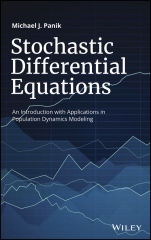
Stochastic Differential Equations: An Introduction with Applications in Population Dynamics Modeling
ISBN 9781119377382
Autor: Michael J. Panik
Wydawca: Wiley
Dostępność: 3-6 tygodni
Cena: 622,65 zł
Przed złożeniem zamówienia prosimy o kontakt mailowy celem potwierdzenia ceny.
ISBN13: |
9781119377382 |
ISBN10: |
1119377382 |
Autor: |
Michael J. Panik |
Oprawa: |
Hardback |
Rok Wydania: |
2017-06-09 |
Ilość stron: |
304 |
Wymiary: |
256x152 |
Tematy: |
PB |
A beginner s guide to stochastic growth modeling
The chief advantage of stochastic growth models over deterministic models is that they combine both deterministic and stochastic elements of dynamic behaviors, such as weather, natural disasters, market fluctuations, and epidemics. This makes stochastic modeling a powerful tool in the hands of practitioners in fields for which population growth is a critical determinant of outcomes.
However, the background requirements for studying SDEs can be daunting for those who lack the rigorous course of study received by math majors. Designed to be accessible to readers who have had only a few courses in calculus and statistics, this book offers a comprehensive review of the mathematical essentials needed to understand and apply stochastic growth models. In addition, the book describes deterministic and stochastic applications of population growth models including logistic, generalized logistic, Gompertz, negative exponential, and linear.
Ideal for students and professionals in an array of fields including economics, population studies, environmental sciences, epidemiology, engineering, finance, and the biological sciences, Stochastic Differential Equations: An Introduction with Applications in Population Dynamics Modeling:
Provides precise definitions of many important terms and concepts and provides many solved example problems Highlights the interpretation of results and does not rely on a theorem–proof approach Features comprehensive chapters addressing any background deficiencies readers may have and offers a comprehensive review for those who need a mathematics refresher Emphasizes solution techniques for SDEs and their practical application to the development of stochastic population modelsAn indispensable resource for students and practitioners with limited exposure to mathematics and statistics, Stochastic Differential Equations: An Introduction with Applications in Population Dynamics Modeling is an excellent fit for advanced undergraduates and beginning graduate students, as well as practitioners who need a gentle introduction to SDEs.
Dedication
Preface
Chapter 1: Mathematical Foundations 1: Point–Set Concepts, Set and Measure Functions, Normed Linear Spaces, and Integration
1.1 Set Notation and Operations
1.2 Single–Valued Functions
1.3 Real and Extended Real Numbers
1.4 Metric Spaces
1.5 Limits of Sequences
1.6 Point–Set Theory
1.7 Continuous Functions
1.8 Operations on Sequences of Sets
1.9 Classes of Subsets of 1.10 Set and Measure Functions
1.11 Normed Linear Spaces
1.12 Integration
Chapter 2: Mathematical Foundations 2: Probability, Random Variables, and Convergence of Random Variables
2.1 Probability Spaces
2.2 Probability Distributions
2.3 The Expectation of a Random Variable
2.4 Moments of a Random Variable
2.5 Multiple Random Variables
2.6 Convergence of Sequences of Random Variables
2.7 A Couple of Important Inequalities
Appendix 2.A The Conditional Expectation E(X|Y)
Chapter 3: Mathematical Foundations 3: Stochastic Processes, Martingales, and Brownian Motion
3.1 Stochastic Processes
3.2 Martingales
3.3 Path Regularity of Stochastic Processes
3.4 Symmetric Random Walk
3.5 Brownian Motion (BM)
Appendix 3.A Kolmogorov Existence Theorem: Another Look
Chapter 4: Mathematical Foundations 4: Stochastic Integrals, Itô s Integral, Itô s Formula, and Martingale Representation
4.1 Introduction
4.2 Stochastic Integration
4.3 One–Dimensional Itô Formula
4.4 Martingale Representation Theorem
4.5 Multi–Dimensional Itô Formula
Appendix 4.A Itô s Formula
Appendix 4.B Multi–Dimensional Itô Formula
Chapter 5: Stochastic Differential Equations (SDEs)
5.1 Introduction
5.2 Existence and Uniqueness of Solutions
5.3 Linear Stochastic Differential Equations
5.4 Stochastic Differential Equations and Stability
Appendix 5.A Solutions of Linear SDEs in Product Form
Appendix 5.B Integrating Factors and Variation of Parameters
Chapter 6: Stochastic Population Growth Models
6.1 Introduction
6.2 A Deterministic Population Growth Model
6.3 A Stochastic Population Growth Model
6.4 Deterministic and Stochastic Logistic Growth Models
6.5 Deterministic and Stochastic Generalized Logistic Growth Models
6.6 Deterministic and Stochastic Gompertz Growth Models
6.7 Deterministic and Stochastic Negative Exponential Growth Models
6.8 Deterministic and Stochastic Linear Growth Models
6.9 Stochastic Square–Root Growth Models with Mean Reversion
Appendix 6.A Deterministic and Stochastic Logistic Growth Models with an Allee Effect
Appendix 6.B Reducible Stochastic Differential Equations
Chapter 7 : Approximation and Estimation of Solutions to SDEs
7.1 Introduction
7.2 Iterative Schemes for Approximating SDEs
7.3 The Lamperti Transformation
7.4 Variations on the E–M and Milstein Schemes
7.5 Local Linearization Techniques
Appendix 7.A Stochastic Taylor Expansions
Appendix 7.B The Euler– Maruyama (E–M) and Milstein Discretizations
Appendix 7.C The Lamperti Transformation
Chapter 8: Estimation of Parameters of SDEs
8.1 Introduction
8.2 The Transition Probability Density Function is Known
8.3 The Transition Probability Density Function is Unknown
Appendix 8.A The Maximum Likelihood (ML) Technique
Appendix 8.B The Log–Normal Probability Distribution
Appendix 8.C The Markov Property, Transition Densities, and the Likelihood Function of the Sample
Appendix 8.D Change of Variable
Appendix A A Review of Some Fundamental Calculus Concepts
Appendix B The Lebesgue Integral
Appendix C Lebesgue–Stieltjes (L–S) Integral
Appendix D A Brief Review of Ordinary Differential Equations (ODEs)
References
Symbols and Abbreviations
Index
Michael J. Panik, PhD, is Professor in the Department of Economics, Barney School of Business and Public Administration at the University of Hartford in Connecticut. He received his PhD in Economics from Boston College and is a member of the American Mathematical Society, The American Statistical Association, and The Econometric Society.
Koszyk
Książek w koszyku: 0 szt.
Wartość zakupów: 0,00 zł
Informacje


Kontakt
Gambit
Centrum Oprogramowania
i Szkoleń Sp. z o.o.
Al. Pokoju 29b/22-24
31-564 Kraków
Siedziba Księgarni
ul. Kordylewskiego 1
31-542 Kraków
+48 12 410 5991
+48 12 410 5987
+48 12 410 5989
Subskrypcje
Administratorem danych osobowych jest firma Gambit COiS Sp. z o.o. Na podany adres będzie wysyłany wyłącznie biuletyn informacyjny.
Autoryzacja płatności

Informacje na temat autoryzacji płatności poprzez PayU.

© Copyright 2012: GAMBIT COiS Sp. z o.o. Wszelkie prawa zastrzeżone.
Projekt i wykonanie: Alchemia Studio Reklamy