


Wydawcy
Katalog tematyczny
- Archeologia (109)
- Ekonomia, finanse, business (13704)
- Filozofia (1445)
- Historia (3040)
- Języki i językoznawstwo (2356)
- Lifestyle, hobby i rozrywka (475)
- Medycyna (9704)
- Nauki humanistyczne (4)
- Nauki o Ziemi i środowisku (2638)
- Nauki ścisłe (20412)
- Astronomia (294)
- Biologia (5119)
- Chemia (6540)
- Fizyka (3309)
- Matematyka (4574)
- Algebra (171)
- Analiza matematyczna (902)
- Filozofia matematyki (1)
- Geometria (237)
- Historia matematyki (57)
- Kombinatoryka, teoria grafów (67)
- Matematyka dyskretna (35)
- Matematyka stosowana (555)
- Optymalizacja (104)
- Podstawy matematyki (129)
- Statystyka, prawdopodobieństwo (296)
- Teoria grup (63)
- Teoria liczb (77)
- Topologia (66)
- Nauki ścisłe, ogólnie (503)
- Nauki społeczne (8486)
- Nauki techniczne (13450)
- Prawo (1696)
- Publikacje informacyjne i interdyscyplinarne (1288)
- Religia i wierzenia (917)
- Technika komputerowa (4067)
- Zdrowie, relacje międzyludzkie i rozwój osobisty (657)





Informacje szczegółowe o książce
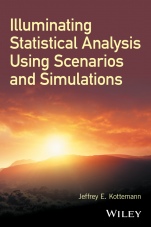
Illuminating Statistical Analysis Using Scenarios and Simulations
ISBN 9781119296331
Autor: Jeffrey E. Kottemann
Wydawca: Wiley
Dostępność: 3-6 tygodni
Cena: 542,85 zł
Przed złożeniem zamówienia prosimy o kontakt mailowy celem potwierdzenia ceny.
ISBN13: |
9781119296331 |
ISBN10: |
1119296331 |
Autor: |
Jeffrey E. Kottemann |
Oprawa: |
Hardback |
Rok Wydania: |
2017-04-11 |
Ilość stron: |
312 |
Wymiary: |
241x159 |
Tematy: |
PB |
Features an integrated approach of statistical scenarios and simulations and aids readers in developing key intuitions needed to understand the wide ranging concepts and methods of statistics and inference
Illuminating Statistical Analysis Using Scenarios and Simulations presents the basic concepts of statistics and statistical inference using the dual mechanisms of scenarios and simulations. This approach helps readers develop key intuitions and deep understandings of statistical analysis. Scenario–specific sampling simulations depict the results that would be obtained by a very large number of individuals investigating the same scenario, each with their own evidence, while graphical depictions of the simulation results present clear and direct pathways to intuitive methods for statistical inference. These intuitive methods can then be easily linked to traditional formulaic methods, and the author does not simply explain the linkages, but rather provides demonstrations throughout for a broad range of statistical phenomena. In addition, induction and deduction are repeatedly interwoven, which fosters a natural "need to know basis" for ordering the topic coverage.
Examining computer simulation results is central to the discussion and provides an illustrative way to (re)discover the properties of sample statistics, the role of chance, and to (re)invent corresponding principles of statistical inference. In addition, the simulation results foreshadow the various mathematical formulas that underlie statistical analysis.
In addition, this book:
Features both an intuitive and analytical perspective and includes a broad introduction to the use of Monte Carlo simulation and formulaic methods for statistical analysis Presents straight–forward coverage of the essentials of basic statistics and ensures proper understanding of key concepts such as sampling distributions, the effects of sample size and variance on uncertainty, analysis of proportion, mean and rank differences, covariance, correlation and regression Introduces advanced topics such as Bayesian statistics, data mining, model cross–validation, robust regression, and resampling Contains numerous example problems in each chapter with detailed solutions as well as an appendix that serves as a manual for constructing simulations quickly and easily using Microsoft® Office Excel®Illuminating Statistical Analysis Using Scenarios and Simulations is an ideal textbook for courses and seminars in statistics and statistical inference. The book also serves as a thought–provoking treatise for researchers, scientists, managers, and others with a keen interest in statistical analysis.
Jeffrey E. Kottemann, PhD, is Professor in the Perdue School at Salisbury University. Dr. Kottemann has published articles in a wide variety of academic research journals in the fields of business administration, computer science, decision sciences, economics, engineering, information systems, psychology, and public administration. He received his PhD in Systems and Quantitative Methods from the University of Arizona.
Preface
Acknowledgements
Part I: Sample Proportions and the Normal Distribution
Chapter 1: Evidence and Verdicts
Chapter 2: Judging Coins I
Chapter 3: Brief on Bell–Shapes
Chapter 4: Judging Coins II
Chapter 5: Amount of Evidence I
Chapter 6: Variance of Evidence I
Chapter 7: Judging Opinion Splits I
Chapter 8: Amount of Evidence II
Chapter 9: Variance of Evidence II
Chapter 10: Judging Opinion Splits II
Chapter 11: It s Been the Normal Distribution All Along
Chapter 12: Judging Opinion Split Differences
Chapter 13: Rescaling to Standard Errors
Chapter 14: The Standardized Normal Distribution Histogram
Chapter 15: The z Distribution
Chapter 16: Brief on Two–Tail vs. One–Tail
Chapter 17: Brief on Type I vs. Type II Errors
Part II: Sample Means and the Normal Distribution
Chapter 18: Scaled Data and Sample Means
Chapter 19: Distribution of Random Sample Means
Chapter 20: Amount of Evidence
Chapter 21: Variance of Evidence
Chapter 22: Homing in on the Population Mean I
Chapter 23: Homing in on the Population Mean II
Chapter 24: Homing in on the Population Mean III
Chapter 25: Judging Mean Differences
Chapter 26: Sample Size, Variance, and Uncertainty
Chapter 27: The t Distribution
Part III: Multiple Proportions and Means: the X2 and F Distributions
Chapter 28: Multiple Proportions and the X2 Distribution
Chapter 29: Facing Degrees of Freedom
Chapter 30: Multiple Proportions: Goodness of Fit
Chapter 31: Two–Way Proportions: Homogeneity
Chapter 32: Two–Way Proportions: Independence
Chapter 33: Variance Ratios and the F Distribution
Chapter 34: Multiple Means and Variance Ratios: ANOVA
Chapter 35: Two–Way Means and Variance Ratios: ANOVA
Part IV: Linear Associations: Covariance, Correlation, and Regression
Chapter 36: Covariance
Chapter 37: Correlation
Chapter 38: What Correlations Happen Just by Chance?
Chapter 39: Judging Correlation Differences
Chapter 40: Correlation with Mixed Data Types
Chapter 41: A Simple Regression Prediction Model
Chapter 42: Using Binomials Too
Chapter 43: A Multiple Regression Prediction Model
Chapter 44: Loose End I (Collinearity)
Chapter 45: Loose End II (Squaring R)
Chapter 46: Loose End III (Adjusting R Squared)
Chapter 47: Reality Strikes
Part V: Dealing with Unruly Scaled Data
Chapter 48: Obstacles and Maneuvers
Chapter 49: Ordered Ranking Maneuver
Chapter 50: What Rank Sums Happen Just By Chance?
Chapter 51: Judging Rank Sum Differences
Chapter 52: Other Methods Using Ranks
Chapter 53: Transforming the Scale of Scaled Data
Chapter 54: Brief on Robust Regression
Chapter 55: Brief on Simulation and Resampling
Part VI: Review and Additional Concepts
Chapter 56: For Part I
Chapter 57: For Part II
Chapter 58: For Part III
Chapter 59: For Part IV
Chapter 60: For Part V
Appendices
A. Data Types and Some Basic Statistics
B. Simulating Statistical Scenarios
C. Standard Error as Standard Deviation
D. Data Excerpt
E. Repeated Measures
F. Bayesian Statistics
G. Data Mining
Index
Jeffrey E. Kottemann, PhD, is Professor in the Perdue School at Salisbury University. Dr. Kottemann has published articles in a wide variety of academic research journals in the fields of business administration, computer science, decision sciences, economics, engineering, information systems, psychology, and public administration. He received his PhD in Systems and Quantitative Methods from the University of Arizona.
Koszyk
Książek w koszyku: 0 szt.
Wartość zakupów: 0,00 zł
Informacje


Kontakt
Gambit
Centrum Oprogramowania
i Szkoleń Sp. z o.o.
Al. Pokoju 29b/22-24
31-564 Kraków
Siedziba Księgarni
ul. Kordylewskiego 1
31-542 Kraków
+48 12 410 5991
+48 12 410 5987
+48 12 410 5989
Subskrypcje
Administratorem danych osobowych jest firma Gambit COiS Sp. z o.o. Na podany adres będzie wysyłany wyłącznie biuletyn informacyjny.
Autoryzacja płatności

Informacje na temat autoryzacji płatności poprzez PayU.

© Copyright 2012: GAMBIT COiS Sp. z o.o. Wszelkie prawa zastrzeżone.
Projekt i wykonanie: Alchemia Studio Reklamy