


Wydawcy
Katalog tematyczny
- Archeologia (109)
- Ekonomia, finanse, business (13704)
- Filozofia (1445)
- Historia (3040)
- Języki i językoznawstwo (2356)
- Lifestyle, hobby i rozrywka (475)
- Medycyna (9704)
- Nauki humanistyczne (4)
- Nauki o Ziemi i środowisku (2638)
- Nauki ścisłe (20412)
- Astronomia (294)
- Biologia (5119)
- Chemia (6540)
- Fizyka (3309)
- Matematyka (4574)
- Algebra (171)
- Analiza matematyczna (902)
- Filozofia matematyki (1)
- Geometria (237)
- Historia matematyki (57)
- Kombinatoryka, teoria grafów (67)
- Matematyka dyskretna (35)
- Matematyka stosowana (555)
- Optymalizacja (104)
- Podstawy matematyki (129)
- Statystyka, prawdopodobieństwo (296)
- Teoria grup (63)
- Teoria liczb (77)
- Topologia (66)
- Nauki ścisłe, ogólnie (503)
- Nauki społeczne (8486)
- Nauki techniczne (13450)
- Prawo (1696)
- Publikacje informacyjne i interdyscyplinarne (1288)
- Religia i wierzenia (917)
- Technika komputerowa (4067)
- Zdrowie, relacje międzyludzkie i rozwój osobisty (657)





Informacje szczegółowe o książce
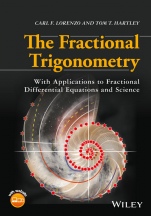
The Fractional Trigonometry: With Applications to Fractional Differential Equations and Science
ISBN 9781119139409
Autor: Carl F. Lorenzo, Tom T. Hartley
Wydawca: Wiley
Dostępność: 3-6 tygodni
Cena: 631,05 zł
Przed złożeniem zamówienia prosimy o kontakt mailowy celem potwierdzenia ceny.
ISBN13: |
9781119139409 |
ISBN10: |
1119139406 |
Autor: |
Carl F. Lorenzo, Tom T. Hartley |
Oprawa: |
Hardback |
Rok Wydania: |
2016-12-30 |
Ilość stron: |
464 |
Wymiary: |
262x179 |
Tematy: |
PB |
Addresses the rapidly growing field of fractional calculus and provides simplified solutions for linear commensurate–order fractional differential equations
The Fractional Trigonometry: With Applications to Fractional Differential Equations and Science is the result of the authors work in fractional calculus, and more particularly, in functions for the solutions of fractional differential equations, which is fostered in the behavior of generalized exponential functions. The authors discuss how fractional trigonometry plays a role analogous to the classical trigonometry for the fractional calculus by providing solutions to linear fractional differential equations. The book begins with an introductory chapter that offers insight into the fundamentals of fractional calculus, and topical coverage is then organized in two main parts. Part One develops the definitions and theories of fractional exponentials and fractional trigonometry. Part Two provides insight into various areas of potential application within the sciences. The fractional exponential function via the fundamental fractional differential equation, the generalized exponential function, and R–function relationships are discussed in addition to the fractional hyperboletry, the R1–fractional trigonometry, the R2–fractional trigonometry, and the R3–trigonometric functions. The Fractional Trigonometry: With Applications to Fractional Differential Equations and Science also:
Presents fractional trigonometry as a tool for scientists and engineers and discusses how to apply fractional–order methods to the current toolbox of mathematical modelers Employs a mathematically clear presentation in an e ort to make the topic broadly accessible Includes solutions to linear fractional differential equations and generously features graphical forms of functions to help readers visualize the presented concepts Provides effective and efficient methods to describe complex structuresThe Fractional Trigonometry: With Applications to Fractional Differential Equations and Science is an ideal reference for academic researchers, research engineers, research scientists, mathematicians, physicists, biologists, and chemists who need to apply new fractional calculus methods to a variety of disciplines. The book is also appropriate as a textbook for graduate– and PhD–level courses in fractional calculus.
Carl F. Lorenzo is Distinguished Research Associate at the NASA Glenn Research Center in Cleveland, Ohio. His past positions include chief engineer of the Instrumentation and Controls Division and chief of the Advanced Controls Technology and Systems Dynamics branches at NASA. He is internationally recognized for his work in the development and application of the fractional calculus and fractional trigonometry.
Tom T. Hartley, PhD, is Emeritus Professor in the Department of Electrical and Computer Engineering at The University of Akron. Dr Hartley is a recognized expert in fractional–order systems, and together with Carl Lorenzo, has solved fundamental problems in the area including Riemann s complementary–function initialization function problem. He received his PhD in Electrical Engineering from Vanderbilt University.
Preface
Acknowledgements
1. Introduction
1.1 Background
1.2 The Fractional Integral and Derivative
1.3 The Traditional Trigonometry
1.4 Previous Efforts
1.5 Expectations of a Generalized Trigonometry and Hyperboletry
2. The Fractional Exponential Function via the Fundamental Fractional Differential Equation
2.1 The Fundamental Fractional Differential Equation
2.2 The Generalized Impulse Response Function
2.3 Relationship of the F–function to the Mittag–Leffler Function
2.4 Properties of the F–function
2.5 Behavior of the F–function as the Parameter a Varies
2.6 Example
3. The Generalized Fractional Exponential Function
3.1 Introduction
3.2 Functions for the Fractional Calculus
3. 3 The R–Function: A Generalized Function
3.4 Properties of the Function
3.5 Relationship of the R–function to the Elementary Functions
3.6 R–Function Identities
3.7 Relationship of the R–Function to the Fractional Calculus Functions
3.8 Example: Cooling Manifold
3.9 A Further Generalized Function: The G–Function and H–function
3.10 Preliminaries to the Fractional Trigonometry Develpoment
3.11 Eigen Character of the R–Function
3.12 Fractional Differintegral of the Time–Scaled R–Function
3.13 R–Function Relationships
3.14. Roots of Complex Numbers
3.15 Indexed Forms of the R–Function
3.16 Term–by–Term Operations
3.17 Discussion
4. R–Function Relationships
4.1 R–Function Basics
4.2 Relationships for in Terms of
4.3 Relationships for in Terms of
4.4 Relationships for the Rational Form in Terms of
4.5 Relationships for in Terms of
4.6 Relating to the Exponential Function
4.7 Inverse Relationships Relationships for in Terms of
4.8 Inverse Relationships Relationships for in Terms of
4.9 Inverse Relationships Relationships for in Terms of
4.10 Discussion
5. The Fractional Hyperboletry
5.1 The Fractional R1–Hyperbolic Functions
5.2 R1–Hyperbolic Function Relationship
5.3 Fractional Calculus Operations on the R1–Hyperbolic Functions
5.4 Laplace Transforms of the R1–Hyperbolic Functions
5.5 Complexity Based Hyperbolic Functions
5.6 Fractional Hyperbolic Differential Equations
5.7 Example
5.8 Discussion
6. The R1 Fractional Trigonometry
6.1 R1–Trigonometric Functions
6.2 R1–Trigonometric Function Interrelationship
6.3 Relationships to R1–Hyperbolic Functions
6.4 Fractional Calculus Operations on the R1–Trigonometric Functions
6.5 Laplace Transforms of the R1–Trigonometric Functions
6.6 Complexity Based R1–Trigonometric Functions
6.7 Fractional Differential Equations
7. The R2 Fractional Trigonometry
7.1 R2–Trigonometric Functions: Based on Real and Imaginary Parts
7.2 R2–Trigonometric Functions: Based on Parity
7.3 Laplace Transforms of the R2–Trigonometric Functions
7.4 R2 Trigonometric Function Relationships
7.5 Fractional Calculus Operations on the R2 Trigonometric Functions
7.5.9 Summary of Fractional Calculus Operations on the R2 Trigonometric Functions
7.6 Inferred Fractional Differential Equations
8. The R3–Trigonometric Functions
8.1 The R3–Trigonometric Functions: Based on Complexity
8.2 The R3–Trigonometric Functions: Based on Parity
8.3 Laplace Transforms of the R3–Trigonometric Functions
8.4 R3 Trigonometric Function Relationships
8.5 Fractional Calculus Operations on the R3 Trigonometric Functions
9. The Fractional Meta–Trigonometry
9.1 The Fractional Meta–Trigonometric Functions: Based on Complexity
9.2 The Meta–Fractional Trigonometric Functions: Based on Parity
9.3 Commutative Properties of the Complexity and Parity Operations
9.4 Laplace Transforms of the Fractional Meta–Trigonometric Functions
9.5 R–Function Representation of the Fractional Meta–Trigonometric Functions
9.6 Fractional Calculus Operations on the Meta–Trigonometric Functions
9.7 Special Topics in Fractional Differintegration
9.8 Meta–Trigonometric Function Relationships
9.9 Fractional Poles: Structure of the Laplace Transforms
9.10 Comments and Issues Relative to the Meta–Trigonometric Functions
9.11 Backward Compatibility to Earlier Fractional Trigonometries
9.12 Discussion
10. The Ratio and Reciprocal Functions
10.1 Fractional Complexity Functions
10.2 The Parity Reciprocal Functions
10.3 The Parity Ratio Functions
10.4 R–Function Representation of the Fractional Ratio and Reciprocal Functions
10.5 Relationships
10.6 Discussion
11. Further Generalized Fractional Trigonometries
11.1 The G–Function Based Trigonometry
11.2 Laplace Transforms for the G–Trigonometric Functions
11.3 The H–Function Based Trigonometry
11.4 Laplace Transforms for the H–Trigonometric Functions
12. The Solution of Linear Fractional Differential Equations based on the Fractional Trigonometry
12.1 Fractional Differential Equations
12.2 Fundamental Fractional Differential Equations of the First Kind
12.3 Fundamental Fractional Differential Equation of the Second Kind
12.4 Preliminaries–Laplace Transforms
12.5 Fractional Differential Equations of Higher Order: Unrepeated
Roots
12.6 Fractional Differential Equations of Higher Order: Containing Repeated Roots
12.7 Fractional Differential Equations Containing Repeated Roots
12.8 Fractional Differential Equations of Non–Commensurate Order
12.9 Indexed Fractional Differential Equations: Multiple Solutions
12.10 Discussion
13. Fractional Trigonometric Systems
13.1 The R–function as a Linear System
13.2 R–System Time Responses
13.3 R–Function Based Frequency Responses
13.4 Meta–Trigonometric Functions Based Frequency Responses
13.5 Fractional Meta–Trigonometry
13.6 Elementary Fractional Transfer Functions
13.7 Stability Theorem (Matignon)
13.8 Stability of Elementary Fractional Transfer Functions
13.9 Insights into the Behavior of the Fractional Meta–Trigonometric Functions
13.10 Discussion
14. Numerical Issues and Approximations in the Fractional Trigonometry
14.1 R–Function Convergence
14.2 The Meta–Trigonometric Function Convergence
14.3 Uniform Convergence
14.4 Numerical Issues in the Fractional Trigonometry
14.5 The R2Cos and R2Sin Function Asymptotic Behavior
14.6 R–function Approximations
14.7 The Near Order Effect
14.8 High Precision Software
15. The Fractional Spiral Functions: Further Characterization of the Fractional Trigonometry
15.1 The Fractional Spiral Functions
15.2 Analysis of Spirals
15.3 Relation to Classical Spirals
15.4 Discussion
16. Fractional Oscillators
16.1 The Space of Linear Fractional Oscillators
16.2 Coupled Fractional Oscillators
17. Shell Morphology and Growth
17.1 Nautilus Pompilius
17.2 –17.7 Various Shells
17.8 Ammonite
17.9 Discussion
18. Mathematical Classification of the Spiral and Ring Galaxy Morphologies
18.1 Introduction
18.2 Background Fractional Spirals for Galactic Classification
18.3 Classification Process
18.4 Mathematical Classification of Selected Galaxies
18.5 Analysis
18.6 Discussion
18.7 Appendix Carbon Star
19. Hurricanes, Tornados and Whirlpools
19.1 Hurricane Cloud Patterns
19.2 Tornado Classification
19.3 Low Pressure Cloud Pattern
19.4 Whirlpool
19.5 Order in Physical Systems
20. A Look Forward
20.1 Properties of the R–Function
20.2 Inverse Functions
20.3 The Generalized Fractional Trigonometries
20.4 Extensions to Negative Time, Complementary Trigonometries and Complex Arguments
20.5 Applications: Fractional Field Equations
20.6 Fractional Spiral Properties and Non–Spiral Properties
20.7 Numerical Improvements for Evaluation to Larger Values of atq
20.8 Epilog
Appendix A Related Works
Appendix B Computer Code
Appendix C Tornado Simulation
Appendix D Special Topics in Fractional Differintegration
D.1 Fractional Integration of the Segmented Function
D.2 Fractional Differentiation of the Segmented Function
D.3 Fractional Integration of Segmented Fractional Trigonometric Functions
D.4 Fractional Differentiation of Segmented Fractional Trigonometric Functions
Appendix E Alternate Forms
E.1 Reduced Variable Summation Forms
E.2 Natural Quency Simplification
Carl F. Lorenzo is Distinguished Research Associate at the NASA Glenn Research Center in Cleveland, Ohio. His past positions include chief engineer of the Instrumentation and Controls Division and chief of the Advanced Controls Technology and Systems Dynamics branches at NASA. He is internationally recognized for his work in the development and application of the fractional calculus and fractional trigonometry.
Tom T. Hartley, PhD, is Emeritus Professor in the Department of Electrical and Computer Engineering at The University of Akron. Dr Hartley is a recognized expert in fractional–order systems, and together with Carl Lorenzo, has solved fundamental problems in the area including Riemann s complementary–function initialization function problem. He received his PhD in Electrical Engineering from Vanderbilt University.
Koszyk
Książek w koszyku: 0 szt.
Wartość zakupów: 0,00 zł
Informacje


Kontakt
Gambit
Centrum Oprogramowania
i Szkoleń Sp. z o.o.
Al. Pokoju 29b/22-24
31-564 Kraków
Siedziba Księgarni
ul. Kordylewskiego 1
31-542 Kraków
+48 12 410 5991
+48 12 410 5987
+48 12 410 5989
Subskrypcje
Administratorem danych osobowych jest firma Gambit COiS Sp. z o.o. Na podany adres będzie wysyłany wyłącznie biuletyn informacyjny.
Autoryzacja płatności

Informacje na temat autoryzacji płatności poprzez PayU.

© Copyright 2012: GAMBIT COiS Sp. z o.o. Wszelkie prawa zastrzeżone.
Projekt i wykonanie: Alchemia Studio Reklamy