


Wydawcy
Katalog tematyczny
- Archeologia (109)
- Ekonomia, finanse, business (13704)
- Filozofia (1445)
- Historia (3040)
- Języki i językoznawstwo (2356)
- Lifestyle, hobby i rozrywka (475)
- Medycyna (9704)
- Nauki humanistyczne (4)
- Nauki o Ziemi i środowisku (2638)
- Nauki ścisłe (20412)
- Astronomia (294)
- Biologia (5119)
- Chemia (6540)
- Fizyka (3309)
- Matematyka (4574)
- Algebra (171)
- Analiza matematyczna (902)
- Filozofia matematyki (1)
- Geometria (237)
- Historia matematyki (57)
- Kombinatoryka, teoria grafów (67)
- Matematyka dyskretna (35)
- Matematyka stosowana (555)
- Optymalizacja (104)
- Podstawy matematyki (129)
- Statystyka, prawdopodobieństwo (296)
- Teoria grup (63)
- Teoria liczb (77)
- Topologia (66)
- Nauki ścisłe, ogólnie (503)
- Nauki społeczne (8486)
- Nauki techniczne (13450)
- Prawo (1696)
- Publikacje informacyjne i interdyscyplinarne (1288)
- Religia i wierzenia (917)
- Technika komputerowa (4067)
- Zdrowie, relacje międzyludzkie i rozwój osobisty (657)





Informacje szczegółowe o książce
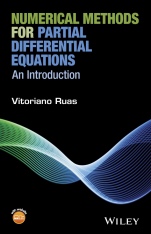
Numerical Methods for Partial Differential Equations: An Introduction
ISBN 9781119111351
Autor: Vitoriano Ruas
Wydawca: Wiley
Dostępność: 3-6 tygodni
Cena: 401,10 zł
Przed złożeniem zamówienia prosimy o kontakt mailowy celem potwierdzenia ceny.
ISBN13: |
9781119111351 |
ISBN10: |
1119111358 |
Autor: |
Vitoriano Ruas |
Oprawa: |
Hardback |
Rok Wydania: |
2016-07-15 |
Ilość stron: |
300 |
Wymiary: |
293x178 |
Tematy: |
PB |
Numerical Methods for Partial Differential Equations: An Introduction
Vitoriano Ruas, Sorbonne Universités, UPMC – Université Paris 6, France
A comprehensive overview of techniques for the computational solution of PDE′s
Numerical Methods for Partial Differential Equations: An Introduction covers the three most popular methods for solving partial differential equations: the finite difference method, the finite element method and the finite volume method. The book combines clear descriptions of the three methods, their reliability, and practical implementation aspects. Justifications for why numerical methods for the main classes of PDE′s work or not, or how well they work, are supplied and exemplified.
Key features:
A balanced emphasis is given to both practical considerations and a rigorous mathematical treatment.
The reliability analyses for the three methods are carried out in a unified framework and in a structured and visible manner, for the basic types of PDE′s.
Special attention is given to low order methods, as practitioner′s overwhelming default options for everyday use.
New techniques are employed to derive known results, thereby simplifying their proof.
Supplementary material is available from a companion website.
Aimed primarily at students of Engineering, Mathematics, Computer Science, Physics and Chemistry among others this book offers a substantial insight into the principles numerical methods in this class of problems are based upon. The book can also be used as a reference for research work on numerical methods for PDE s.
Preface
Eugenio Oñate
Preface
Larisa Beilina
Acknowledgements
About the companion website
Introduction; Aim, Scope and Approach
Key Reminders on Linear Algebra
1 GETTING STARTED IN ONE SPACE VARIABLE 1
1.1 A model two–point boundary value problem 2
1.2 The basic FDM 8
1.3 The piecewise linear FEM (P1 FEM) 15
1.4 The basic FVM 22
1.4.1 The vertex–centred FVM 22
1.4.2 The cell–centred FVM 25
1.4.3 Connections to the other methods 28
1.5 Handling non zero boundary conditions 30
1.6 Effective resolution 32
1.6.1 Solving SLAE′s for one–dimensional problems 33
1.6.2 Example 1.1 Numerical experiments with the cell–centred FVM 34
1.7 Exercises 36
2 QUALITATIVE RELIABILITY ANALYSIS 39
2.1 Norms and inner products 41
2.1.1 Normed vector spaces 41
2.1.2 Inner product spaces 43
2.2 Stability of a numerical method 46
2.2.1 Stability in the maximum norm 47
2.2.2 Stability in the mean–square sense 51
2.3 Scheme consistency 55
2.3.1 Consistency of the three–point FD scheme 55
2.3.2 Consistency of the P1 FE scheme 57
2.4 Convergence of the discretisation methods 62
2.4.1 Convergence of the three–point FDM 63
2.4.2 Convergence of the P1 FEM 64
2.4.3 Remarks on the convergence of the FVM 67
2.4.4 Example 2.1 Sensitivity study of three equivalent methods 70
2.5 Exercises 75
3 TIME–DEPENDENT BOUNDARY VALUE PROBLEMS 77
3.1 Numerical solution of the heat equation 81
3.1.1 Implicit time discretisation 82
3.1.2 Explicit time discretisation 84
3.1.3 Example 3.1 Numerical behaviour of the Forward Euler scheme 86
3.2 Numerical solution of the transport equation 88
3.2.1 Natural schemes 89
3.2.2 The Lax scheme 91
3.2.3 Upwind schemes 92
3.2.4 Extensions to the FVM and the FEM 93
3.3 Stability of the numerical models 97
3.3.1 Schemes for the heat equation 98
3.3.2 The Lax scheme for the transport equation 101
3.4 Consistency and convergence results 103
3.4.1 Euler schemes for the heat equation 103
3.4.2 Schemes for the transport equation 106
3.5 Complements on the equation of the vibrating string (VSE) 108
3.5.1 The Lax scheme to solve the VS first order system 108
3.5.2 Example 3.2 Numerical study of schemes for the VS first order system 109
3.5.3 A natural explicit scheme for the VSE 111
3.6 Exercises 115
4 METHODS FOR TWO–DIMENSIONAL PROBLEMS 117
4.1 The Poisson equation 119
4.2 The five–point FDM 121
4.2.1 Framework and method description 121
4.2.2 A few words on possible extensions 125
4.3 The P1 FEM 127
4.3.1 Green′s identities 128
4.3.2 The standard Galerkin variational formulation 131
4.3.3 Method description 133
4.3.4 Implementation aspects 140
4.3.5 The master element technique 146
4.3.6 Application to linear elasticity 149
4.4 Basic FVM 154
4.4.1 The vertex–centred FVM; equivalence with the P1 FEM 154
4.4.2 The cell–centred FVM; focus on flux computations 160
4.5 SLAE resolution 174
4.5.1 Example 4.1 A Crout solver for banded matrices 177
4.5.2 Example 4.2 Iterative solution of equivalent FD–FE–FV SLAE′s 181
4.6 Exercises 185
5 ANALYSES IN TWO SPACE VARIABLES 187
5.1 Methods for the Poisson equation 188
5.1.1 Convergence of the five–point FDM 188
5.1.2 Convergence of the P1 FEM 193
5.1.3 Example 5.1 Solving the Poisson equation with Neumann boundary conditions 205
5.1.4 Example 5.2 Convergence of the P1 FEM to non smooth solutions. 208
5.1.5 Convergence of the FVM 211
5.1.6 Example 5.3 Triangle–centred FVM versus RT0 mixed FE 234
5.2 Time integration schemes for the heat equation 241
5.2.1 Pointwise convergence of five–point FD schemes 242
5.2.2 Convergence of P1 FE schemes in the mean–square sense 246
5.2.3 Pointwise behaviour of FE and FV schemes: an overview. 256
5.3 Exercises 257
6 EXTENSIONS 261
6.1 Lagrange FEM of degree greater than one 262
6.1.1 The Pk FEM in one–dimension space for k > 1 262
6.1.2 A FEM for quadrilateral meshes 270
6.1.3 Piecewise quadratic FE′s in two space variables 277
6.1.4 The case of curved domains 281
6.1.5 Example 6.1 P2–FE solution of the equation u – u = f in a curved domain 288
6.1.6 More about implementation in two–dimension space 292
6.2 Extensions to the three–dimensional case 301
6.2.1 Methods for rectangular domains 302
6.2.2 Tetrahedron based methods 307
6.2.3 Implementation aspects 312
6.2.4 Example 6.2 A MATLAB code for three–dimensional FE computations 316
6.3 Exercises 324
7 MISCELLANEOUS COMPLEMENTS 327
7.1 Numerical solution of biharmonic equations in rectangles 328
7.1.1 Model fourth–order elliptic PDE′s 328
7.1.2 The thirteen–point FD scheme 330
7.1.3 Hermite FEM in intervals and rectangles 332
7.2 The advection–diffusion equation 341
7.2.1 A model one–dimensional equation 342
7.2.2 Overcoming the main difficulties with the FDM 344
7.2.3 Example 7.1 Numerical study of the upwind FD scheme 348
7.2.4 The SUPG formulation 349
7.2.5 Example 7.2 Numerics of the SUPG formulation for the P1 FEM 354
7.2.6 An upwind FV scheme 355
7.2.7 A FE scheme for the time–dependent problem 359
7.2.8 Example 7.3 Numerical study of the weighted mass FE scheme 367
7.3 Basics of a posteriori error estimates and adaptivity 370
7.3.1 A posteriori error estimates 371
7.3.2 Mesh adaptivity; h–, p– and h p–methods 375
7.4 A word about non linear PDE′s 377
7.4.1 Example 7.4 Solving non–linear two–point boundary value problems 380
7.4.2 Example 7.5 A quasi–explicit method for the Navier–Stokes equations 384
7.5 Exercises 390
Appendix 391
References
Index
Koszyk
Książek w koszyku: 0 szt.
Wartość zakupów: 0,00 zł
Informacje


Kontakt
Gambit
Centrum Oprogramowania
i Szkoleń Sp. z o.o.
Al. Pokoju 29b/22-24
31-564 Kraków
Siedziba Księgarni
ul. Kordylewskiego 1
31-542 Kraków
+48 12 410 5991
+48 12 410 5987
+48 12 410 5989
Subskrypcje
Administratorem danych osobowych jest firma Gambit COiS Sp. z o.o. Na podany adres będzie wysyłany wyłącznie biuletyn informacyjny.
Autoryzacja płatności

Informacje na temat autoryzacji płatności poprzez PayU.

© Copyright 2012: GAMBIT COiS Sp. z o.o. Wszelkie prawa zastrzeżone.
Projekt i wykonanie: Alchemia Studio Reklamy