


Wydawcy
Katalog tematyczny
- Archeologia (109)
- Ekonomia, finanse, business (13704)
- Filozofia (1445)
- Historia (3040)
- Języki i językoznawstwo (2356)
- Lifestyle, hobby i rozrywka (475)
- Medycyna (9704)
- Nauki humanistyczne (4)
- Nauki o Ziemi i środowisku (2638)
- Nauki ścisłe (20412)
- Astronomia (294)
- Biologia (5119)
- Chemia (6540)
- Fizyka (3309)
- Matematyka (4574)
- Algebra (171)
- Analiza matematyczna (902)
- Filozofia matematyki (1)
- Geometria (237)
- Historia matematyki (57)
- Kombinatoryka, teoria grafów (67)
- Matematyka dyskretna (35)
- Matematyka stosowana (555)
- Optymalizacja (104)
- Podstawy matematyki (129)
- Statystyka, prawdopodobieństwo (296)
- Teoria grup (63)
- Teoria liczb (77)
- Topologia (66)
- Nauki ścisłe, ogólnie (503)
- Nauki społeczne (8486)
- Nauki techniczne (13450)
- Prawo (1696)
- Publikacje informacyjne i interdyscyplinarne (1288)
- Religia i wierzenia (917)
- Technika komputerowa (4067)
- Zdrowie, relacje międzyludzkie i rozwój osobisty (657)





Informacje szczegółowe o książce
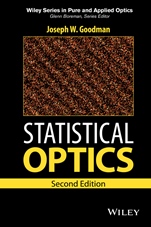
Statistical Optics
ISBN 9781119009450
Autor: Joseph W. Goodman
Wydawca: Wiley
Dostępność: 3-6 tygodni
Cena: 542,85 zł
Przed złożeniem zamówienia prosimy o kontakt mailowy celem potwierdzenia ceny.
ISBN13: |
9781119009450 |
ISBN10: |
1119009456 |
Autor: |
Joseph W. Goodman |
Oprawa: |
Hardback |
Rok Wydania: |
2015-06-02 |
Numer Wydania: |
2nd Edition |
Ilość stron: |
544 |
Wymiary: |
234x145 |
Tematy: |
PB |
This book discusses statistical methods that are useful for treating problems in modern optics, and the application of these methods to solving a variety of such problems
This book covers a variety of statistical problems in optics, including both theory and applications. The text covers the necessary background in statistics, statistical properties of light waves of various types, the theory of partial coherence and its applications, imaging with partially coherent light, atmospheric degradations of images, and noise limitations in the detection of light. New topics have been introduced in the second edition, including:
Analysis of the Vander Pol oscillator model of laser light Coverage on coherence tomography and coherence multiplexing of fiber sensors An expansion of the chapter on imaging with partially coherent light, including several new examples An expanded section on speckle and its properties New sections on the cross–spectrum and bispectrum techniques for obtaining images free from atmospheric distortions A new section on imaging through atmospheric turbulence using coherent light The addition of the effects of read noise to the discussions of limitations encountered in detecting very weak optical signals A number of new problems and many new references have been addedStatistical Optics, 2nd Edition is written for researchers and engineering students interested in optics, physicists and chemists, as well as graduate level courses in a University Engineering or Physics Department.
Joseph W. Goodman is an engineer and physicist. He has held a number of positions in the field of optics, including the presidency of the Optical Society of America and the presidency of the International Commission for Optics. He chaired the Department of Electrical Engineering at Stanford University from 1988 until 1996, and served as Senior Associate Dean of Engineering from 1996 through 2000.
1 Introduction 1
1.1 Deterministic Versus Statistical Phenomena and Models 2
1.2 Statistical Phenomena in Optics 3
1.3 An Outline of the Book 5
2 Random Variables 6
2.1 Definitions of Probability and Random Variables 6
2.2 Distribution Functions and Density Functions 8
2.3 Extension to Two or More Joint Random Variables 12
2.4 Statistical Averages 14
2.4.1 Moments of a Random Variable 15
2.4.2 Joint Moments of Random Variables 16
2.4.3 Characteristic Functions and Moment–Generating Functions 17
2.5 Transformations of Random Variables 20
2.5.1 General Transformations 20
2.5.2 Monotonic Transformations 22
2.5.3 Multivariate Transformations 26
2.6 Sums of Real Random Variables 27
2.6.1 Two Methods for Finding pZ(z) 27
2.6.2 Independent Random Variables 29
2.6.3 The Central Limit Theorem 30
2.7 Gaussian Random Variables 32
2.7.1 Definitions 32
2.7.2 Special Properties of Gaussian Random Variables 33
2.8 Complex–Valued Random Variables 37
2.8.1 General Descriptions 37
2.8.2 Complex Gaussian Random Variables 38
2.8.3 The Complex Gaussian Moment Theorem 41
2.9 Random Phasor Sums 42
2.9.1 Initial Assumptions 42
2.9.2 Calculations of Means Variances and the Correlation Coefficient 43
2.9.3 Statistics of the Length and Phase 45
2.9.4 Constant Phasor Plus a Random Phasor Sum 47
2.9.5 Strong Constant Phasor Plus a Weak Random Phasor Sum 50
2.10 Poisson Random Variables 52
3 Random Processes 56
3.1 Definition and Description of a Random Process 56
3.2 Stationarity and Ergodicity 59
3.3 Spectral Analysis of Random Processes 64
3.3.1 Spectral Densities of a Known Function 65
3.3.2 Spectral Densities of a Random Process 66
3.3.3 Energy and Power Spectral Densities for Linearly Filtered Random Processes 67
3.4 Autocorrelation Functions and the Wiener Khinchin Theorem 69
3.4.1 Definitions and Properties 69
3.4.2 Relationship to the Power Spectral Density 70
3.4.3 An Example Calculation 72
3.4.4 Autocovariance Functions and Structure Functions 74
3.5 Cross–Correlation Functions and Cross–Spectral Densities 75
3.6 Gaussian Random Processes 78
3.6.1 Definition 78
3.6.2 Linearly Filtered Gaussian Random Processes 79
3.6.3 Wide–Sense Stationarity and Strict Stationarity 79
3.6.4 Fourth– and Higher–Order Moments 80
3.7 Poisson Impulse Processes 80
3.7.1 Definition 80
3.7.2 Derivation of Poisson Statistics from Fundamental Hypotheses 82
3.7.3 Derivation of Poisson Statistics from Random Event Times 84
3.7.4 Energy and Power Spectral Densities of Poisson Processes 85
3.7.5 Doubly Stochastic Poisson Processes 88
3.7.6 Spectral Densities of Filtered Processes 91
3.8 Random Processes Derived from Analytic Signals 93
3.8.1 Representation of a Monochromatic Signal by a Complex Signal 93
3.8.2 Representation of a Nonmonochromatic Signal by a Complex Signal 95
3.8.3 Complex Envelopes or Time–Varying Phasors 97
3.8.4 The Analytic Signal as a Complex–Valued Random Process 98
3.9 The Circular Complex Gaussian Random Process 101
3.10 The Karhunen Loève Expansion 102
4 Some First–Order Statistical Properties of Light 109
4.1 Propagation of Light 110
4.1.1 Monochromatic Light 110
4.1.2 Nonmonochromatic Light 111
4.1.3 Narrowband Light 113
4.1.4 Intensity or Irradiance 113
4.2 Thermal Light 114
4.2.1 Polarized Thermal Light 115
4.2.2 Unpolarized Thermal Light 118
4.3 Partially Polarized Thermal Light 119
4.3.1 Passage of Narrowband Light Through Polarization–Sensitive Systems 120
4.3.2 The Coherency Matrix 122
4.3.3 The Degree of Polarization 126
4.3.4 First–Order Statistics of the Instantaneous Intensity 128
4.4 Single–Mode Laser Light 130
4.4.1 An Ideal Oscillation 131
4.4.2 Oscillation with a Random Instantaneous Frequency 132
4.4.3 The Van der Pol Oscillator Model 134
4.4.4 A More Complete Solution for Laser Output Intensity Statistics 141
4.5 Multimode Laser Light 143
4.5.1 Amplitude Statistics 144
4.6 Pseudothermal Light Produced by Passing Laser Light Through a Changing Diffuser 148
5 Temporal and Spatial Coherence of Optical Waves 152
5.1 Temporal Coherence 153
5.1.1 Interferometers that Measure Temporal Coherence 153
5.1.2 The Role of the Autocorrelation Function in Predicting the Interferogram 156
5.1.3 Relationship Between the Interferogram and the Power Spectral Density of the Light 158
5.1.4 Fourier Transform Spectroscopy 162
5.1.5 Optical Coherence Tomography 165
5.1.6 Coherence Multiplexing 170
5.2 Spatial Coherence 172
5.2.1 Young s Experiment 172
5.2.2 Mathematical Description of the Experiment 173
5.2.3 Some Geometrical Considerations 177
5.2.4 Interference Under Quasimonochromatic Conditions 180
5.2.5 Cross–Spectral Density and the Spectral Degree of Coherence 183
5.2.6 Summary of the Various Measures of Coherence 186
5.2.7 Effects of Finite Pinhole Size 186
5.3 Separability of Spatial and Temporal Coherence Effects 188
5.4 Propagation of Mutual Coherence 191
5.4.1 Solution Based on the Huygens Fresnel Principle 191
5.4.2 Wave Equations Governing Propagation of Mutual Coherence 193
5.4.3 Propagation of Cross–Spectral Density 195
5.5 Special Forms of the Mutual Coherence Function 196
5.5.1 A Coherent Field 196
5.5.2 An Incoherent Field 199
5.5.3 A Schell–Model Field 200
5.5.4 A Quasihomogeneous Field 201
5.5.5 Expansion of the Mutual Intensity Function in Coherent Modes 201
5.6 Diffraction of Partially Coherent Light by a Transmitting Structure 202
5.6.1 Effect of a Thin Transmitting Structure on Mutual Intensity 203
5.6.2 Calculation of the Observed Intensity Pattern 203
5.6.3 Discussion 205
5.6.4 An Example 207
5.7 The Van Cittert Zernike Theorem 208
5.7.1 Mathematical Derivation of the Theorem 208
5.7.2 Discussion 210
5.7.3 An Example 212
5.8 A Generalized Van Cittert Zernike Theorem 214
5.9 Ensemble–Average Coherence 218
6 Some Problems Involving Higher–Order Coherence 227
6.1 Statistical Properties of the Integrated Intensity of Thermal or Pseudothermal Light 228
6.1.1 Mean and Variance of the Integrated Intensity 229
6.1.2 Approximate Form of the Probability Density Function of Integrated Intensity 232
6.1.3 Exact Solution for the Probability Density Function of Integrated Intensity 237
6.2 Statistical Properties of Mutual Intensity with Finite Measurement Time 243
6.2.1 Moments of the Real and Imaginary Parts of 12(T) 245
6.3 Classical Analysis of the Intensity Interferometer 249
6.3.1 Amplitude versus Intensity Interferometry 250
6.3.2 Ideal Output of the Intensity Interferometer 252
6.3.3 Noise at the Interferometer Output 255
7 Effects of Partial Coherence in Imaging Systems 262
7.1 Preliminaries 263
7.1.1 Passage of Partially Coherent Light through a Thin Transmitting Structure 263
7.1.2 Hopkins Formula 265
7.1.3 Focal Plane to Focal Plane Coherence Relationships 267
7.1.4 A Generic Optical Imaging System 268
7.2 Space–Domain Calculation of Image Intensity 269
7.2.1 An Approach to Calculate the Mutual Intensity Incident on the Object 270
7.2.2 Zernike s Approximation 271
7.2.3 Critical Illumination and Köhler s Illumination 273
7.3 Frequency Domain Calculation of the Image Intensity Spectrum 274
7.3.1 Mutual Intensity Relations in the Frequency Domain 274
7.3.2 The Transmission Cross–Coefficient 276
7.4 The Incoherent and Coherent Limits 280
7.4.1 The Incoherent Case 280
7.4.2 The Coherent Case 282
7.4.3 When is an Optical Imaging System Fully Coherent or Fully Incoherent? 283
7.5 Some Examples 286
7.5.1 The Image of Two Closely Spaced Points 286
7.5.2 The Image of an Amplitude Step 289
7.5.3 The Image of a –Radian Phase Step 290
7.5.4 The Image of a Sinusoidal Amplitude Object 291
7.6 Image Formation as an Interferometric Process 293
7.6.1 An Imaging System as an Interferometer 294
7.6.2 The Case of an Incoherent Object 296
7.6.3 Gathering Image Information with Interferometers 298
7.6.4 The Michelson Stellar Interferometer 300
7.6.5 The Importance of Phase Information 301
7.6.6 Phase Retrieval in One Dimension 304
7.6.7 Phase Retrieval in Two Dimensions Iterative Phase Retrieval 307
7.7 The Speckle Effect in Imaging 308
7.7.1 The Origin and First–Order Statistics of Speckle 310
7.7.2 Ensemble–Average Van Cittert Zernike Theorem 312
7.7.3 The Power Spectral Density of Image Speckle 314
7.7.4 Speckle Suppression 316
8 Imaging Through Randomly Inhomogeneous Media 323
8.1 Effects of Thin Random Screens on Image Quality 324
8.1.1 Assumptions and Simplifications 324
8.1.2 The Average Optical Transfer Function 325
8.1.3 The Average Point–Spread Function 328
8.2 Random–Phase Screens 328
8.2.1 General Formulation 329
8.2.2 The Gaussian Random–Phase Screen 330
8.2.3 Limiting Forms for the Average OTF and the Average PSF for Large Phase Variance 334
8.3 The Earth s Atmosphere as a Thick Phase Screen 336
8.3.1 Definitions and Notation 338
8.3.2 Atmospheric Model 341
8.4 Electromagnetic Wave Propagation Through the Inhomogeneous Atmosphere 344
8.4.1 Wave Equation in an Inhomogeneous Transparent Medium 344
8.4.2 The Born Approximation 346
8.4.3 The Rytov Approximation 348
8.4.4 Intensity Statistics 350
8.5 The Long–Exposure OTF 352
8.5.1 Long–Exposure OTF in Terms of the Wave Structure Function 352
8.5.2 Near–Field Calculation of the Wave Structure Function 357
8.5.3 Effects of Smooth Variations of the Refractive Index Structure Constant C2
n 364
8.5.4 The Atmospheric Coherence Diameter r0 366
8.5.5 Structure Function for a Spherical Wave 368
8.5.6 Extension to Longer Propagation Paths Log–Amplitude and Phase Filter Functions 369
8.6 The Short–Exposure OTF 375
8.6.1 Long versus Short Exposures 375
8.6.2 Calculation of the Average Short–Exposure OTF 377
8.7 Stellar Speckle Interferometry 382
8.7.1 Principles of the Method 383
8.7.2 Heuristic Analysis of the Method 385
8.7.3 Simulation 389
8.7.4 A More Complete Analysis 390
8.8 The Cross–Spectrum or Knox Thompson Technique 392
8.8.1 The Cross–Spectrum Transfer Function 392
8.8.2 Constraints on | | 394
8.8.3 Simulation 394
8.8.4 Recovering Object Spectral Phase Information from the
Cross–Spectrum 396
8.9 The Bispectrum Technique 398
8.9.1 The Bispectrum Transfer Function 398
8.9.2 Recovering Full Object Information from the Bispectrum 399
8.10 Adaptive Optics 401
8.11 Generality of the Theoretical Results 404
8.12 Imaging Laser–Illuminated Objects through a Turbulent
Atmosphere 406
9 Fundamental Limits in Photoelectric Detection of Light 415
9.1 The Semiclassical Model for Photoelectric Detection 416
9.2 Effects of Random Fluctuations of the Classical Intensity 417
9.2.1 Photocount Statistics for Well–Stabilized Single–Mode Laser Light 419
9.2.2 Photocount Statistics for Polarized Thermal Light 421
9.2.3 Polarization Effects 425
9.2.4 Effects of Incomplete Spatial Coherence 427
9.3 The Degeneracy Parameter 429
9.3.1 Fluctuations of Photocounts 429
9.3.2 The Degeneracy Parameter for Blackbody Radiation 433
9.3.3 Read Noise 436
9.4 Noise Limitations of the Amplitude Interferometer at Low Light Levels 439
9.4.1 The Measurement System and the Quantities to Be Measured 439
9.4.2 Statistical Properties of the Count Vector 441
9.4.3 The Discrete Fourier Transform as an Estimation Tool 442
9.4.4 Accuracy of the Visibility and Phase Estimates 444
9.4.5 Amplitude Interferometer Example 448
9.5 Noise Limitations of the Intensity Interferometer at Low Light Levels 449
9.5.1 The Counting Version of the Intensity Interferometer 449
9.5.2 The Expected Value of the Count–Fluctuation Product and Its Relation to Fringe Visibility 450
9.5.3 The Signal–to–Noise Ratio Associated with the Visibility Estimate 452
9.5.4 Intensity Interferometer Example 454
9.6 Noise Limitations in Stellar Speckle Interferometry 456
9.6.1 A Continuous Model for the Detection Process 457
9.6.2 The Spectral Density of the Detected Image 458
9.6.3 Fluctuations of the Estimate of Image Spectral Density 461
9.6.4 Signal–to–Noise Ratio for Stellar Speckle Interferometry 463
9.6.5 Discussion of the Results 464
Appendix A The Fourier Transform 471
A.1 Fourier Transform Definitions 471
A.2 Basic Properties of the Fourier Transform 473
A.3 Tables of Fourier Transforms 476
Appendix B Random Phasor Sums 478
Appendix C The Atmospheric Filter Functions 484
Appendix D Analysis of Stellar Speckle Interferometry 489
Appendix E Fourth–Order Moment of the Spectrum
of a Detected Speckle Image 493
Bibliography 496
Index 509
Koszyk
Książek w koszyku: 0 szt.
Wartość zakupów: 0,00 zł
Informacje


Kontakt
Gambit
Centrum Oprogramowania
i Szkoleń Sp. z o.o.
Al. Pokoju 29b/22-24
31-564 Kraków
Siedziba Księgarni
ul. Kordylewskiego 1
31-542 Kraków
+48 12 410 5991
+48 12 410 5987
+48 12 410 5989
Subskrypcje
Administratorem danych osobowych jest firma Gambit COiS Sp. z o.o. Na podany adres będzie wysyłany wyłącznie biuletyn informacyjny.
Autoryzacja płatności

Informacje na temat autoryzacji płatności poprzez PayU.

© Copyright 2012: GAMBIT COiS Sp. z o.o. Wszelkie prawa zastrzeżone.
Projekt i wykonanie: Alchemia Studio Reklamy