


Wydawcy
Katalog tematyczny
- Archeologia (109)
- Ekonomia, finanse, business (13704)
- Filozofia (1445)
- Historia (3040)
- Języki i językoznawstwo (2356)
- Lifestyle, hobby i rozrywka (475)
- Medycyna (9704)
- Nauki humanistyczne (4)
- Nauki o Ziemi i środowisku (2638)
- Nauki ścisłe (20412)
- Astronomia (294)
- Biologia (5119)
- Chemia (6540)
- Fizyka (3309)
- Matematyka (4574)
- Algebra (171)
- Analiza matematyczna (902)
- Filozofia matematyki (1)
- Geometria (237)
- Historia matematyki (57)
- Kombinatoryka, teoria grafów (67)
- Matematyka dyskretna (35)
- Matematyka stosowana (555)
- Optymalizacja (104)
- Podstawy matematyki (129)
- Statystyka, prawdopodobieństwo (296)
- Teoria grup (63)
- Teoria liczb (77)
- Topologia (66)
- Nauki ścisłe, ogólnie (503)
- Nauki społeczne (8486)
- Nauki techniczne (13450)
- Prawo (1696)
- Publikacje informacyjne i interdyscyplinarne (1288)
- Religia i wierzenia (917)
- Technika komputerowa (4067)
- Zdrowie, relacje międzyludzkie i rozwój osobisty (657)





Informacje szczegółowe o książce
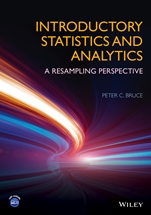
Introductory Statistics and Analytics: A Resampling Perspective
ISBN 9781118881354
Autor: Peter C. Bruce
Wydawca: Wiley
Dostępność: 3-6 tygodni
Cena: 370,65 zł
Przed złożeniem zamówienia prosimy o kontakt mailowy celem potwierdzenia ceny.
ISBN13: |
9781118881354 |
ISBN10: |
1118881354 |
Autor: |
Peter C. Bruce |
Oprawa: |
Paperback |
Rok Wydania: |
2015-02-20 |
Ilość stron: |
312 |
Wymiary: |
253x177 |
Tematy: |
PB |
A concise, thoroughly class–tested primer that features basic statistical concepts in the context of analytics, resampling, and the bootstrap A uniquely developed presentation of key statistical topics, Introductory Statistics and Analytics: A Resampling Perspective provides an accessible approach to statistical analytics, resampling, and the bootstrap for readers with various levels of exposure to basic probability and statistics. Originally class–tested at one of the first online learning companies in the discipline, www.statistics.com, the book primarily focuses on applications of statistical concepts developed via resampling, with a background discussion of mathematical theory. This feature stresses statistical literacy and understanding, which demonstrates the fundamental basis for statistical inference and demystifies traditional formulas. The book begins with illustrations that have the essential statistical topics interwoven throughout before moving on to demonstrate the proper design of studies. Meeting all of the Guidelines for Assessment and Instruction in Statistics Education (GAISE) requirements for an introductory statistics course, Introductory Statistics and Analytics: A Resampling Perspective also includes: Over 300 "Try It Yourself" exercises and intermittent practice questions, which challenge readers at multiple levels to investigate and explore key statistical concepts Numerous interactive links designed to provide readers with solutions to exercises and further information on crucial concepts Linkages that connect statistics to the rapidly growing field of data science Multiple discussions of various software systems, such as Microsoft® Office Excel®, StatCrunch, and R, to develop and analyze data Areas of concern and/or contrasting points–of–view indicated through the use of “Caution” icons Introductory Statistics and Analytics: A Resampling Perspective is an excellent primary textbook for courses in preliminary statistics as well as a supplement for courses in upper–level statistics and related fields, such as biostatistics and econometrics. The book is also a general reference for readers interested in revisiting the value of statistics.
Advisory Board 1 Additional Resources xii Stan Blank xiii Michelle Everson xiii Robert Hayden xiii If You Can′t Measure It, You Can′t Manage It xv Phantom Protection From Vitamin E xvi Statistician, Heal Thyself xvii Identifying Terrorists in Airports xviii Looking Ahead in the Course xix Resampling xix Big Data and Statisticians xxi 1 Designing and Carrying Out a Statistical Study 23 1.1 A Small Example 25 1.2 Is Chance Responsible? The Foundation of Hypothesis Testing 25 1.3 A Major Example 30 1.4 Designing an Experiment 30 1.5 What to Measure—Central Location 37 1.6 What to Measure—Variability 41 1.7 What to Measure—Distance (Nearness) 45 1.8 Test Statistic 47 1.9 The Data 49 1.10 Variables and Their Flavors 57 1.11 Examining and Displaying the Data 60 1.12 Are We Sure We Made a Difference? 71 1.13 Exercises 72 1.14 Answers to Try It Yourself Exercises 76 2 Statistical Inference 79 2.1 Repeating the Experiment 79 2.2 How Many Reshuffles? 83 2.3 How Odd is Odd? 89 2.4 Statistical and Practical Significance 91 2.5 When to use Hypothesis Tests 92 2.6 Exercises 92 2.7 Answers to Try It Yourself exercises 95 3 Displaying and Exploring Data 96 3.1 Bar Charts 96 3.2 Pie Charts 98 3.3 Misuse of Graphs 100 3.4 Indexing 102 3.5 Exercises 107 3.6 Answers to Try It Yourself exercises 109 4 Probability 111 4.1 Mendel’s Peas 112 4.2 Simple Probability 113 4.3 Random Variables and Their Probability Distributions 118 4.4 The Normal Distribution 121 4.5 Exercises 126 4.6 Answers to Try It Yourself exercises 127 5 Relationship Between Two Categorical Variables 129 5.1 Two–Way Tables 129 5.2 Comparing Proportions 133 5.3 More Probability 136 5.4 From Conditional Probabilities to Bayesian Estimates 140 5.5 Independence 142 5.6 Exploratory Data Analysis (EDA) 144 5.7 Exercises 145 5.8 Answers to Try It Yourself exercises 147 6 Surveys and Sampling 149 6.1 Simple Random Samples 149 6.2 Margin of Error: Sampling Distribution for a Proportion 154 6.3 Sampling Distribution for a Mean 157 6.4 A Shortcut—the Bootstrap 160 6.5 Beyond Simple Random Sampling 164 6.6 Absolute vs. Relative Sample Size 168 6.7 Exercises 168 6.8 Answers to Try It Yourself exercises 171 7 Confidence intervals 173 7.1 Point Estimates 173 7.2 Interval Estimates (Confidence Intervals) 173 7.3 Confidence Interval for a Mean 174 7.4 Formula–Based Counterparts to the Bootstrap 178 7.5 Standard Error 182 7.6 Confidence Intervals for a Single Proportion 183 7.7 Confidence Interval for a Difference in Means 187 7.8 Confidence Interval for a Difference in Proportions 190 7.9 Recapping 192 7.10 Exercises 201 7.11 Answers to Try It Yourself exercises and chapter questions 204 8 Hypothesis Tests 206 8.1 Review of Terminology 206 8.2 A–B Tests: The Two Sample Comparison 210 8.3 Comparing Two Means 212 8.4 Comparing Two Proportions 213 8.5 Formula–Based Alternative—T–Test for Means 215 8.6 The Null and Alternative Hypotheses 216 8.7 Paired Comparisons 221 8.8 Exercises 234 8.9 Answers to chapter practice questions 237 9 Hypothesis Testing – 2 240 9.1 A Single Proportion 240 9.2 A Single Mean 241 9.3 More than Two Samples 244 9.4 Continuous Data 250 9.5 Goodness–of–Fit 250 9.6 Exercises 255 9.7 Answers to chapter questions 256 10 Correlation 258 10.1 Example: Delta Wire 258 10.2 Example: Cotton Dust and Lung Disease 260 10.3 The Vector Product and Sum Test 261 10.4 Correlation Coefficient 265 10.5 Other Forms of Association 270 10.6 Correlation is not Causation 271 10.7 Exercises 273 10.8 Answers to chapter questions 276 11 Regression 278 11.1 Finding the regression line by eye 279 11.2 Finding the regression line by minimizing residuals 282 11.3 Linear Relationships 283 11.4 Inference for Regression 288 11.5 Exercises 294 11.6 Answers to chapter questions 296 12 Analysis of Variance—ANOVA 298 12.1 Comparing more than two groups: ANOVA 298 12.2 The Problem of Multiple Inference 302 12.3 A Single Test 304 12.4 Components of Variance 304 12.5 Two–Way ANOVA 317 12.6 Factorial Design 323 12.7 Exercises 326 12.8 Answer to chapter question 328 13 Multiple Regression 329 13.1 Regression as Explanation 330 13.2 Simple Linear Regression –– Explore the Data First 331 13.3 More Independent Variables 335 13.4 Model Assessment and Inference 339 13.5 Assumptions 346 13.6 Interaction, Again 350 13.7 Regression for Prediction 353 13.8 Exercises 360 13.9 Answers to chapter questions 363 Index 364
Peter Bruce is President and Founder of the Institute for Statistics Education at www.statistics.com. He has written a number of journal articles and is the developer of Resampling Stats software. Dr. Bruce is the coauthor of Data Mining for Business Intelligence: Concepts, Techniques, and Applications in Microsoft Office Excel with XLMiner®, Second Edition , also published by Wiley.
Koszyk
Książek w koszyku: 0 szt.
Wartość zakupów: 0,00 zł
Informacje


Kontakt
Gambit
Centrum Oprogramowania
i Szkoleń Sp. z o.o.
Al. Pokoju 29b/22-24
31-564 Kraków
Siedziba Księgarni
ul. Kordylewskiego 1
31-542 Kraków
+48 12 410 5991
+48 12 410 5987
+48 12 410 5989
Subskrypcje
Administratorem danych osobowych jest firma Gambit COiS Sp. z o.o. Na podany adres będzie wysyłany wyłącznie biuletyn informacyjny.
Autoryzacja płatności

Informacje na temat autoryzacji płatności poprzez PayU.

© Copyright 2012: GAMBIT COiS Sp. z o.o. Wszelkie prawa zastrzeżone.
Projekt i wykonanie: Alchemia Studio Reklamy