


Wydawcy
Katalog tematyczny
- Archeologia (109)
- Ekonomia, finanse, business (13704)
- Filozofia (1445)
- Historia (3040)
- Języki i językoznawstwo (2356)
- Lifestyle, hobby i rozrywka (475)
- Medycyna (9704)
- Nauki humanistyczne (4)
- Nauki o Ziemi i środowisku (2638)
- Nauki ścisłe (20412)
- Astronomia (294)
- Biologia (5119)
- Chemia (6540)
- Fizyka (3309)
- Matematyka (4574)
- Algebra (171)
- Analiza matematyczna (902)
- Filozofia matematyki (1)
- Geometria (237)
- Historia matematyki (57)
- Kombinatoryka, teoria grafów (67)
- Matematyka dyskretna (35)
- Matematyka stosowana (555)
- Optymalizacja (104)
- Podstawy matematyki (129)
- Statystyka, prawdopodobieństwo (296)
- Teoria grup (63)
- Teoria liczb (77)
- Topologia (66)
- Nauki ścisłe, ogólnie (503)
- Nauki społeczne (8486)
- Nauki techniczne (13450)
- Prawo (1696)
- Publikacje informacyjne i interdyscyplinarne (1288)
- Religia i wierzenia (917)
- Technika komputerowa (4067)
- Zdrowie, relacje międzyludzkie i rozwój osobisty (657)





Informacje szczegółowe o książce
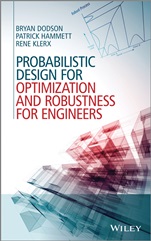
Probabilistic Design for Optimization and Robustness for Engineers
ISBN 9781118796191
Autor: Bryan Dodson, Patrick Hammett, Rene Klerx
Wydawca: Wiley
Dostępność: 3-6 tygodni
Cena: 416,85 zł
Przed złożeniem zamówienia prosimy o kontakt mailowy celem potwierdzenia ceny.
ISBN13: |
9781118796191 |
ISBN10: |
1118796195 |
Autor: |
Bryan Dodson, Patrick Hammett, Rene Klerx |
Oprawa: |
Hardback |
Rok Wydania: |
2014-09-26 |
Ilość stron: |
272 |
Wymiary: |
230x163 |
Tematy: |
PB |
How to apply robust design to engineering design problems Unlike the Taguchi approach to robustness, which requires experimentation, the approach described in this book takes advantage of engineering knowledge to create models for system variation. Probabilistic Design for Optimization and Robustness for Engineers illustrates how to use these variation models to optimize total system cost, including component cost, manufacturing cost, re–work cost, and scrap cost. The text begins with simple, single output systems, and proceeds to complex systems with multiple outputs and many inputs. This methodology works equally well for engineering designs, or process design, or process improvement. This book: Provides a comprehensive guide to optimization and robustness for probabilistic design for engineers without a statistical background Features examples, case studies, and exercises that are applicable to a wide range of disciplines such as mechanical, electrical, chemical, aerospace, and industrial engineering Describes how to derive an empirical model when the engineering model is Describes how to derive an empirical model when the engineering model is unknown Provides a robustness roadmap when using engineering modeling software, such as finite element analysis Demonstrates the effective application of numerous tools and methods to develop robust designs including Total Desirability Index and Binary Logistic Regression for Customer Loss Functions Is supported by an accompanying website ( www.wiley.com/go/robustness—for—engineers ) featuring interactive animations and templates that can be customized for design problems encountered in practice Probabilistic Design for Optimization and Robustness for Engineers is useful for practising engineers faced with the challenge of variation in design as well as senior and graduate level engineering and statistics students studying systems engineering or multi–disciplinary design. Simulations are also featured on the book’s companion website, providing an excellent tool for instructors to use during lectures.
Preface Acknowledgements 1. Product development process 1.1 Introduction to new product development 1.2 Phases of new product development 1.3 Patterns of new product development 1.4 New product development and design for six sigma 1.5 Summary 1.6 Exercises 2. Statistical background for engineering design 2.1 Expectation 2.2 Statistical distributions 2.3 Probability plotting 2.4 Summary 2.5 Exercises 3. Introduction to variation in engineering design 3.1 Variation in engineering design 3.2 Propagation of error 3.3 Protecting designs against variation 3.4 Estimates of means and variances of functions of several variables 3.5 Statistical bias 3.6 Robustness 3.7 Summary 3.8 Exercises 4. Monte Carlo simulation 4.1 Determining variation of the inputs 4.2 Random number generators 4.3 Validation 4.4 Stratified sampling 4.5 Summary 4.6 Exercises 5. Modeling variation of complex systems 5.1 Approximating the mean, bias and variance 5.2 Estimating the parameters of non–normal distributions 5.3 Limitations of first order Taylor series approximation for variance 5.4 Effect of non–normal input distributions 5.5 Non–constant input standard deviation 5.6 Summary 5.7 Exercises 6. Desirability 6.1 Introduction 6.2 Requirements and scorecards 6.3 Desirability – single requirement 6.4 Desirability – multiple requirements 6.5 Desirability – accounting for variation 6.6 Summary 6.7 Exercises 7. Optimization and sensitivity 7.1 Optimization procedure 7.2 Statistical outliers 7.3 Process capability 7.4 Sensitivity and cost reduction 7.5 Reservoir flow example 7.6 Summary 7.7 Exercises 8. Modeling system cost and multiple outputs 8.1 Optimizing for total system cost 8.2 Multiple outputs 8.3 Large scale systems 8.4 Summary 8.5 Exercises 9. Tolerance analysis 9.1 Introduction 9.2 Tolerance analysis methods 9.3 Tolerance allocation 9.4 Drift, shift and sorting 9.5 Non–normal inputs 9.6 Summary 9.7 Exercises 10. Empirical model development 10.1 Screening 10.2 Response surface 10.3 Taguchi 10.4 Summary 10.5 Exercises 11. Binary logistic regression and loss functions 11.1 Introduction 11.2 Binary logistic regression 11.3 Logistic regression and customer loss functions 11.4 Loss function with maximum (or minimum) response 11.5 Summary 11.6 Exercises 12. Verification and validation 12.1 Introduction 12.2 Engineering model V&V 12.3 Design verification methods and tools 12.4 Process validation procedure 12.5 Summary References Bibliography Answers to selected exercises Index
Koszyk
Książek w koszyku: 0 szt.
Wartość zakupów: 0,00 zł
Informacje


Kontakt
Gambit
Centrum Oprogramowania
i Szkoleń Sp. z o.o.
Al. Pokoju 29b/22-24
31-564 Kraków
Siedziba Księgarni
ul. Kordylewskiego 1
31-542 Kraków
+48 12 410 5991
+48 12 410 5987
+48 12 410 5989
Subskrypcje
Administratorem danych osobowych jest firma Gambit COiS Sp. z o.o. Na podany adres będzie wysyłany wyłącznie biuletyn informacyjny.
Autoryzacja płatności

Informacje na temat autoryzacji płatności poprzez PayU.

© Copyright 2012: GAMBIT COiS Sp. z o.o. Wszelkie prawa zastrzeżone.
Projekt i wykonanie: Alchemia Studio Reklamy