


Wydawcy
Katalog tematyczny
- Archeologia (109)
- Ekonomia, finanse, business (13704)
- Filozofia (1445)
- Historia (3040)
- Języki i językoznawstwo (2356)
- Lifestyle, hobby i rozrywka (475)
- Medycyna (9704)
- Nauki humanistyczne (4)
- Nauki o Ziemi i środowisku (2638)
- Nauki ścisłe (20412)
- Astronomia (294)
- Biologia (5119)
- Chemia (6540)
- Fizyka (3309)
- Matematyka (4574)
- Algebra (171)
- Analiza matematyczna (902)
- Filozofia matematyki (1)
- Geometria (237)
- Historia matematyki (57)
- Kombinatoryka, teoria grafów (67)
- Matematyka dyskretna (35)
- Matematyka stosowana (555)
- Optymalizacja (104)
- Podstawy matematyki (129)
- Statystyka, prawdopodobieństwo (296)
- Teoria grup (63)
- Teoria liczb (77)
- Topologia (66)
- Nauki ścisłe, ogólnie (503)
- Nauki społeczne (8486)
- Nauki techniczne (13450)
- Prawo (1696)
- Publikacje informacyjne i interdyscyplinarne (1288)
- Religia i wierzenia (917)
- Technika komputerowa (4067)
- Zdrowie, relacje międzyludzkie i rozwój osobisty (657)





Informacje szczegółowe o książce
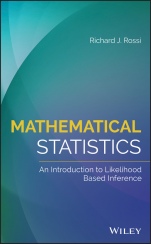
Mathematical Statistics: An Introduction to Likelihood Based Inference
ISBN 9781118771044
Autor: Richard J. Rossi
Wydawca: Wiley
Dostępność: 3-6 tygodni
Cena: 557,55 zł
Przed złożeniem zamówienia prosimy o kontakt mailowy celem potwierdzenia ceny.
ISBN13: |
9781118771044 |
ISBN10: |
1118771044 |
Autor: |
Richard J. Rossi |
Oprawa: |
Hardback |
Rok Wydania: |
2018-12-04 |
Ilość stron: |
448 |
Wymiary: |
237x153 |
Tematy: |
PB |
Presents a unified approach to parametric estimation, confidence intervals, hypothesis testing, and statistical modeling, which are uniquely based on the likelihood function
This book addresses mathematical statistics for upper–undergraduates and first year graduate students, tying chapters on estimation, confidence intervals, hypothesis testing, and statistical models together to present a unifying focus on the likelihood function. It also emphasizes the important ideas in statistical modeling, such as sufficiency, exponential family distributions, and large sample properties. Mathematical Statistics: An Introduction to Likelihood Based Inference makes advanced topics accessible and understandable and covers many topics in more depth than typical mathematical statistics textbooks. It includes numerous examples, case studies, a large number of exercises ranging from drill and skill to extremely difficult problems, and many of the important theorems of mathematical statistics along with their proofs.
In addition to the connected chapters mentioned above, Mathematical Statistics covers likelihood–based estimation, with emphasis on multidimensional parameter spaces and range dependent support. It also includes a chapter on confidence intervals, which contains examples of exact confidence intervals along with the standard large sample confidence intervals based on the MLE′s and bootstrap confidence intervals. There s also a chapter on parametric statistical models featuring sections on non–iid observations, linear regression, logistic regression, Poisson regression, and linear models.
Prepares students with the tools needed to be successful in their future work in statistics data science Includes practical case studies including real–life data collected from Yellowstone National Park, the Donner party, and the Titanic voyage Emphasizes the important ideas to statistical modeling, such as sufficiency, exponential family distributions, and large sample properties Includes sections on Bayesian estimation and credible intervals Features examples, problems, and solutionsMathematical Statistics: An Introduction to Likelihood Based Inference is an ideal textbook for upper–undergraduate and graduate courses in probability, mathematical statistics, and/or statistical inference.
Dedication
Preface
Chapter 1 Probability
1.1 Sample Spaces, Events, and Algebras
Problems
1.2 Probability Axioms and Rules
Problems
1.3 Probability with Equally Likely Outcomes
Problems
1.4 Conditional Probability
Problems
1.5 Independence
Problems
1.6 Counting Methods
Problems
1.7 Case Study The Birthday Problem
Problems
Chapter 2 Random Variables and Random Vectors
2.1 Random Variables
2.1.1 Properties of Random Variables
Problems
2.2 Random Vectors
2.2.1 Properties of Random Vectors
Problems
2.3 Independent Random Variables
Problems
2.4 Transformations of Random Variables
2.4.1 Transformations of Discrete Random Variables
2.4.2 Transformations of Continuous Random Variables
2.4.3 Transformations of Continuous Bivariate Random Vectors
Problems
2.5 Expected Values for Random Variables
2.5.1 Expected Values and Moments of Random Variables
2.5.2 The Variance of a Random Variable
2.5.3 Moment Generating Functions
Problems
2.6 Expected Values for Random Vectors
2.6.1 Properties of Expectation with Random Vectors
2.6.2 Covariance and Correlation
2.6.3 Conditional Expectation and Variance
Problems
2.7 Sums of Random Variables
Problems
2.8 Case Study How Many Times was the Coin Tossed?
2.8.1 The Probability Model
Problems
Chapter 3 Probability Models
3.1 Discrete Probability Models
3.1.1 The Binomial Model
3.1.2 The Hypergeometric Model
3.1.3 The Poisson Model
3.1.4 The Negative Binomial Model
3.1.5 The MultinomialModel
Problems
3.2 Continuous ProbabilityModels
3.2.1 The UniformModel
3.2.2 The Gamma Model
3.2.3 The Normal Model
3.2.4 The LognormalModel
3.2.5 The Beta Model
Problems
3.3 Important Distributional Relationships
3.3.1 Sums of Random Variables
3.3.2 The T and F Distributions
Problems
3.4 Case Study The Central Limit Theorem
3.4.1 Convergence in Distribution
3.4.2 The Central Limit Theorem
Problems
Chapter 4 Parametric Point Estimation
4.1 Statistics
4.1.1 Sampling Distributions
4.1.2 Unbiased Statistics and Estimators
4.1.3 Standard Error and Mean Squared Error
4.1.4 The Delta Method
Problems
4.2 Sufficient Statistics
4.2.1 Exponential Family Distributions
Problems
4.3 Minimum Variance Unbiased Estimators
4.3.1 Cram´erRao Lower Bound
Problems
4.4 Case Study The Order Statistics
Problems
Chapter 5 Likelihood Based Estimation
5.1 Maximum Likelihood Estimation
5.1.1 Properties of MLE s
5.1.2 One Parameter Probability Models
5.1.3 Multi Parameter Probability Models
Problems
5.2 Bayesian Estimation
5.2.1 The Bayesian Setting
5.2.2 Bayesian Estimators
Problems
5.3 Interval Estimation
5.3.1 Exact Confidence Intervals
5.3.2 Large Sample Confidence Intervals
5.3.3 Bayesian Credible Intervals
Problems
5.4 Case Study Modeling Obsidian Rind Thicknesses
5.4.1 Finite Mixture Model
Problems
Chapter 6 Hypothesis Testing
6.1 Components of a Hypothesis Test
Problems
6.2 Most Powerful Tests
Problems
6.3 Uniformly Most Powerful Tests
6.3.1 UniformlyMost Powerful Unbiased Tests
Problems
6.4 Generalized Likelihood Ratio Tests
Problems
6.5 Large Sample Tests
6.5.1 Large Sample Tests based on the MLE
6.5.2 Score Tests
Problems
6.6 Case Study Modeling Survival of the Titanic Passengers
6.6.1 Exploring the Data
6.6.2 Modeling the Probability of Survival
6.6.3 Analysis of the Fitted Survival Model
Problems
Chapter 7 Generalized Linear Models
7.1 Generalized Linear Models
Problems
7.2 Fitting a Generalized Linear Model
7.2.1 Estimating ∼
7.2.2 Model Deviance
Problems
7.3 Hypothesis Testing in a Generalized Linear Model
7.3.1 Asymptotic Properties
7.3.2 Wald Tests and Confidence Intervals
7.3.3 Likelihood Ratio Tests
Problems
7.4 Generalized Linear Models for a Normal Response Variable
7.4.1 Estimation
7.4.2 Properties of the MLE s
7.4.3 Deviance
7.4.4 Hypothesis Testing
Problems
7.5 Generalized Linear Models for a Binomial Response Variable
7.5.1 Estimation
7.5.2 Properties of the MLE s
7.5.3 Deviance
7.5.4 Hypothesis Testing
Problems
7.6 Case Study IDNAP
Experiment with Poisson Count Data
7.6.1 The Model
7.6.2 Statistical Methods
7.6.3 Results of the First Experiment
Problems
References
A Probability Models
B Data Sets
Problem Solutions
Index
Richard J. Rossi, PhD, is Director of the Statistics Program and Co–Director of the Data Science Program at Montana Tech of The University of Montana, in Butte, MT. He acted as President of the Montana Chapter of the American Statistical Association in 2001 and as Associate Editor for Biometrics from 1997–2000. He is a member of the American Mathematical Society, the Institute of Mathematical Statistics, and the American Statistical Association.
Koszyk
Książek w koszyku: 0 szt.
Wartość zakupów: 0,00 zł
Informacje


Kontakt
Gambit
Centrum Oprogramowania
i Szkoleń Sp. z o.o.
Al. Pokoju 29b/22-24
31-564 Kraków
Siedziba Księgarni
ul. Kordylewskiego 1
31-542 Kraków
+48 12 410 5991
+48 12 410 5987
+48 12 410 5989
Subskrypcje
Administratorem danych osobowych jest firma Gambit COiS Sp. z o.o. Na podany adres będzie wysyłany wyłącznie biuletyn informacyjny.
Autoryzacja płatności

Informacje na temat autoryzacji płatności poprzez PayU.

© Copyright 2012: GAMBIT COiS Sp. z o.o. Wszelkie prawa zastrzeżone.
Projekt i wykonanie: Alchemia Studio Reklamy