


Wydawcy
Katalog tematyczny
- Archeologia (109)
- Ekonomia, finanse, business (13704)
- Filozofia (1445)
- Historia (3040)
- Języki i językoznawstwo (2356)
- Lifestyle, hobby i rozrywka (475)
- Medycyna (9704)
- Nauki humanistyczne (4)
- Nauki o Ziemi i środowisku (2638)
- Nauki ścisłe (20412)
- Astronomia (294)
- Biologia (5119)
- Chemia (6540)
- Fizyka (3309)
- Matematyka (4574)
- Algebra (171)
- Analiza matematyczna (902)
- Filozofia matematyki (1)
- Geometria (237)
- Historia matematyki (57)
- Kombinatoryka, teoria grafów (67)
- Matematyka dyskretna (35)
- Matematyka stosowana (555)
- Optymalizacja (104)
- Podstawy matematyki (129)
- Statystyka, prawdopodobieństwo (296)
- Teoria grup (63)
- Teoria liczb (77)
- Topologia (66)
- Nauki ścisłe, ogólnie (503)
- Nauki społeczne (8486)
- Nauki techniczne (13450)
- Prawo (1696)
- Publikacje informacyjne i interdyscyplinarne (1288)
- Religia i wierzenia (917)
- Technika komputerowa (4067)
- Zdrowie, relacje międzyludzkie i rozwój osobisty (657)





Informacje szczegółowe o książce
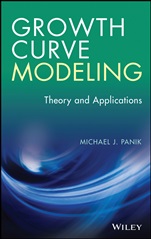
Growth Curve Modeling: Theory and Applications
ISBN 9781118764046
Autor: Michael J. Panik
Wydawca: Wiley
Dostępność: 3-6 tygodni
Cena: 638,40 zł
Przed złożeniem zamówienia prosimy o kontakt mailowy celem potwierdzenia ceny.
ISBN13: |
9781118764046 |
ISBN10: |
1118764048 |
Autor: |
Michael J. Panik |
Oprawa: |
Hardback |
Rok Wydania: |
2014-02-21 |
Ilość stron: |
454 |
Wymiary: |
237x163 |
Tematy: |
PB |
Features recent trends and advances in the theory and techniques used to accurately measure and model growth Growth Curve Modeling: Theory and Applications features an accessible introduction to growth curve modeling and addresses how to monitor the change in variables over time since there is no “one size fits all” approach to growth measurement. A review of the requisite mathematics for growth modeling and the statistical techniques needed for estimating growth models are provided, and an overview of popular growth curves, such as linear, logarithmic, reciprocal, logistic, Gompertz, Weibull, negative exponential, and log–logistic, among others, is included. In addition, the book discusses key application areas including economic, plant, population, forest, and firm growth and is suitable as a resource for assessing recent growth modeling trends in the medical field. SAS ® is utilized throughout to analyze and model growth curves, aiding readers in estimating specialized growth rates and curves. Including derivations of virtually all of the major growth curves and models, Growth Curve Modeling: Theory and Applications also features: Statistical distribution analysis as it pertains to growth modeling Trend estimations Dynamic site equations obtained from growth models Nonlinear regression Yield–density curves Nonlinear mixed effects models for repeated measurements data Growth Curve Modeling: Theory and Applications is an excellent resource for statisticians, public health analysts, biologists, botanists, economists, and demographers who require a modern review of statistical methods for modeling growth curves and analyzing longitudinal data. The book is also useful for upper–undergraduate and graduate courses on growth modeling.
Chapter 1. Mathematical Preliminaries 1.1 Arithmetic Progression 1.2 Geometric Progression 1.3 The Binomial Formula 1.4 The Calculus of Finite Differences 1.5 The Number e 1.6 The Natural Logarithm 1.7 The Exponential Function 1.8 Exponential and Logarithmic Functions – Another Look 1.9 Change of Base of a Logarithm 1.10 The Arithmetic (Natural) Scale vs. the Logarithmic Scale 1.11 Compound Interest Arithmetic Chapter 2. Fundamentals of Growth 2.1 Time Series Data 2.2 Relative and Average Rates of Change 2.3 Annual Rates of Change 2.3.A Simple Rates of Change 2.3.B Compounded Rates of Change 2.3.C Comparing Two Time Series: Indexing Data to a Common Starting Point 2.4 Discrete vs. Continuous Growth 2.5 The Growth of a Variable Expressed in Terms of the Growth of its Individual Arguments 2.6 Growth Rate Variability 2.7 Growth in a Mixture of Variables Chapter 3. Parametric Growth Curve Modeling 3.1 Introduction 3.2 The Linear Growth Model 3.3 The Logarithmic Reciprocal Model 3.4 The Logistic Model 3.5 The Gompertz Model 3.6 The Weibull Model 3.7 The Negative Exponential Model 3.8 The von Bertalanffy Model 3.9 The Log–Logistic Model 3.10 The Brody Growth Model 3.11 The Janoschek Model 3.12 The Lundqvist–Korf Growth Model 3.13 The Hossfeld Growth Model 3.14 The Stannard Growth Model 3.15 The Schnute Growth Model 3.16 The Morgan–Mercer–Flodin Growth Model 3.17 The McDill–Amateis Growth Model 3.18 An Assortment of Additional Growth Models 3.18.A Modifications of the Hossfeld Equation The The Levkovic I Growth Model The Levkovic III Growth Model The Yoshida I Growth Model 3.18.B The Sloboda Growth Model Appendix 3.A The Logistic Model Derived Appendix 3.B The Gompertz Model Derived Appendix 3.C The Negative Exponential Model Derived Appendix 3.D The von Bertalanffy and Richards Model Derived Appendix 3.E The Schnute Model Derived Appendix 3.F The McDill–Amateis Model Derived Appendix 3.G The Slobada Model Derived Appendix 3.H A Generalized Michaelis–Menton Growth Equation Chapter 4. Estimation of Trend 4.1 Linear Trend Equation 4.2 Ordinary Least Squares (OLS) Estimation 4.3 Maximum Likelihood (ML) Estimation 4.4 The SAS System 4.5 Changing the Unit of Time 4.5.A Annual Totals vs. Monthly Averages vs. Monthly Totals 4.5.B Annual Totals vs. Quarterly Averages vs. Quarterly Totals 4.6 Autocorrelated Errors 4.6.A Properties of the OLS Estimators When is AR (1) 4.6.B Testing for the Absence of Autocorrelation: The Durbin–Watson Test 4.6.C Detection of and Estimation With Autocorrelated Errors 4.7 Polynomial Models in t 4.8 Issues Involving Trended Data 4.8.A Stochastic Processes and Time Series 4.8.B Autoregressive Process of Order p 4.8.C Random Walk Processes 4.8.D Integrated Processes 4.8.E Testing for Unit Roots The Structure of the Dickey–Fuller (1979, 1982) Test Equation Nonstandard Critical Values The Augmented Dickey–Fuller Test Testing Downwards for Unit Roots Appendix 4.A OLS Estimated and Related Growth Rates The OLS Growth Rate The Log–Difference (LD) Growth Rate The Average Annual Growth Rate Geometric Average Growth Rate Chapter 5. Dynamic Site Equations Obtained from Growth Models 5.1 Introduction 5.2 Base–Age Specific (BAS) Models 5.3 Algebraic Difference Approach (ADA) Models 5.4 Generalized Algebraic Difference Approach (GADA) Models 5.5 A Site Equation Generating Function 5.5.A ADA Derivations 5.5.B GADA Derivations Linearity Inverse–Saturation Quadratic 5.6 The Grounded GADA (g–GADA) Model Appendix 5.A A Glossary of Selected Forestry Terms Chapter 6. Nonlinear Regression 6.1 Intrinsic Linearity/Nonlinearity 6.2 Estimation of Intrinsically Nonlinear Regression Models 6.2.A Nonlinear Least Squares (NLS) 6.2.B Maximum Likelihood (ML) Appendix 6.A Gauss–Newton Iteration Scheme: The Single Parameter Case Appendix 6.B Gauss–Newton Iteration Scheme: The r Parameter Case Appendix 6.C The Newton–Raphson and Scoring Methods Appendix 6.D The Levenberg–Marquardt Modification/Compromise Chapter 7. Yield–Density Curves 7.1 Introduction 7.2 Structuring Yield–Density Equations 7.3 Reciprocal Yield–Density Equations 7.3.A The Shinozaki and Kira Yield–Density Curves 7.3.B The Holliday Yield–Density Curves 7.3.C The Farazdaghi and Harris Yield–Density Curves 7.3.D The Bleasdale and Nelder Yield–Density Curves 7.4 Weight of a Plant Part and Plant Density 7.5 The Expolinear Growth Equation 7.6 The Beta Growth Function 7.7 Asymmetric Growth Equations (for plant parts) 7.7.1 Model I 7.7.2 Model II 7.7.3 Model III Appendix 7.A Derivation of the Shinozaki and Kira Yield–Density Curves Appendix 7.B Derivation of the Farazdaghi and Harris Yield–Density Curves Appendix 7.C Derivation of the Bleasdale and Nelder Yield–Density Curves Appendix 7.D Derivation of the Expolinear Growth Curve Appendix 7.E Derivation of the Beta Growth Function Appendix 7.F Derivation of Asymmetric Growth Equations Appendix 7.G Chanter Growth Function Chapter 8. Nonlinear Mixed Effects Models for Repeated Measurements Data 8.1 Some Basic Terminology Concerning Experimental Design 8.2 Model Specification 8.2.1 Model and Data Elements 8.2.2 A Hierarchical (Staged) Model 8.3 Some Special Cases of a Hierarchical Global Model 8.4 The SAS/STAT NLMIXED Procedure for Fitting Nonlinear Mixed Models Chapter 9. Modeling the Size and Growth Rate Distributions of Firms 9.1 Introduction 9.2 Measuring Firm Size and Growth 9.3 Modeling the Size Distribution of Firms 9.4 Gibrat’s Law 9.5 Rationalizing the Firm Size Distribution 9.6 Modeling the Growth Rate Distribution of Firms 9.7 Basic Empirics of Gibrat’s Law (GL) 9.7.1 Firm Size and Expected Growth Rates 9.7.2 Firm Size and Growth Rate Variability 9.7.3 Econometric Issues 9.7.4 Persistence of Growth Rates 9.8 Conclusion Appendix 9.A Kernel Density Estimation 9.A.1 Motivation 9.A.2 Weighting Functions 9.A.3 Smooth Weighting Functions: Kernel Estimators Appendix 9.B The Log–Normal and Gibrat Distributions 9.B.1 Derivation of Log–Normal Forms 9.B.2 Generalized Log–Normal Distribution Appendix 9.C The Theory of Proportionate Effect Appendix 9.D Classical Laplace Distribution 9.D.1 The Symmetric Case 9.D.2 The Asymmetric Case 9.D.3 The Generalized Laplace Distribution 9.D.4 The Log–Laplace Distribution Appendix 9.E Power–Law Behavior 9.E.1 Pareto’s Power Law 9.E.2 Generalized Pareto Distribution 9.E.3 Zipf’s Power Law Appendix 9.F The Yule Distribution Appendix 9.G Overcoming Sample Selection Bias 9.G.1 Selection and Gibrat’s Law (GL) 9.G.2 Characterizing Selection Bias 9.G.3 Correcting for Selection Bias: The Heckman Two–Step Procedure 9.G.4 The Heckman Two–Step Procedure under Modified Selection Chapter10. Fundamentals of Population Dynamics 10.1 The Concept of a Population 10.2 The Concept of Population Growth 10.3 Modeling Population Growth 10.4 Exponential (Density–Independent) Population Growth 10.4.A The Continuous Case 10.4.B The Discrete Case 10.4.C Malthusian Population Growth Dynamics 10.5 Density–Dependent Population Growth 10.5.1 Logistic Growth Models 10.5.1.A Continuous–Time Logistic 10.5.1.B Discrete–Time Logistic 10.6 Beverton and Holt (B–H) Model 10.7 Ricker Model 10.8 Hassell Model 10.9 Generalized Beverton and Holt (B–H) Model 10.10 Generalized Ricker Model Appendix 10.A A Glossary of Selected Population Demography/Ecology Terms Appendix 10.B Equilibrium and Stability Analysis Appendix 10.C Discretization of the Continuous Time Logistic Growth Equation Appendix 10.D Derivation of the B–H Stock–Recruitment Relationship Appendix 10.E Derivation of the Ricker Stock–Recruitment Relationship Appendix A Table A.1 Standard Normal Areas ( Z is N (0,1)) Table A.2 Quantiles of the t Distribution ( T is t v ) Table A.3 Quantiles of the Distribution ( X is ) Table A.4 Quantiles of the F Distribution ( F is) Table A.5 Durbin–Watson DW Statistic: 5% Significance Points ( n is the sample size and is the number of regressors excluding the intercept) Table A.6 Empirical Cumulative Distribution of for =1 References Index
Koszyk
Książek w koszyku: 0 szt.
Wartość zakupów: 0,00 zł
Informacje


Kontakt
Gambit
Centrum Oprogramowania
i Szkoleń Sp. z o.o.
Al. Pokoju 29b/22-24
31-564 Kraków
Siedziba Księgarni
ul. Kordylewskiego 1
31-542 Kraków
+48 12 410 5991
+48 12 410 5987
+48 12 410 5989
Subskrypcje
Administratorem danych osobowych jest firma Gambit COiS Sp. z o.o. Na podany adres będzie wysyłany wyłącznie biuletyn informacyjny.
Autoryzacja płatności

Informacje na temat autoryzacji płatności poprzez PayU.

© Copyright 2012: GAMBIT COiS Sp. z o.o. Wszelkie prawa zastrzeżone.
Projekt i wykonanie: Alchemia Studio Reklamy