


Wydawcy
Katalog tematyczny
- Archeologia (109)
- Ekonomia, finanse, business (13704)
- Filozofia (1445)
- Historia (3040)
- Języki i językoznawstwo (2356)
- Lifestyle, hobby i rozrywka (475)
- Medycyna (9704)
- Nauki humanistyczne (4)
- Nauki o Ziemi i środowisku (2638)
- Nauki ścisłe (20412)
- Astronomia (294)
- Biologia (5119)
- Chemia (6540)
- Fizyka (3309)
- Matematyka (4574)
- Algebra (171)
- Analiza matematyczna (902)
- Filozofia matematyki (1)
- Geometria (237)
- Historia matematyki (57)
- Kombinatoryka, teoria grafów (67)
- Matematyka dyskretna (35)
- Matematyka stosowana (555)
- Optymalizacja (104)
- Podstawy matematyki (129)
- Statystyka, prawdopodobieństwo (296)
- Teoria grup (63)
- Teoria liczb (77)
- Topologia (66)
- Nauki ścisłe, ogólnie (503)
- Nauki społeczne (8486)
- Nauki techniczne (13450)
- Prawo (1696)
- Publikacje informacyjne i interdyscyplinarne (1288)
- Religia i wierzenia (917)
- Technika komputerowa (4067)
- Zdrowie, relacje międzyludzkie i rozwój osobisty (657)





Informacje szczegółowe o książce
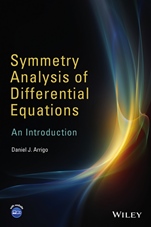
Symmetry Analysis of Differential Equations: An Introduction
ISBN 9781118721407
Autor: Daniel J. Arrigo
Wydawca: Wiley
Dostępność: 3-6 tygodni
Cena: 437,85 zł
Przed złożeniem zamówienia prosimy o kontakt mailowy celem potwierdzenia ceny.
ISBN13: |
9781118721407 |
ISBN10: |
1118721403 |
Autor: |
Daniel J. Arrigo |
Oprawa: |
Hardback |
Rok Wydania: |
2015-02-13 |
Ilość stron: |
192 |
Wymiary: |
242x168 |
Tematy: |
PB |
A self–contained introduction to the methods and techniques of symmetry analysis used to solve ODEs and PDEs Symmetry Analysis of Differential Equations: An Introduction presents an accessible approach to the uses of symmetry methods in solving both ordinary differential equations (ODEs) and partial differential equations (PDEs). Providing comprehensive coverage, the book fills a gap in the literature by discussing elementary symmetry concepts and invariance, including methods for reducing the complexity of ODEs and PDEs in an effort to solve the associated problems. Thoroughly class–tested, the author presents classical methods in a systematic, logical, and well–balanced manner. As the book progresses, the chapters graduate from elementary symmetries and the invariance of algebraic equations, to ODEs and PDEs, followed by cover age of the nonclassical method and compatibility. Symmetry Analysis of Differential Equations: An Introduction also features: • Detailed examples throughout to guide readers step–by–step through the methods of symmetry analysis • End–of–chapter exercises, varying from elementary to advanced, with select solutions provided to aid in the calculation of the presented algorithmic methods
Preface i Acknowledgements iii Dedication iv 1 An Introduction 1 1.1 What is a symmetry? 1 1.2 Lie Groups 4 1.3 Invariance of Differential Equations 6 1.4 Some Ordinary Differential Equations 8 1.5 Exercises 11 2 Ordinary Differential Equations 13 2.1 Infinitesimal Transformations 16 2.2 Lie’s Invariance Condition 19 2.2.1 Exercises 22 2.3 Standard Integration Techniques 23 2.3.1 Linear Equations 24 2.3.2 Bernoulli Equation 25 2.3.3 Homogeneous Equations 26 2.3.4 Exact Equations 27 2.3.5 Riccati Equations 30 2.3.6 Exercises 31 2.4 Infinitesimal Operator and Higher Order Equations 32 2.4.1 The Infinitesimal Operator 32 2.4.2 The Extended Operator 32 2.4.3 Extension to Higher Orders 33 2.4.4 First Order Infinitesimals (revisited) 33 2.4.5 Second Order Infinitesimals 34 2.4.6 The Invariance of Second Order Equations 35 2.4.7 Equations of arbitrary order 36 2.5 Second Order Equations 36 2.5.1 Exercises 46 2.6 Higher Order Equations 47 2.6.1 Exercises 51 2.7 ODE Systems 52 2.7.1 First Order Systems 52 2.7.2 Higher Order Systems 56 2.7.3 Exercises 60 3 Partial Differential Equations 62 3.1 First Order Equations 62 3.1.1 What do we do with the symmetries of PDEs? 65 3.1.2 Direct Reductions 68 3.1.3 The Invariant Surface Condition 70 3.1.4 Exercises 71 3.2 Second Order PDEs 71 3.2.1 Heat Equation 71 3.2.2 Laplace’s Equation 76 3.2.3 Burgers’ Equation and a Relative 80 3.2.4 Heat equation with a source 85 3.2.5 Exercises 91 3.3 Higher Order PDEs 93 3.3.1 Exercises 98 3.4 Systems of PDEs 99 3.4.1 First order systems 99 3.4.2 Second order systems 103 3.4.3 Exercises 106 3.5 Higher Dimensional PDEs 107 3.5.1 Exercises 113 4 Nonclassical Symmetries and Compatibility 114 4.1 Nonclassical Symmetries 114 4.1.1 Invariance of the Invariant Surface Condition 116 4.1.2 The nonclassical method 117 4.2 Nonclassical Symmetry Analysis and Compatibility 125 4.3 Beyond Symmetries Analysis − General compatibility 126 4.3.1 Compatibility with First Order PDEs – Charpit’s Method 127 4.3.2 Compatibility of systems 134 4.3.3 Compatibility of the nonlinear heat equation 136 4.4 Exercises 137 4.5 Concluding Remarks 138 Solutions 139 References 145
Daniel J. Arrigo, PhD, is Professor in the Department of Mathematics at the University of Central Arkansas. The author of over thirty journal articles, his research interests include the construction of exact solutions of PDEs; symmetry analysis of nonlinear PDEs; and solutions to physically important equations, such as the nonlinear heat equations and the governing equations modeling of granular materials and nonlinear elasticity. Dr. Arrigo received the Oklahoma–Arkansas Section of the Mathematical Association of America’s “Award for Distinguished Teaching of College or University Mathematics” in 2008.
Koszyk
Książek w koszyku: 0 szt.
Wartość zakupów: 0,00 zł
Informacje


Kontakt
Gambit
Centrum Oprogramowania
i Szkoleń Sp. z o.o.
Al. Pokoju 29b/22-24
31-564 Kraków
Siedziba Księgarni
ul. Kordylewskiego 1
31-542 Kraków
+48 12 410 5991
+48 12 410 5987
+48 12 410 5989
Subskrypcje
Administratorem danych osobowych jest firma Gambit COiS Sp. z o.o. Na podany adres będzie wysyłany wyłącznie biuletyn informacyjny.
Autoryzacja płatności

Informacje na temat autoryzacji płatności poprzez PayU.

© Copyright 2012: GAMBIT COiS Sp. z o.o. Wszelkie prawa zastrzeżone.
Projekt i wykonanie: Alchemia Studio Reklamy