


Wydawcy
Katalog tematyczny
- Archeologia (109)
- Ekonomia, finanse, business (13704)
- Filozofia (1445)
- Historia (3040)
- Języki i językoznawstwo (2356)
- Lifestyle, hobby i rozrywka (475)
- Medycyna (9704)
- Nauki humanistyczne (4)
- Nauki o Ziemi i środowisku (2638)
- Nauki ścisłe (20412)
- Astronomia (294)
- Biologia (5119)
- Chemia (6540)
- Fizyka (3309)
- Matematyka (4574)
- Algebra (171)
- Analiza matematyczna (902)
- Filozofia matematyki (1)
- Geometria (237)
- Historia matematyki (57)
- Kombinatoryka, teoria grafów (67)
- Matematyka dyskretna (35)
- Matematyka stosowana (555)
- Optymalizacja (104)
- Podstawy matematyki (129)
- Statystyka, prawdopodobieństwo (296)
- Teoria grup (63)
- Teoria liczb (77)
- Topologia (66)
- Nauki ścisłe, ogólnie (503)
- Nauki społeczne (8486)
- Nauki techniczne (13450)
- Prawo (1696)
- Publikacje informacyjne i interdyscyplinarne (1288)
- Religia i wierzenia (917)
- Technika komputerowa (4067)
- Zdrowie, relacje międzyludzkie i rozwój osobisty (657)





Informacje szczegółowe o książce
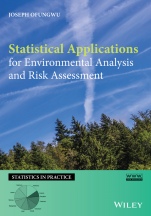
Statistical Applications for Environmental Analysis and Risk Assessment
ISBN 9781118634530
Autor: Joseph Ofungwu
Wydawca: Wiley
Dostępność: 3-6 tygodni
Cena: 583,80 zł
Przed złożeniem zamówienia prosimy o kontakt mailowy celem potwierdzenia ceny.
ISBN13: |
9781118634530 |
ISBN10: |
1118634535 |
Autor: |
Joseph Ofungwu |
Oprawa: |
Hardback |
Rok Wydania: |
2014-07-11 |
Ilość stron: |
656 |
Wymiary: |
260x183 |
Tematy: |
PB |
Stressing a basic knowledge of statistics and statistical analysis for making sense of data in environmental engineering and sciences For the environmental professional, accurate data collection, analysis, and assessment is crucial for the protection of public health and ecological well–being. Statistical Applications for Environmental Analysis and Risk Assessment guides readers through real–world situations and the best statistical methods used to determine the nature and extent of the problem, evaluate the potential human health and ecological risks, and design and implement remedial systems as necessary. Featuring numerous worked examples using actual data and “ready–made” software scripts, Statistical Applications for Environmental Analysis and Risk Assessment also includes: Descriptions of basic statistical concepts and principles in an informal style and no presumption of prior familiarity with the subject Detailed illustrations of applications in familiar practice areas in the environmental and related water resources fields using real–world data as would typically be encountered by practitioners Software scripts using the high–powered statistical software system, R, and supplemented by USEPA’s ProUCL and USDOE’s VSP software packages, which are all freely available Coverage of frequent data sample issues such as non–detects, outliers, skewness, sustained and cyclical trend that habitually plague environmental data samples Clear demonstrations of the crucial, but often overlooked, role of statistics in environmental sampling design and subsequent exposure risk assessment Statistical Applications for Environmental Analysis and Risk Assessment is an excellent book for upper–undergraduate and graduate–level courses on environmental statistics for students in environmental engineering, geological and environmental science programs. The book is also a valuable reference for practicing environmental professionals, such as earth scientists, geologists, and hydrologists, who have to routinely analyze and interpret data.
Preface Acknowledgements 1. Introduction 1.1 Introduction and Overview 1.2 The Aim of the Book: Get in the Game! 1.3 The Approach and Style: Impossible to Misunderstand! PART I BASIC STATISTICAL MEASURES AND CONCEPTS 2. Introduction to Software Packages used in this Book 2.1 R 2.2 ProUCL 2.3 Visual Sample Plan 2.4 DataPlot 2.5 Kendal–Thiel Robust Line 2.6 Minitab ® 2.7 Excel 2010 3. Laboratory Detection Limits, Non–Detects and Data Analysis 3.1 Introduction and Overview 3.2 Types of Laboratory Data Detection Limits 3.3 Problems with Non–Detects (NDs) in Statistical Data Samples 3.4 Options for Addressing Non–Detects in Data Analysis 4. Data Sample, Data Population and Data Distribution 4.1 Introduction and Overview 4.2 Data Sample versus Data Population or Universe 4.3 The Concept of a Distribution 4.4 Types of Distributions EXERCISES 5. Graphics for Data Analysis and Presentation 5.1 Introduction and Overview 5.2 Graphics for Single Univariate Data Samples 5.3 Graphics for Two or more Univariate Data Samples 5.4 Graphics for Bivariate and Multivariate Data Samples 5.5 Graphics for Data Presentation 5.6 Data Smoothing EXERCISES 6. Basic Statistical Measures: Descriptive or Summary Statistics 6.1 Introduction and Overview 6.2 Arithmetic Mean and Weighted Mean 6.3 Median and other Robust Measures of Central Tendency 6.4 Standard Deviation, Variance, and other Measures of Dispersion or Spread 6.5 Skewness and other Measures of Shape 6.6 Outliers 6.6.1 Tests for Outliers 6.7 Data Transformations EXERCISES PART II STATISTICAL PROCEDURES FOR UNIVARIATE DATA 7. Statistical Intervals: Confidence, Tolerance and Prediction Intervals 7.1 Introduction and Overview 7.2 Confidence Intervals 7.3 Tolerance Intervals 7.4 Prediction Intervals 7.5 Control Charts EXERCISES 8. Tests of Hypothesis and Decision Making 8.1 Introduction and Overview 8.2 Basic Terminology and Procedures for Tests of Hypothesis 8.3 Type I and Type II Decision Errors, Statistical Power, and Inter–relationships 8.4 The Problem with Multiple Tests or Comparisons: Site–wide False Positive Error Rates (SWFPR) 8.5 Tests for Equality of Variance EXERCISES 9. Applications of Hypothesis Tests: Comparing Populations, Analysis of Variance 9.1 Introduction and Overview 9.2 Single Sample Tests 9.3 Two–Sample Tests 9.4 Comparing Three or More Populations: Parametric ANOVA and Non–Parametric Kruskal–Wallis Tests EXERCISES 10. Trends, Autocorrelation and Temporal Dependence 10.1 Introduction and Overview 10.2 Tests for Autocorrelation and Temporal Effects 10.3 Tests for Trend 10.4 Correcting Seasonality and Temporal Effects in the Data 10.5 Effects of Exogenous Variables on Trend Tests EXERCISES PART III BIVARIATE AND MULTIVARIATE DATA ANALYSES 11. Correlation, Covariance, Geostatistics 11.1 Introduction and Overview 11.2 Correlation and Covariance 11.3 Introduction to Geostatistics EXERCISES 12. Simple Linear Regression 12.1 Introduction and Overview 12.2 The Simple Linear Regression Model 12.3 Basic Applications of Simple Linear Regression 12.4 Verify Compliance with the Assumptions of Conventional Linear Regression 12.5 Check the Regression Diagnostics for the Presence of Influential Data Points 12. 6 Confidence Intervals for the Predicted Y Values 12.7 Regression for Left–Censored Data (Non Detects) EXERCISES 13. Data Transformation versus Generalized Linear Model 13.1 Introduction and Overview 13.2 Data Transformation 13.3 The Generalized Linear Model (GLM) and Applications for Regression 13.4 Extension of Data Transformation and Generalized Linear Model to Multiple Regression EXERCISES 14. Robust Regression 14.1 Introduction and Overview 14.2 Kendall–Theil Robust Line 14.3 Weighted Least Squares Regression 14.4 Iteratively Reweighted Least Squares Regression 14.5 Other Robust Regression Alternatives 14.6 Robust Regression Methods for Multiple–Variable Data EXERCISES 15. Multiple Linear Regression 15.1 Introduction and Overview 15.2 The Need for Multiple Regression 15.3 The Multiple Linear Regression Model 15.4 The Estimated Multivariable X–Y Relationship based on a Data Sample 15.5 Assumptions of Multiple Linear Regression 15.6 Hypothesis Tests for Reliability of the MLR Model 15.7 Confidence Intervals for the Regression Coefficients and Predicted Y Values 15.8 Coefficient of Multiple Correlation (R), Multiple Determination (R 2 ), Adjusted R 2 , and Partial Correlation Coefficients 15.9 Regression Diagnostics 15.10 Model Interactions and Multiplicative Effects EXERCISES 16. Categorical Data Analysis 16.1 Introduction and Overview 16.2 Types of Variables and associated Data 16.3 One–Way Analysis of Variance (ANOVA) Model 16.4 Two–Way Analysis of Variance (ANOVA) Regression Model with no Interactions 16.5 Two–Way Analysis of Variance (ANOVA) Model with Interactions 16.6 Analysis of Covariance (ANCOVA) Regression Model EXERCISES 17. Model Building: Stepwise Regression and Best Subsets Regression 17.1 Introduction and Overview 17.2 Consequences of Inappropriate Variable Selection 17.3 Stepwise Regression Procedures 17.4 Subsets Regression EXERCISES 18. Nonlinear Regression 18.1 Introduction and Overview 18.2 The Nonlinear Regression Model 18.3 Assumptions of Nonlinear Least Squares Regression EXERCISES PART IV STATISTICS IN ENVIRONMENTAL SAMPLING DESIGN AND RISK ASSESSMENT 19. Data Quality Objectives and Environmental Sampling Design 19.1 Introduction and Overview 19.2 Sampling Design 19.3 Sampling Plans 19.4 Sample Size Determination EXERCISES 20. Determination of Background and Applications in Risk Assessment 20.1 Introduction and Overview 20.2 When Background Sampling is required and when it is not 20.3 Background Sampling Plans 20.4 Graphical and Quantitative Data Analysis for Site versus Background Data Comparisons 20.5 Determination of Exposure Point Concentration and Contaminants of Potential Concern EXERCISES 21. Statistics in Conventional and Probabilistic Risk Assessment 21.1 Introduction and Overview 21.2 Conventional or Point Risk Estimation 21.3 Probabilistic Risk Assessment using Monte Carlo Simulation EXERCISES Appendix A: Software Scripts Appendix B: Datasets References Index
Joseph Ofungwu, PhD , is an environmental professional with over eighteen years of hands–on experience in environmental practice, including contaminant impact analysis, human health and ecological risk assessment, pollutant fate and transport modeling in ambient air, soil, ground and surface water. Dr. Ofungwu is also Visiting Assistant Professor with the Urban Environmental Systems Management Program at Pratt Institute and teaches statistics courses for professional engineer license maintenance requirements.
Koszyk
Książek w koszyku: 0 szt.
Wartość zakupów: 0,00 zł
Informacje


Kontakt
Gambit
Centrum Oprogramowania
i Szkoleń Sp. z o.o.
Al. Pokoju 29b/22-24
31-564 Kraków
Siedziba Księgarni
ul. Kordylewskiego 1
31-542 Kraków
+48 12 410 5991
+48 12 410 5987
+48 12 410 5989
Subskrypcje
Administratorem danych osobowych jest firma Gambit COiS Sp. z o.o. Na podany adres będzie wysyłany wyłącznie biuletyn informacyjny.
Autoryzacja płatności

Informacje na temat autoryzacji płatności poprzez PayU.

© Copyright 2012: GAMBIT COiS Sp. z o.o. Wszelkie prawa zastrzeżone.
Projekt i wykonanie: Alchemia Studio Reklamy