


Wydawcy
Katalog tematyczny
- Archeologia (109)
- Ekonomia, finanse, business (13704)
- Filozofia (1445)
- Historia (3040)
- Języki i językoznawstwo (2356)
- Lifestyle, hobby i rozrywka (475)
- Medycyna (9704)
- Nauki humanistyczne (4)
- Nauki o Ziemi i środowisku (2638)
- Nauki ścisłe (20412)
- Astronomia (294)
- Biologia (5119)
- Chemia (6540)
- Fizyka (3309)
- Matematyka (4574)
- Algebra (171)
- Analiza matematyczna (902)
- Filozofia matematyki (1)
- Geometria (237)
- Historia matematyki (57)
- Kombinatoryka, teoria grafów (67)
- Matematyka dyskretna (35)
- Matematyka stosowana (555)
- Optymalizacja (104)
- Podstawy matematyki (129)
- Statystyka, prawdopodobieństwo (296)
- Teoria grup (63)
- Teoria liczb (77)
- Topologia (66)
- Nauki ścisłe, ogólnie (503)
- Nauki społeczne (8486)
- Nauki techniczne (13450)
- Prawo (1696)
- Publikacje informacyjne i interdyscyplinarne (1288)
- Religia i wierzenia (917)
- Technika komputerowa (4067)
- Zdrowie, relacje międzyludzkie i rozwój osobisty (657)





Informacje szczegółowe o książce
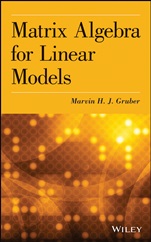
Matrix Algebra for Linear Models
ISBN 9781118592557
Autor: Marvin H. J. Gruber
Wydawca: Wiley
Dostępność: 3-6 tygodni
Cena: 533,40 zł
Przed złożeniem zamówienia prosimy o kontakt mailowy celem potwierdzenia ceny.
ISBN13: |
9781118592557 |
ISBN10: |
1118592557 |
Autor: |
Marvin H. J. Gruber |
Oprawa: |
Hardback |
Rok Wydania: |
2014-02-11 |
Ilość stron: |
392 |
Wymiary: |
242x154 |
Tematy: |
PB |
A self–contained introduction to matrix analysis theory and applications in the field of statistics Comprehensive in scope, Matrix Algebra for Linear Models offers a succinct summary of matrix theory and its related applications to statistics, especially linear models. The book provides a unified presentation of the mathematical properties and statistical applications of matrices in order to define and manipulate data. Written for theoretical and applied statisticians, the book utilizes multiple numerical examples to illustrate key ideas, methods, and techniques crucial to understanding matrix algebras application in linear models. Matrix Algebra for Linear Models expertly balances concepts and methods allowing for a side–by–side presentation of matrix theory and its linear model applications. Including concise summaries on each topic, the book also features: Methods of deriving results from the properties of eigenvalues and the singular value decomposition Solutions to matrix optimization problems for obtaining more efficient biased estimators for parameters in linear regression models A section on the generalized singular value decomposition Multiple chapter exercises with selected answers to enhance understanding of the presented material Matrix Algebra for Linear Models is an ideal textbook for advanced undergraduate and graduate–level courses on statistics, matrices, and linear algebra. The book is also an excellent reference for statisticians, engineers, economists, and readers interested in the linear statistical model.
Preface xiii Acknowledgments xv Part I Basic Ideas about Matrices and Systems of Linear Equations 1 Section 1 What Matrices are and Some Basic Operations with Them 3 1.1 Introduction, 3 1.2 What are Matrices and Why are they Interesting to a Statistician? 3 1.3 Matrix Notation, Addition, and Multiplication, 6 1.4 Summary, 10 Exercises, 10 Section 2 Determinants and Solving a System of Equations 14 2.1 Introduction, 14 2.2 Definition of and Formulae for Expanding Determinants, 14 2.3 Some Computational Tricks for the Evaluation of Determinants, 16 2.4 Solution to Linear Equations Using Determinants, 18 2.5 Gauss Elimination, 22 2.6 Summary, 27 Exercises, 27 Section 3 The Inverse of a Matrix 30 3.1 Introduction, 30 3.2 The Adjoint Method of Finding the Inverse of a Matrix, 30 3.3 Using Elementary Row Operations, 31 3.4 Using the Matrix Inverse to Solve a System of Equations, 33 3.5 Partitioned Matrices and Their Inverses, 34 3.6 Finding the Least Square Estimator, 38 3.7 Summary, 44 Exercises, 44 Section 4 Special Matrices and Facts about Matrices that will be Used in the Sequel 47 4.1 Introduction, 47 4.2 Matrices of the Form aIn + bJn, 47 4.3 Orthogonal Matrices, 49 4.4 Direct Product of Matrices, 52 4.5 An Important Property of Determinants, 53 4.6 The Trace of a Matrix, 56 4.7 Matrix Differentiation, 57 4.8 The Least Square Estimator Again, 62 4.9 Summary, 62 Exercises, 63 Section 5 Vector Spaces 66 5.1 Introduction, 66 5.2 What is a Vector Space?, 66 5.3 The Dimension of a Vector Space, 68 5.4 Inner Product Spaces, 70 5.5 Linear Transformations, 73 5.6 Summary, 76 Exercises, 76 Section 6 The Rank of a Matrix and Solutions to Systems of Equations 79 6.1 Introduction, 79 6.2 The Rank of a Matrix, 79 6.3 Solving Systems of Equations with Coefficient Matrix of Less than Full Rank, 84 6.4 Summary, 87 Exercises, 87 Part II Eigenvalues, the Singular Value Decomposition, and Principal Components 91 Section 7 Finding the Eigenvalues of a Matrix 93 7.1 Introduction, 93 7.2 Eigenvalues and Eigenvectors of a Matrix, 93 7.3 Nonnegative Definite Matrices, 101 7.4 Summary, 104 Exercises, 105 Section 8 The Eigenvalues and Eigenvectors of Special Matrices 108 8.1 Introduction, 108 8.2 Orthogonal, Nonsingular, and Idempotent Matrices, 109 8.3 The Cayley–Hamilton Theorem, 112 8.4 The Relationship between the Trace, the Determinant, and the Eigenvalues of a Matrix, 114 8.5 The Eigenvalues and Eigenvectors of the Kronecker Product of Two Matrices, 116 8.6 The Eigenvalues and the Eigenvectors of a Matrix of the Form aI + bJ, 117 8.7 The Loewner Ordering, 119 8.8 Summary, 121 Exercises, 122 Section 9 The Singular Value Decomposition (SVD) 124 9.1 Introduction, 124 9.2 The Existence of the SVD, 125 9.3 Uses and Examples of the SVD, 127 9.4 Summary, 134 Exercises, 134 Section 10 Applications of the Singular Value Decomposition 137 10.1 Introduction, 137 10.2 Reparameterization of a Non–full–Rank Model to a Full–Rank Model, 137 10.3 Principal Components, 141 10.4 The Multicollinearity Problem, 143 10.5 Summary, 144 Exercises, 145 Section 11 Relative Eigenvalues and Generalizations of the Singular Value Decomposition 146 11.1 Introduction, 146 11.2 Relative Eigenvalues and Eigenvectors, 146 11.3 Generalizations of the Singular Value Decomposition: Overview, 151 11.4 The First Generalization, 152 11.5 The Second Generalization, 157 11.6 Summary, 160 Exercises, 160 Part III Generalized Inverses 163 Section 12 Basic Ideas about Generalized Inverses 165 12.1 Introduction, 165 12.2 What is a Generalized Inverse and How is One Obtained?, 165 12.3 The Moore–Penrose Inverse, 170 12.4 Summary, 173 Exercises, 173 Section 13 Characterizations of Generalized Inverses Using the Singular Value Decomposition 175 13.1 Introduction, 175 13.2 Characterization of the Moore–Penrose Inverse, 175 13.3 Generalized Inverses in Terms of the Moore–Penrose Inverse, 177 13.4 Summary, 185 Exercises, 186 Section 14 Least Square and Minimum Norm Generalized Inverses 188 14.1 Introduction, 188 14.2 Minimum Norm Generalized Inverses, 189 14.3 Least Square Generalized Inverses, 193 14.4 An Extension of Theorem 7.3 to Positive–Semi–definite Matrices, 196 14.5 Summary, 197 Exercises, 197 Section 15 More Representations of Generalized Inverses 200 15.1 Introduction, 200 15.2 Another Characterization of the Moore–Penrose Inverse, 200 15.3 Still Another Representation of the Generalized Inverse, 204 15.4 The Generalized Inverse of a Partitioned Matrix, 207 15.5 Summary, 211 Exercises, 211 Section 16 Least Square Estimators for Less than Full–Rank Models 213 16.1 Introduction, 213 16.2 Some Preliminaries, 213 16.3 Obtaining the LS Estimator, 214 16.4 Summary, 221 Exercises, 221 Part IV Quadratic Forms and the Analysis of Variance 223 Section 17 Quadratic Forms and their Probability Distributions 225 17.1 Introduction, 225 17.2 Examples of Quadratic Forms, 225 17.3 The Chi–Square Distribution, 228 17.4 When does the Quadratic Form of a Random Variable have a Chi–Square Distribution?, 230 17.5 When are Two Quadratic Forms with the Chi–Square Distribution Independent?, 231 17.6 Summary, 234 Exercises, 235 Section 18 Analysis of Variance: Regression Models and the One– and Two–Way Classification 237 18.1 Introduction, 237 18.2 The Full–Rank General Linear Regression Model, 237 18.3 Analysis of Variance: One–Way Classification, 241 18.4 Analysis of Variance: Two–Way Classification, 244 18.5 Summary, 249 Exercises, 249 Section 19 More ANOVA—253 19.1 Introduction, 253 19.2 The Two–Way Classification with Interaction, 254 19.3 The Two–Way Classification with One Factor Nested, 258 19.4 Summary, 262 Exercises, 262 Section 20 The General Linear Hypothesis 264 20.1 Introduction, 264 20.2 The Full–Rank Case, 264 20.3 The Non–full–Rank Case, 267 20.4 Contrasts, 270 20.5 Summary, 273 Exercises, 273 Part V Matrix Optimization Problems 275 Section 21 Unconstrained Optimization Problems 277 21.1 Introduction, 277 21.2 Unconstrained Optimization Problems, 277 21.3 The Least Square Estimator Again, 281 21.4 Summary, 283 Exercises, 283 Section 22 Constrained Minimization Problems with Linear Constraints 287 22.1 Introduction, 287 22.2 An Overview of Lagrange Multipliers, 287 22.3 Minimizing a Second–Degree Form with Respect to a Linear Constraint, 293 22.4 The Constrained Least Square Estimator, 295 22.5 Canonical Correlation, 299 22.6 Summary, 302 Exercises, 302 Section 23 The Gauss–Markov Theorem 304 23.1 Introduction, 304 23.2 The Gauss–Markov Theorem and the Least Square Estimator, 304 23.3 The Modified Gauss–Markov Theorem and the Linear Bayes Estimator, 306 23.4 Summary, 311 Exercises, 311 Section 24 Ridge Regression–Type Estimators 314 24.1 Introduction, 314 24.2 Minimizing a Second–Degree Form with Respect to a Quadratic Constraint, 314 24.3 The Generalized Ridge Regression Estimators, 315 24.4 The Mean Square Error of the Generalized Ridge Estimator without Averaging over the Prior Distribution, 317 24.5 The Mean Square Error Averaging over the Prior Distribution, 321 24.6 Summary, 321 Exercises, 321 Answers to Selected Exercises 324 References 366 Index 368
Marvin H. J. Gruber, PHD, is Professor Emeritus in the School of Mathematical Sciences at Rochester Institute of Technology. He has authored several books and journal articles in his areas of research interest, which include improving the efficiency of regression estimators. Dr. Gruber is a member of the American Mathematical Society and the American Statistical Association.
Koszyk
Książek w koszyku: 0 szt.
Wartość zakupów: 0,00 zł
Informacje


Kontakt
Gambit
Centrum Oprogramowania
i Szkoleń Sp. z o.o.
Al. Pokoju 29b/22-24
31-564 Kraków
Siedziba Księgarni
ul. Kordylewskiego 1
31-542 Kraków
+48 12 410 5991
+48 12 410 5987
+48 12 410 5989
Subskrypcje
Administratorem danych osobowych jest firma Gambit COiS Sp. z o.o. Na podany adres będzie wysyłany wyłącznie biuletyn informacyjny.
Autoryzacja płatności

Informacje na temat autoryzacji płatności poprzez PayU.

© Copyright 2012: GAMBIT COiS Sp. z o.o. Wszelkie prawa zastrzeżone.
Projekt i wykonanie: Alchemia Studio Reklamy