


Wydawcy
Katalog tematyczny
- Archeologia (109)
- Ekonomia, finanse, business (13704)
- Filozofia (1445)
- Historia (3040)
- Języki i językoznawstwo (2356)
- Lifestyle, hobby i rozrywka (475)
- Medycyna (9704)
- Nauki humanistyczne (4)
- Nauki o Ziemi i środowisku (2638)
- Nauki ścisłe (20412)
- Astronomia (294)
- Biologia (5119)
- Chemia (6540)
- Fizyka (3309)
- Matematyka (4574)
- Algebra (171)
- Analiza matematyczna (902)
- Filozofia matematyki (1)
- Geometria (237)
- Historia matematyki (57)
- Kombinatoryka, teoria grafów (67)
- Matematyka dyskretna (35)
- Matematyka stosowana (555)
- Optymalizacja (104)
- Podstawy matematyki (129)
- Statystyka, prawdopodobieństwo (296)
- Teoria grup (63)
- Teoria liczb (77)
- Topologia (66)
- Nauki ścisłe, ogólnie (503)
- Nauki społeczne (8486)
- Nauki techniczne (13450)
- Prawo (1696)
- Publikacje informacyjne i interdyscyplinarne (1288)
- Religia i wierzenia (917)
- Technika komputerowa (4067)
- Zdrowie, relacje międzyludzkie i rozwój osobisty (657)








Informacje szczegółowe o książce
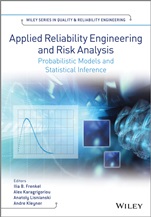
Applied Reliability Engineering and Risk Analysis: Probabilistic Models and Statistical Inference
ISBN 9781118539422
Autor: Ilia B. Frenkel, Alex Karagrigoriou, Anatoly Lisnianski, Andre V. Kleyner
Wydawca: Wiley
Dostępność: 3-6 tygodni
Cena: 735,00 zł
Przed złożeniem zamówienia prosimy o kontakt mailowy celem potwierdzenia ceny.
ISBN13: |
9781118539422 |
ISBN10: |
1118539427 |
Autor: |
Ilia B. Frenkel, Alex Karagrigoriou, Anatoly Lisnianski, Andre V. Kleyner |
Oprawa: |
Hardback |
Rok Wydania: |
2013-10-25 |
Ilość stron: |
448 |
Wymiary: |
251x177 |
Tematy: |
PB |
This complete resource on the theory and applications of reliability engineering, probabilistic models and risk analysis consolidates all the latest research, presenting the most up–to–date developments in this field. With comprehensive coverage of the theoretical and practical issues of both classic and modern topics, it also provides a unique commemoration to the centennial of the birth of Boris Gnedenko, one of the most prominent reliability scientists of the twentieth century. Key features include: expert treatment of probabilistic models and statistical inference from leading scientists, researchers and practitioners in their respective reliability fields detailed coverage of multi–state system reliability, maintenance models, statistical inference in reliability, systemability, physics of failures and reliability demonstration many examples and engineering case studies to illustrate the theoretical results and their practical applications in industry Applied Reliability Engineering and Risk Analysis is one of the first works to treat the important areas of degradation analysis, multi–state system reliability, networks and large–scale systems in one comprehensive volume. It is an essential reference for engineers and scientists involved in reliability analysis, applied probability and statistics, reliability engineering and maintenance, logistics, and quality control. It is also a useful resource for graduate students specialising in reliability analysis and applied probability and statistics.
Remembering Boris Gnedenko xvii List of Contributors xxv Preface xxix Acknowledgements xxxv Part I DEGRADATION ANALYSIS, MULTI–STATE AND CONTINUOUS–STATE SYSTEM RELIABILITY 1 Methods of Solutions of Inhomogeneous Continuous Time Markov Chains for Degradation Process Modeling 3 Yan–Fu Li, Enrico Zio and Yan–Hui Lin 1.1 Introduction 3 1.2 Formalism of ICTMC 4 1.3 Numerical Solution Techniques 5 1.3.1 The Runge–Kutta Method 5 1.3.2 Uniformization 6 1.3.3 Monte Carlo Simulation 7 1.3.4 State–Space Enrichment 9 1.4 Examples 10 1.4.1 Example of Computing System Degradation 10 1.4.2 Example of Nuclear Component Degradation 11 1.5 Comparisons of the Methods and Guidelines of Utilization 13 1.6 Conclusion 15 References 15 2 Multistate Degradation and Condition Monitoring for Devices with Multiple Independent Failure Modes 17 Ramin Moghaddass and Ming J. Zuo 2.1 Introduction 17 2.2 Multistate Degradation and Multiple Independent Failure Modes 19 2.2.1 Notation 19 2.2.2 Assumptions 20 2.2.3 The Stochastic Process Model 21 2.3 Parameter Estimation 23 2.4 Important Reliability Measures of a Condition–Monitored Device 25 2.5 Numerical Example 27 2.6 Conclusion 28 Acknowledgements 30 References 30 3 Time Series Regression with Exponential Errors for Accelerated Testing and Degradation Tracking 32 Nozer D. Singpurwalla 3.1 Introduction 32 3.2 Preliminaries: Statement of the Problem 33 3.2.1 Relevance to Accelerated Testing, Degradation and Risk 33 3.3 Estimation and Prediction by Least Squares 34 3.4 Estimation and Prediction by MLE 35 3.4.1 Properties of the Maximum Likelihood Estimator 35 3.5 The Bayesian Approach: The Predictive Distribution 37 3.5.1 The Predictive Distribution of YT+1 when λ > A 38 3.5.2 The Predictive Distribution of YT+1 when λ ≤ A 39 3.5.3 Alternative Prior for β 40 Acknowledgements 42 References 42 4 Inverse Lz–Transform for a Discrete–State Continuous–Time Markov Process and Its Application to Multi–State System Reliability Analysis 43 Anatoly Lisnianski and Yi Ding 4.1 Introduction 43 4.2 Inverse Lz–Transform: Definitions and Computational Procedure 44 4.2.1 Definitions 44 4.2.2 Computational Procedure 47 4.3 Application of Inverse Lz–Transform to MSS Reliability Analysis 50 4.4 Numerical Example 52 4.5 Conclusion 57 References 58 5 OntheLz–Transform Application for Availability Assessment of an Aging Multi–State Water Cooling System for Medical Equipment 59 Ilia Frenkel, Anatoly Lisnianski and Lev Khvatskin 5.1 Introduction 59 5.2 Brief Description of the Lz–Transform Method 61 5.3 Multi–state Model of the Water Cooling System for the MRI Equipment 62 5.3.1 System Description 62 5.3.2 The Chiller Sub–System 64 5.3.3 The Heat Exchanger Sub–System 66 5.3.4 The Pump Sub–System 67 5.3.5 The Electric Board Sub–System 69 5.3.6 Model of Stochastic Demand 71 5.3.7 Multi–State Model for the MRI Cooling System 73 5.4 Availability Calculation 75 5.5 Conclusion 76 Acknowledgments 76 References 77 6 Combined Clustering and Lz–Transform Technique to Reduce the Computational Complexity of a Multi–State System Reliability Evaluation 78 Yi Ding 6.1 Introduction 78 6.2 The Lz–Transform for Dynamic Reliability Evaluation for MSS 79 6.3 Clustering Composition Operator in the Lz–Transform 81 6.4 Computational Procedures 83 6.5 Numerical Example 83 6.6 Conclusion 85 References 85 7 Sliding Window Systems with Gaps 87 Gregory Levitin 7.1 Introduction 87 7.2 The Models 89 7.2.1 The k/eSWS Model 89 7.2.2 The mCSWS Model 89 7.2.3 The mGSWS Model 90 7.2.4 Interrelations among Different Models 90 7.3 Reliability Evaluation Technique 91 7.3.1 Determining u–functions for Individual Elements and their Groups 91 7.3.2 Determining u–functions for all the Groups of r Consecutive Elements 92 7.3.3 Detecting the System Failure 93 7.3.4 Updating the Counter 94 7.3.5 Recursive Determination of System Failure Probability 95 7.3.6 Computational Complexity Reduction 95 7.3.7 Algorithm for System Reliability Evaluation 95 7.4 Conclusion 96 References 96 8 Development of Reliability Measures Motivated by Fuzzy Sets for Systems with Multi– or Infinite–States 98 Zhaojun (Steven) Li and Kailash C. Kapur 8.1 Introduction 98 8.2 Models for Components and Systems Using Fuzzy Sets 100 8.2.1 Binary Reliability and Multi–State Reliability Model 100 8.2.2 Definition of Fuzzy Reliability 101 8.2.3 Fuzzy Unreliability: A Different Perspective 102 8.2.4 Evolution from Binary State to Multi–State and to Fuzzy State Reliability Modeling 102 8.3 Fuzzy Reliability for Systems with Continuous or Infinite States 103 8.4 Dynamic Fuzzy Reliability 104 8.4.1 Time to Fuzzy Failure Modeled by Fuzzy Random Variable 105 8.4.2 Stochastic Performance Degradation Model 106 8.4.3 Membership Function Evaluation for the Expectation of Time to Fuzzy Failure 107 8.4.4 Performance Measures for Dynamic Fuzzy Reliability 108 8.5 System Fuzzy Reliability 110 8.6 Examples and Applications 111 8.6.1 Reliability Performance Evaluation Based on Time to Fuzzy Failure 111 8.6.2 Example for System Fuzzy Reliability Modeling 113 8.6.3 Numerical Results 115 8.7 Conclusion 117 References 118 9 Imperatives for Performability Design in the Twenty–First Century 119 Krishna B. Misra 9.1 Introduction 119 9.2 Strategies for Sustainable Development 120 9.2.1 The Internalization of Hidden Costs 120 9.2.2 Mitigation Policies 121 9.2.3 Dematerialization 121 9.2.4 Minimization of Energy Requirement 124 9.3 Reappraisal of the Performance of Products and Systems 124 9.4 Dependability and Environmental Risk are Interdependent 126 9.5 Performability: An Appropriate Measure of Performance 126 9.5.1 Performability Engineering 127 9.6 Towards Dependable and Sustainable Designs 129 9.7 Conclusion 130 References 130 Part II NETWORKS AND LARGE–SCALE SYSTEMS 10 Network Reliability Calculations Based on Structural Invariants 135 Ilya B. Gertsbakh and Yoseph Shpungin 10.1 First Invariant: D–Spectrum, Signature 135 10.2 Second Invariant: Importance Spectrum. Birnbaum Importance Measure (BIM) 139 10.3 Example: Reliability of a Road Network 141 10.4 Third Invariant: Border States 142 10.5 Monte Carlo to Approximate the Invariants 144 10.6 Conclusion 146 References 146 11 Performance and Availability Evaluation of IMS–Based Core Networks 148 Kishor S. Trivedi, Fabio Postiglione and Xiaoyan Yin 11.1 Introduction 148 11.2 IMS–Based Core Network Description 149 11.3 Analytic Models for Independent Software Recovery 151 11.3.1 Model 1: Hierarchical Model with Top–Level RBD and Lower–Level MFT 152 11.3.2 Model 2: Hierarchical Model with Top–Level RBD and Lower–Level FT 153 11.3.3 Model 3: Hierarchical Model with Top–Level RBD and Lower–Level SRN 154 11.4 Analytic Models for Recovery with Dependencies 155 11.4.1 Model 4: Hierarchical Model with Top–Level RBD, Middle–Level MFT and Lower–Level CTMC 155 11.4.2 Model 5: Alternative Approach for Model 4 based on UGF 156 11.4.3 Model 6: Hierarchical Model with Top–Level RBD and Lower–Level SRN 158 11.5 Redundancy Optimization 158 11.6 Numerical Results 159 11.6.1 Model Comparison 159 11.6.2 Influences of Performance Demand and Redundancy Configuration 162 11.7 Conclusion 165 References 165 12 Reliability and Probability of First Occurred Failure for Discrete–Time Semi–Markov Systems 167 Stylianos Georgiadis, Nikolaos Limnios and Irene Votsi 12.1 Introduction 167 12.2 Discrete–Time Semi–Markov Model 168 12.3 Reliability and Probability of First Occurred Failure 170 12.3.1 Rate of Occurrence of Failures 171 12.3.2 Steady–State Availability 171 12.3.3 Probability of First Occurred Failure 172 12.4 Nonparametric Estimation of Reliability Measures 172 12.4.1 Estimation of ROCOF 173 12.4.2 Estimation of the Steady–State Availability 174 12.4.3 Estimation of the Probability of First Occurred Failure 175 12.5 Numerical Application 176 12.6 Conclusion 178 References 179 13 Single–Source Epidemic Process in a System of Two Interconnected Networks 180 Ilya B. Gertsbakh and Yoseph Shpungin 13.1 Introduction 180 13.2 Failure Process and the Distribution of the Number of Failed Nodes 181 13.3 Network Failure Probabilities 184 13.4 Example 185 13.5 Conclusion 187 13.A Appendix D: Spectrum (Signature) 188 References 189 Part III MAINTENANCE MODELS 14 Comparisons of Periodic and Random Replacement Policies 193 Xufeng Zhao and Toshio Nakagawa 14.1 Introduction 193 14.2 Four Policies 195 14.2.1 Standard Replacement 195 14.2.2 Replacement First 195 14.2.3 Replacement Last 196 14.2.4 Replacement Over Time 196 14.3 Comparisons of Optimal Policies 197 14.3.1 Comparisons of T ∗ S and T ∗ F, T ∗ L, and T ∗ O 197 14.3.2 Comparisons of T ∗ O and T ∗ F, T ∗ L 198 14.3.3 Comparisons of T ∗ F and T ∗ L 199 14.4 Numerical Examples 1 199 14.5 Comparisons of Policies with Different Replacement Costs 201 14.5.1 Comparisons of T ∗ S, and T ∗ F, T ∗ L 201 14.5.2 Comparisons of T ∗ S and T ∗ O 201 14.6 Numerical Examples 2 202 14.7 Conclusion 203 Acknowledgements 204 References 204 15 Random Evolution of Degradation and Occurrences of Words in Random Sequences of Letters 205 Emilio De Santis and Fabio Spizzichino 15.1 Introduction 205 15.2 Waiting Times to Words’ Occurrences 206 15.2.1 The Markov Chain Approach 207 15.2.2 Leading Numbers and Occurrences Times 208 15.3 Some Reliability–Maintenance Models 209 15.3.1 Model 1 (Simple Machine Replacement) 209 15.3.2 Model 2 (Random Reduction of Age) 210 15.3.3 Model 3 (Random Number of Effective Repairs in a Parallel System) 211 15.3.4 Degradation and Words 212 15.4 Waiting Times to Occurrences of Words and Stochastic Comparisons for Degradation 213 15.5 Conclusions 216 Acknowledgements 217 References 217 16 Occupancy Times for Markov and Semi–Markov Models in Systems Reliability 218 Alan G. Hawkes, Lirong Cui and Shijia Du 16.1 Introduction 218 16.2 Markov Models for Systems Reliability 220 16.3 Semi–Markov Models 222 16.3.1 Joint Distributions of Operational and Failed Times 223 16.3.2 Distribution of Cumulative Times 224 16.4 Time Interval Omission 225 16.5 Numerical Examples 226 16.6 Conclusion 229 Acknowledgements 229 References 229 17 A Practice of Imperfect Maintenance Model Selection for Diesel Engines 231 Yu Liu, Hong–Zhong Huang, Shun–Peng Zhu and Yan–Feng Li 17.1 Introduction 231 17.2 Review of Imperfect Maintenance Model Selection Method 233 17.2.1 Estimation of the Parameters 234 17.2.2 The Proposed GOF Test 234 17.2.3 Bayesian Model Selection 235 17.3 Application to Preventive Maintenance Scheduling of Diesel Engines 236 17.3.1 Initial Failure Intensity Estimation 237 17.3.2 Imperfect Maintenance Model Selection 237 17.3.3 Implementation in Preventive Maintenance Decision–Making 240 17.4 Conclusion 244 Acknowledgment 245 References 245 18 Reliability of Warm Standby Systems with Imperfect Fault Coverage 246 Rui Peng, Ola Tannous, Liudong Xing and Min Xie 18.1 Introduction 246 18.2 Literature Review 247 18.3 The BDD–Based Approach 250 18.3.1 The BDD Construction 251 18.3.2 System Unreliability Evaluation 251 18.3.3 Illustrative Examples 252 18.4 Conclusion 253 Acknowledgments 254 References 254 Part IV STATISTICAL INFERENCE IN RELIABILITY 19 On the Validity of the Weibull–Gnedenko Model 259 Vilijandas Bagdonavi¡cius, Mikhail Nikulin and Ruta Levuliene 19.1 Introduction 259 19.2 Integrated Likelihood Ratio Test 261 19.3 Tests based on the Difference of Non–Parametric and Parametric Estimators of the Cumulative Distribution Function 264 19.4 Tests based on Spacings 266 19.5 Chi–Squared Tests 267 19.6 Correlation Test 269 19.7 Power Comparison 269 19.8 Conclusion 272 References 272 20 Statistical Inference for Heavy–Tailed Distributions in Reliability Systems 273 Ilia Vonta and Alex Karagrigoriou 20.1 Introduction 273 20.2 Heavy–Tailed Distributions 274 20.3 Examples of Heavy–Tailed Distributions 277 20.4 Divergence Measures 280 20.5 Hypothesis Testing 284 20.6 Simulations 286 20.7 Conclusion 287 References 287 21 Robust Inference based on Divergences in Reliability Systems 290 Abhik Ghosh, Avijit Maji and Ayanendranath Basu 21.1 Introduction 290 21.2 The Power Divergence (PD) Family 291 21.2.1 Minimum Disparity Estimation 293 21.2.2 The Robustness of the Minimum Disparity Estimators (MDEs) 294 21.2.3 Asymptotic Properties 295 21.3 Density Power Divergence (DPD) and Parametric Inference 296 21.3.1 Connections between the PD and the DPD 298 21.3.2 Influence Function of the Minimum DPD estimator 299 21.3.3 Asymptotic Properties of the Minimum DPD estimator 300 21.4 A Generalized Form: The S–Divergence 301 21.4.1 The Divergence and the Estimating Equation 301 21.4.2 Influence Function of the Minimum S–Divergence estimator 303 21.4.3 Minimum S–Divergence Estimators: Asymptotic Properties 303 21.5 Applications 304 21.5.1 Reliability: The Generalized Pareto Distribution 304 21.5.2 Survival Analysis 305 21.5.3 Model Selection: Divergence Information Criterion 306 21.6 Conclusion 306 References 306 22 COM–Poisson Cure Rate Models and Associated Likelihood–based Inference with Exponential and Weibull Lifetimes 308 N. Balakrishnan and Suvra Pal 22.1 Introduction 308 22.2 Role of Cure Rate Models in Reliability 310 22.3 The COM–Poisson Cure Rate Model 310 22.4 Data and the Likelihood 311 22.5 EM Algorithm 312 22.6 Standard Errors and Asymptotic Confidence Intervals 314 22.7 Exponential Lifetime Distribution 314 22.7.1 Simulation Study: Model Fitting 315 22.7.2 Simulation Study: Model Discrimination 319 22.8 Weibull Lifetime Distribution 322 22.8.1 Simulation Study: Model Fitting 322 22.8.2 Simulation Study: Model Discrimination 328 22.9 Analysis of Cutaneous Melanoma Data 334 22.9.1 Exponential Lifetimes with Log–Linear Link Function 334 22.9.2 Weibull Lifetimes with Logistic Link Function 335 22.10 Conclusion 337 22.A1 Appendix A1: E–Step and M–Step Formulas for Exponential Lifetimes 337 22.A2 Appendix A2: E–Step and M–Step Formulas for Weibull Lifetimes 341 22.B1 Appendix B1: Observed Information Matrix for Exponential Lifetimes 344 22.B2 Appendix B2: Observed Information Matrix for Weibull Lifetimes 346 References 347 23 Exponential Expansions for Perturbed Discrete Time Renewal Equations 349 Dmitrii Silvestrov and Mikael Petersson 23.1 Introduction 349 23.2 Asymptotic Results 350 23.3 Proofs 353 23.4 Discrete Time Regenerative Processes 358 23.5 Queuing and Risk Applications 359 References 361 24 On Generalized Extreme Shock Models under Renewal Shock Processes 363 Ji Hwan Cha and Maxim Finkelstein 24.1 Introduction 363 24.2 Generalized Extreme Shock Models 364 24.2.1 ‘Classical’ Extreme Shock Model for Renewal Process of Shocks 364 24.2.2 History–Dependent Extreme Shock Model 365 24.3 Specific Models 367 24.3.1 Stress–Strength Model 367 24.3.2 Model A in Cha and Finkelstein (2011) 369 24.3.3 State–Dependent Shock Model 370 24.4 Conclusion 373 Acknowledgements 373 References 373 Part V SYSTEMABILITY, PHYSICS–OF–FAILURE AND RELIABILITY DEMONSTRATION 25 Systemability Theory and its Applications 377 Hoang Pham 25.1 Introduction 377 25.2 Systemability Measures 378 25.3 Systemability Analysis of k–out–of–n Systems 379 25.3.1 Variance of Systemability Calculations 380 25.4 Systemability Function Approximation 380 25.5 Systemability with Loglog Distribution 383 25.5.1 Loglog Distribution 383 25.6 Sensitivity Analysis 384 25.7 Applications: Red Light Camera Systems 385 25.8 Conclusion 387 References 387 26 Physics–of–Failure based Reliability Engineering 389 Pedro O. Quintero and Michael Pecht 26.1 Introduction 389 26.2 Physics–of–Failure–based Reliability Assessment 393 26.2.1 Information Requirements 393 26.2.2 Failure Modes, Mechanisms, and Effects Analysis (FMMEA) 396 26.2.3 Stress Analysis 397 26.2.4 Reliability Assessment 397 26.3 Uses of Physics–of–Failure 398 26.3.1 Design–for–Reliability (DfR) 398 26.3.2 Stress Testing Conditions 398 26.3.3 Qualification 399 26.3.4 Screening Conditions 399 26.3.5 Prognostics and Health Management (PHM) 399 26.4 Conclusion 400 References 400 27 Accelerated Testing: Effect of Variance in Field Environmental Conditions on the Demonstrated Reliability 403 Andre Kleyner 27.1 Introduction 403 27.2 Accelerated Testing and Field Stress Variation 404 27.3 Case Study: Reliability Demonstration Using Temperature Cycling Test 405 27.4 Conclusion 408 References 408 Index 409
Koszyk
Książek w koszyku: 0 szt.
Wartość zakupów: 0,00 zł
Informacje


Kontakt
Gambit
Centrum Oprogramowania
i Szkoleń Sp. z o.o.
Al. Pokoju 29b/22-24
31-564 Kraków
Siedziba Księgarni
ul. Kordylewskiego 1
31-542 Kraków
+48 12 410 5991
+48 12 410 5987
+48 12 410 5989
Subskrypcje
Administratorem danych osobowych jest firma Gambit COiS Sp. z o.o. Na podany adres będzie wysyłany wyłącznie biuletyn informacyjny.
Autoryzacja płatności

Informacje na temat autoryzacji płatności poprzez PayU.

© Copyright 2012: GAMBIT COiS Sp. z o.o. Wszelkie prawa zastrzeżone.
Projekt i wykonanie: Alchemia Studio Reklamy