


Wydawcy
Katalog tematyczny
- Archeologia (109)
- Ekonomia, finanse, business (13704)
- Filozofia (1445)
- Historia (3040)
- Języki i językoznawstwo (2356)
- Lifestyle, hobby i rozrywka (475)
- Medycyna (9704)
- Nauki humanistyczne (4)
- Nauki o Ziemi i środowisku (2638)
- Nauki ścisłe (20412)
- Astronomia (294)
- Biologia (5119)
- Chemia (6540)
- Fizyka (3309)
- Matematyka (4574)
- Algebra (171)
- Analiza matematyczna (902)
- Filozofia matematyki (1)
- Geometria (237)
- Historia matematyki (57)
- Kombinatoryka, teoria grafów (67)
- Matematyka dyskretna (35)
- Matematyka stosowana (555)
- Optymalizacja (104)
- Podstawy matematyki (129)
- Statystyka, prawdopodobieństwo (296)
- Teoria grup (63)
- Teoria liczb (77)
- Topologia (66)
- Nauki ścisłe, ogólnie (503)
- Nauki społeczne (8486)
- Nauki techniczne (13450)
- Prawo (1696)
- Publikacje informacyjne i interdyscyplinarne (1288)
- Religia i wierzenia (917)
- Technika komputerowa (4067)
- Zdrowie, relacje międzyludzkie i rozwój osobisty (657)





Informacje szczegółowe o książce
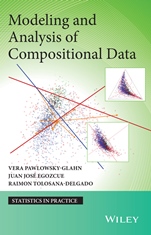
Modeling and Analysis of Compositional Data
ISBN 9781118443064
Autor: Vera Pawlowsky–Glahn, Juan José Egozcue, Raimon Tolosana–Delgado
Wydawca: Wiley
Dostępność: 3-6 tygodni
Cena: 429,45 zł
Przed złożeniem zamówienia prosimy o kontakt mailowy celem potwierdzenia ceny.
ISBN13: |
9781118443064 |
ISBN10: |
1118443063 |
Autor: |
Vera Pawlowsky–Glahn, Juan José Egozcue, Raimon Tolosana–Delgado |
Oprawa: |
Hardback |
Rok Wydania: |
2015-03-27 |
Ilość stron: |
272 |
Wymiary: |
228x159 |
Tematy: |
PB |
Statistical analysis of compositional data has been a topic ofresearch for more than a century; within the last decade,theoretical results have shown that the simplex the samplespace of compositional data can be structured as a Euclideanspace. This allows the representation of compositions incoordinates; in particular, in coordinates with respect to anorthonormal (Cartesian) basis. In turn, it offers a way to applyall known methods in multivariate statistics, which were developedunder the assumption that data are realizations of real randomvariables. Modeling and Analysis of Compositional Data presents apractical and comprehensive introduction with numerous examples toillustrate both theory and application of each method. The authorsprovide a complete and current compendium of fundamental toadvanced methodologies along with exercises at the end of eachchapter to aid the readers understanding. Solutions toquestions raised throughout the text, along with datasets, areavailable on the companion website (www.wiley.com/go/glahn/practical). Presents a comprehensive and practical introduction tothe analysis of compositional data. Presents numerous examples of compositional data andexercises from many fields of science. Uses a sample space approach to compositional databased on its algebraic/geometric structure. Written by leading experts responsible for manyadvances in the field. Accompanied by a website featuring a manual withsolutions, instructions to access free software, and datasets.
Statisticians, mathematicians, and researchers in all fields ofscience that have to deal with compositional data will find thisbook a useful resource. It can also be used as a textbook forstudents with basic knowledge of linear algebra, calculus, andstatistics.
Preface xi
About the Authors xv
Acknowledgments xix
1 Introduction 1
2 Compositional Data and Their Sample Space 8
2.1 Basic concepts 8
2.2 Principles of compositional analysis 12
2.2.1 Scale invariance 12
2.2.2 Permutation invariance 15
2.2.3 Subcompositional coherence 16
2.3 Zeros, missing values, and other irregular components 16
2.3.1 Kinds of irregular components 16
2.3.2 Strategies to analyze irregular data 19
2.4 Exercises 21
3 The Aitchison Geometry 23
3.1 General comments 23
3.2 Vector space structure 24
3.3 Inner product, norm and distance 26
3.4 Geometric figures 28
3.5 Exercises 30
4 Coordinate Representation 32
4.1 Introduction 32
4.2 Compositional observations in real space 33
4.3 Generating systems 33
4.4 Orthonormal coordinates 36
4.5 Balances 38
4.6 Working on coordinates 43
4.7 Additive logratio coordinates (alr) 46
4.8 Orthogonal projections 48
4.9 Matrix operations in the simplex 54
4.9.1 Perturbation–linear combination of compositions 54
4.9.2 Linear transformations of óKòù:endomorphisms 55
4.9.3 Other matrix transformations on óKòù:nonlinear transformations 57
4.10 Coordinates leading to alternative Euclidean structures59
4.11 Exercises 61
5 Exploratory Data Analysis 65
5.1 General remarks 65
5.2 Sample center, total variance, and variation matrix 66
5.3 Centering and scaling 68
5.4 The biplot: a graphical display 70
5.4.1 Construction of a biplot 70
5.4.2 Interpretation of a 2D compositional biplot 72
5.5 Exploratory analysis of coordinates 76
5.6 A geological example 79
5.7 Linear trends along principal components 85
5.8 A nutrition example 89
5.9 A political example 96
5.10 Exercises 100
6 Random Compositions 103
6.1 Sample space 103
6.1.1 Conventional approach to the sample space of compositions105
6.1.2 A compositional approach to the sample space ofcompositions 106
6.1.3 Definitions related to random compositions 107
6.2 Variability and center 108
6.3 Probability distributions on the simplex 112
6.3.1 The normal distribution on the simplex 114
6.3.2 The Dirichlet distribution 121
6.3.3 Other distributions 127
6.4 Exercises 128
7 Statistical Inference 130
7.1 Point estimation of center and variability 130
7.2 Testing hypotheses on compositional normality 135
7.3 Testing hypotheses about two populations 136
7.4 Probability and confidence regions for normal data 142
7.5 Bayesian estimation with count data 144
7.6 Exercises 147
8 Linear Models 149
8.1 Linear regression with compositional response 150
8.2 Regression with compositional covariates 156
8.3 Analysis of variance with compositional response 160
8.4 Linear discrimination with compositional predictor 163
8.5 Exercises 165
9 Compositional Processes 172
9.1 Linear processes 173
9.2 Mixture processes 176
9.3 Settling processes 178
9.4 Simplicial derivative 183
9.5 Elementary differential equations 186
9.5.1 Constant derivative 187
9.5.2 Forced derivative 189
9.5.3 Complete first–order linear equation 194
9.5.4 Harmonic oscillator 200
9.6 Exercises 204
10 Epilogue 206
References 211
Appendix A Practical Recipes 222
A.1 Plotting a ternary diagram 222
A.2 Parameterization of an elliptic region 224
A.3 Matrix expressions of change of representation 226
Appendix B Random Variables 228
B.1 Probability spaces and random variables 228
B.2 Description of probability 232
List of Abbreviations and Symbols 234
Author Index 237
General Index 241
VERA PAWLOWSKY–GLAHN Department of Computer Science, AppliedMathematics, and Statistics, University of Girona, Spain
JUAN JOSÉ EGOZCUE Department of Applied MathematicsIII, Technical University of Catalonia, Barcelona, Spain
RAIMON TOLOSANA–DELGADO Helmholtz Institute Freiberg forResource Technology, Germany
Koszyk
Książek w koszyku: 0 szt.
Wartość zakupów: 0,00 zł
Informacje


Kontakt
Gambit
Centrum Oprogramowania
i Szkoleń Sp. z o.o.
Al. Pokoju 29b/22-24
31-564 Kraków
Siedziba Księgarni
ul. Kordylewskiego 1
31-542 Kraków
+48 12 410 5991
+48 12 410 5987
+48 12 410 5989
Subskrypcje
Administratorem danych osobowych jest firma Gambit COiS Sp. z o.o. Na podany adres będzie wysyłany wyłącznie biuletyn informacyjny.
Autoryzacja płatności

Informacje na temat autoryzacji płatności poprzez PayU.

© Copyright 2012: GAMBIT COiS Sp. z o.o. Wszelkie prawa zastrzeżone.
Projekt i wykonanie: Alchemia Studio Reklamy