


Wydawcy
Katalog tematyczny
- Archeologia (109)
- Ekonomia, finanse, business (13704)
- Filozofia (1445)
- Historia (3040)
- Języki i językoznawstwo (2356)
- Lifestyle, hobby i rozrywka (475)
- Medycyna (9704)
- Nauki humanistyczne (4)
- Nauki o Ziemi i środowisku (2638)
- Nauki ścisłe (20412)
- Astronomia (294)
- Biologia (5119)
- Chemia (6540)
- Fizyka (3309)
- Matematyka (4574)
- Algebra (171)
- Analiza matematyczna (902)
- Filozofia matematyki (1)
- Geometria (237)
- Historia matematyki (57)
- Kombinatoryka, teoria grafów (67)
- Matematyka dyskretna (35)
- Matematyka stosowana (555)
- Optymalizacja (104)
- Podstawy matematyki (129)
- Statystyka, prawdopodobieństwo (296)
- Teoria grup (63)
- Teoria liczb (77)
- Topologia (66)
- Nauki ścisłe, ogólnie (503)
- Nauki społeczne (8486)
- Nauki techniczne (13450)
- Prawo (1696)
- Publikacje informacyjne i interdyscyplinarne (1288)
- Religia i wierzenia (917)
- Technika komputerowa (4067)
- Zdrowie, relacje międzyludzkie i rozwój osobisty (657)





Informacje szczegółowe o książce
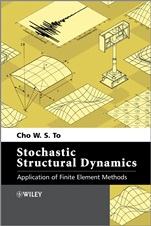
Stochastic Structural Dynamics: Application of Finite Element Methods
ISBN 9781118342350
Autor: Cho W. S. To
Wydawca: Wiley
Dostępność: 3-6 tygodni
Cena: 554,40 zł
Przed złożeniem zamówienia prosimy o kontakt mailowy celem potwierdzenia ceny.
ISBN13: |
9781118342350 |
ISBN10: |
1118342356 |
Autor: |
Cho W. S. To |
Oprawa: |
Hardback |
Rok Wydania: |
2013-12-06 |
Ilość stron: |
350 |
Wymiary: |
248x170 |
Tematy: |
PB |
The parallel developments of the Finite Element Methods (FEM) and the engineering applications of stochastic processes in the mid–20 th century provided a combined numerical analysis tool for the studies of dynamics of structures and structural systems under random loadings. In the open literature, there are books on statistical dynamics of structures and books on structural dynamics with chapters dealing with random response analysis. However, a systematic treatment of stochastic structural dynamics applying the finite element methods seems to be lacking, and this book redresses the balance. Aimed at advanced and specialist levels, the author presents and illustrates closed form solutions and the stochastic central difference methods for the computation of response statistics of linear and quasi–linear structures to nonstationary random loads. In addition to the linear and quasi–linear problems, the text also addresses highly nonlinear systems with uncertain parameters of large variations. The systems considered in the text include beam, plate and shell structures which are represented by the FEM. Key features: Fully illustrated throughout and aimed at advanced and specialist levels, the focus is on closed form solutions and computational approaches Emphasizes results of time–dependent response statistics of beam, plate and shell structures represented by the FEM Presents and illustrates computed results of highly nonlinear deformations of finite rotations and finite strains with large uncertain variations Presents efficient methods for large–scale computation of time–dependent linear and nonlinear response statistics of structural systems approximated by the FEM
Dedication xi Preface xiii Acknowledgements xv 1. Introduction 1 1.1 Displacement Formulation Based Finite Element Method 2 1.1.1 Derivation of element equation of motion 2 1.1.2 Mass and stiffness matrices of uniform beam element 7 1.1.3 Mass and stiffness matrices of tapered beam element 9 1.2 Element Equations of Motion for Temporally and Spatially Stochastic Systems 13 1.3 Hybrid Stress Based Element Equations of Motion 14 1.3.1 Derivation of element equation of motion 15 1.3.2 Mass and stiffness matrices of uniform beam element 16 1.4 Incremental Variational Principle and Mixed Formulation Based Nonlinear Element Matrices 18 1.4.1 Incremental variational principle and linearization 19 1.4.2 Linear and nonlinear element stiffness matrices 23 1.5 Constitutive Relations and Updating of Configurations and Stresses 36 1.5.1 Elastic materials 36 1.5.2 Elasto–plastic materials with isotropic strain hardening 39 1.5.3 Configuration and stress updatings 45 1.6 Concluding Remarks 48 References 49 2. Spectral Analysis and Response Statistics of Linear Structural Systems 53 2.1 Spectral Analysis 53 2.1.1 Theory of spectral analysis 54 2.1.2 Remarks 56 2.2 Evolutionary Spectral Analysis 56 2.2.1 Theory of evolutionary spectra 56 2.2.2 Modal analysis and evolutionary spectra 57 2.3 Evolutionary Spectra of Engineering Structures 60 2.3.1 Evolutionary spectra of mast antenna structure 61 2.3.2 Evolutionary spectra of cantilever beam structure 67 2.3.3 Evolutionary spectra of plate structure 71 2.3.4 Remarks 73 2.4 Modal Analysis and Time–Dependent Response Statistics 76 2.4.1 Time–dependent covariances of displacements 77 2.4.2 Time–dependent covariances of displacements and velocities 77 2.4.3 Time–dependent covariances of velocities 78 2.4.4 Remarks 78 2.5 Response Statistics of Engineering Structures 79 2.5.1 Mast antenna structure 79 2.5.2 Truncated conical shell structures 81 2.5.3 Laminated composite plate and shell structures 87 References 94 3. Direct Integration Methods for Linear Structural Systems 97 3.1 Stochastic Central Difference Method 97 3.2 Stochastic Central Difference Method with Time Co–ordinate Transformation 100 3.3 Applications 102 3.3.1 Beam structures under base random excitations 102 3.3.2 Plate structures 109 3.3.3 Remarks 114 3.4 Extended Stochastic Central Difference Method and Narrow–band Force Vector 114 3.4.1 Extended stochastic central difference method 114 3.4.2 Beam structure under a narrow–band excitations 118 3.4.3 Concluding remarks 122 3.5 Stochastic Newmark Family of Algorithms 122 3.5.1 Deterministic Newmark family of algorithms 122 3.5.2 Stochastic version of Newmark algorithms 124 3.5.3 Responses of square plates under transverse random forces 126 References 128 4. Modal Analysis and Response Statistics of Quasi–linear Structural Systems 131 4.1 Modal Analysis of Temporally Stochastic Quasi–linear Systems 131 4.1.1 Modal analysis and bi–modal approach 132 4.1.2 Response statistics by Cumming′s approach 137 4.2 Response Analysis Based on Melosh–Zienkiewicz–Cheung Bending Plate Finite Element 141 4.2.1 Simply–supported plate structure 142 4.2.2 Square plate clamped at all sides 150 4.2.3 Remarks 152 4.3 Response Analysis Based on High Precision Triangular Plate Finite Element 156 4.3.1 Simply–supported plate structures 157 4.3.2 Square plate clamped at all sides 159 4.4 Concluding Remarks 166 References 166 5. Direct Integration Methods for Response Statistics of Quasi–linear Structural Systems 169 5.1 Stochastic Central Difference Method for Quasi–linear Structural Systems 169 5.1.1 Derivation of covariance matrix of displacements 169 5.1.2 Column under external and parametric random excitations 171 5.2 Recursive Covariance Matrix of Displacements of Cantilever Pipe Containing Turbulent Fluid 174 5.2.1 Recursive covariance matrix of displacements 174 5.2.2 Cantilever pipe containing turbulent fluid 178 5.3 Quasi–linear Systems under Narrow–band Random Excitations 184 5.3.1 Recursive covariance matrix of pipe with mean flow and under narrow–band random excitation 184 5.3.2 Responses of pinned pipe with mean flow and under narrow–band random excitation 186 5.4 Concluding Remarks 188 References 190 6. Direct Integration Methods for Temporally Stochastic Nonlinear Structural Systems 191 6.1 Statistical Linearization Techniques 191 6.2 Symplectic Algorithms of Newmark Family of Integration Schemes 194 6.2.1 Deterministic symplectic algorithms 195 6.2.2 Symplectic members of stochastic version of Newmark family of algorithms 197 6.2.3 Remarks 199 6.3 Stochastic Central Difference Method with Time Co–ordinate Transformation and Adaptive Time Schemes 199 6.3.1 Issues in general nonlinear analysis of shells 200 6.3.2 Time–dependent variances and mean squares of responses 207 6.3.3 Time co–ordinate transformation and adaptive time schemes 210 6.4 Outline of steps in computer program 211 6.5 Large Deformations of Plate and Shell Structures 213 6.5.1 Responses of cantilever plate structure 213 6.5.2 Responses of clamped spherical cap 221 6.6 Concluding Remarks 224 References 226 7. Direct Integration Methods for Temporally and Spatially Stochastic Nonlinear Structural Systems 231 7.1 Perturbation Approximation Techniques and Stochastic Finite Element Methods 232 7.1.1 Stochastic finite element method 232 7.1.2 Statistical moments of responses 236 7.1.3 Solution procedure and computational steps 237 7.1.4 Concluding remarks 241 7.2 Stochastic Central Difference Methods for Temporally and Spatially Stochastic Nonlinear Systems 241 7.2.1 Temporally and spatially homogeneous stochastic nonlinear systems 242 7.2.2 Temporally and spatially non–homogeneous stochastic nonlinear systems 248 7.3 Finite Deformations of Spherical Shells with Large Spatially Stochastic Parameters 251 7.3.1 Spherical cap with spatially homogeneous properties 252 7.3.2 Spherical cap with spatially non–homogeneous properties 254 7.4 Closing Remarks 255 References 257 Appendices 1A Mass and Stiffness Matrices of Higher Order Tapered Beam Element 261 1B Consistent Stiffness Matrix of Lower Order Triangular Shell Element 267 1B.1 Inverse of Element Generalized Stiffness Matrix 267 1B.2 Element Leverage Matrices 268 1B.3 Element Component Stiffness Matrix Associated with Torsion 271 References 276 1C Consistent Mass Matrix of Lower Order Triangular Shell Element 277 Reference 280 2A Eigenvalue Solution 281 References 282 2B Derivation of Evolutionary Spectral Densities and Variances of Displacements 283 2B.1 Evolutionary Spectral Densities Due to Exponentially Decaying Random Excitations 283 2B.2 Evolutionary Spectral Densities Due to Uniformly Modulated Random Excitations 286 2B.3 Variances of Displacements 288 References 297 2C Time–dependent Covariances of Displacements 299 2D Covariances of Displacements and Velocities 311 2E Time–dependent Covariances of Velocities 317 2F Cylindrical Shell Element Matrices 323 3A Deterministic Newmark Family of Algorithms 327 Reference 331 Index 333
Cho Wing Solomon To is Professor of Mechanical Engineering at the University of Nebraska–Lincoln, USA. He gained his Ph.D from the University of Southampton, UK, in 1980. Prior to joining UNL, he was a Professor at the University of Western Ontario and an Associate Professor at the University of Calgary. He was a Research Fellow of the Natural Sciences and Engineering Research Council of Canada from 1982–1992, and a Research Fellow at the Institute of Sound and Vibration Research (ISVR), University of Southampton. He is a member of the American Society of Mechanical Engineers (ASME), the American Academy of Mechanics (AAM), the Society of Industrial and Applied Mathematics (SIAM), and a founder Fellow of the Institution of Diagnostics Engineers, U.K. He served as chair of the ASME Finite Element Techniques and Computational Technologies Technical Committee. Dr To’s research interests include Sound and Vibration Studies, Solid and Computational Mechanics, and System Dynamics and Controls.
Koszyk
Książek w koszyku: 0 szt.
Wartość zakupów: 0,00 zł
Informacje


Kontakt
Gambit
Centrum Oprogramowania
i Szkoleń Sp. z o.o.
Al. Pokoju 29b/22-24
31-564 Kraków
Siedziba Księgarni
ul. Kordylewskiego 1
31-542 Kraków
+48 12 410 5991
+48 12 410 5987
+48 12 410 5989
Subskrypcje
Administratorem danych osobowych jest firma Gambit COiS Sp. z o.o. Na podany adres będzie wysyłany wyłącznie biuletyn informacyjny.
Autoryzacja płatności

Informacje na temat autoryzacji płatności poprzez PayU.

© Copyright 2012: GAMBIT COiS Sp. z o.o. Wszelkie prawa zastrzeżone.
Projekt i wykonanie: Alchemia Studio Reklamy