


Wydawcy
Katalog tematyczny
- Archeologia (109)
- Ekonomia, finanse, business (13704)
- Filozofia (1445)
- Historia (3040)
- Języki i językoznawstwo (2356)
- Lifestyle, hobby i rozrywka (475)
- Medycyna (9704)
- Nauki humanistyczne (4)
- Nauki o Ziemi i środowisku (2638)
- Nauki ścisłe (20412)
- Nauki społeczne (8486)
- Nauki techniczne (13450)
- Prawo (1696)
- Publikacje informacyjne i interdyscyplinarne (1288)
- Religia i wierzenia (917)
- Technika komputerowa (4067)
- Bazy danych (75)
- Bezpieczeństwo komputerowe (454)
- Certyfikacja komputerowa (1)
- Grafika i media cyfrowe (32)
- Informatyka (779)
- Komputery, ogólnie (74)
- Programowanie (351)
- Programy komercyjne (49)
- Sieci komputerowe (350)
- Sprzęt komputerowy (4)
- Systemy operacyjne (32)
- Technika cyfrowa na co dzień (7)
- Zdrowie, relacje międzyludzkie i rozwój osobisty (657)





Informacje szczegółowe o książce
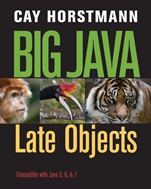
Big Java: Late Objects
ISBN 9781118087886
Autor: Cay S. Horstmann
Wydawca: Wiley
Dostępność: 3-6 tygodni
Cena: 1 149,75 zł
Przed złożeniem zamówienia prosimy o kontakt mailowy celem potwierdzenia ceny.
ISBN13: |
9781118087886 |
ISBN10: |
1118087887 |
Autor: |
Cay S. Horstmann |
Oprawa: |
Paperback |
Rok Wydania: |
2012-02-20 |
Numer Wydania: |
1st Edition |
Ilość stron: |
1056 |
Wymiary: |
254x210 |
Tematy: |
UP |
BIG JAVA + LATE OBJECTS = A GREAT INTRODUCTION TO JAVA PROGRAMMING
Nobody supports your desire to teach students good programming skills like Cay Horstmann. Active in both the classroom and the software industry, Horstmann knows that meticulous coding not shortcuts is the base upon which great programmers are made. Using an innovative visual design that leads students step–by–step through the intricacies of Java programming, Big Java: Late Objects instills confidence in beginning programmers, and confidence leads to success.
Key Features
This new text provides the Horstmann approach for an objects–late, one, two or three term comprehensive introduction to Java. The text includes a full range of topics including GUI, Data Structures, Web Applications, and many others. Presents fundamentals first:Big Java: Late Objects takes a traditional path through the material, stressing control structures, methods, and procedural decomposition before object–oriented programming. Objects are used when appropriate in the early chapters. Students start designing and implementing their own classes in Chapter 8.
A focus on problem solving:The text includes practical, step–by–step illustrations of techniques that can help students devise and evaluate solutions to programming problems. Introduced within the chapters where they are most relevant, these strategies include:
Algorithm design (using pseudocode) Hand–tracing Storyboards Stepwise refinementVideo Examples feature Cay Horstmann explaining the steps he is taking and showing his work as he solves a programming problem.
Practice makes perfect:Before students begin to implement nontrivial programs, they need to have the confidence to succeed. Each section concludes with self–check questions and Practice It pointers that suggest exercises to try. A wealth of programming assignments, plus online practice opportunities such as guided lab exercises, code completion questions, and skill–oriented multiple–choice questions provide ample opportunity for student practice.
A visual approach motivates the reader and eases navigationPhotographs present visual analogies that explain the nature and behavior of computer concepts. Step–by–step figures illustrate complex programming operations. Syntax boxes and example tables clearly present a variety of typical and special cases in a compact format. Visuals can be browsed by students prior to focusing on the textual material.
Guidance and worked examples help students succeedBeginning programmers often ask "How do I start?" and "Now what do I do?" While an activity as complex as programming cannot be reduced to cookbook–style instructions, step–by–step guidance is immensely helpful for building confidence and providing an outline for tasks at hand. The book contains a large number of How To guides for common tasks, together with additional worked examples and videos on the web.
Preface v
Special Features xxvi
Chapter 1 INTRODUCTION 1
1.1 Computer Programs 2
1.2 The Anatomy of a Computer 3
1.3 The Java Programming Language 5
1.4 Becoming Familiar with Your Programming Environment 8
1.5 Analyzing Your First Program 12
1.6 Errors 15
1.7 Problem Solving: Algorithm Design 16
Chapter 2 FUNDAMENTAL DATA TYPES 29
2.1 Variables 30
2.2 Arithmetic 41
2.3 Input and Output 48
2.4 Problem Solving: First Do It By Hand 57
2.5 Strings 59
Chapter 3 DECISIONS 81
3.1 The if Statement 82
3.2 Comparing Numbers and Strings 88
3.3 Multiple Alternatives 96
3.4 Nested Branches 100
3.5 Problem Solving: Flowcharts 105
3.6 Problem Solving: Test Cases 108
3.7 Boolean Variables and Operators 111
3.8 Application: Input Validation 116
Chapter 4 LOOPS 139
4.1 The while Loop 140
4.2 Problem Solving: Hand–Tracing 147
4.3 The for Loop 150
4.4 The do Loop 156
4.5 Application: Processing Sentinel Values 158
4.6 Problem Solving: Storyboards 162
4.7 Common Loop algorithms 165
4.8 Nested Loops 172
4.9 Application: Random Numbers and Simulations 176
Chapter 5 METHODS 201
5.1 Methods as Black Boxes 202
5.2 Implementing Methods 204
5.3 Parameter Passing 207
5.4 Return Values 210
5.5 Methods Without Return Values 214
5.6 Problem Solving: Reusable Methods 215
5.7 Problem Solving: Stepwise Refinement 218
5.8 Variable Scope 225
5.9 Recursive Methods (Optional) 228
Chapter 6 ARRAYS AND ARRAY LISTS 249
6.1 Arrays 250
6.2 The Enhanced for Loop 257
6.3 Common Array Algorithms 258
6.4 Using Arrays with Methods 268
6.5 Problem Solving: Adapting Algorithms 272
6.6 Problem Solving: Discovering Algorithms by Manipulating Physical Objects 279
6.7 Two–Dimensional Arrays 282
6.8 Array Lists 289
Chapter 7 INPUT/OUTPUT AND EXCEPTION HANDLING 317
7.1 Reading and Writing Text files 318
7.2 Text Input and Output 323
7.3 Command Line Arguments 330
7.4 Exception Handling 337
7.5 Application: Handling Input Errors 347
Chapter 8 OBJECTS AND CLASSES 361
8.1 Object–Oriented Programming 362
8.2 Implementing a Simple Class 364
8.3 Specifying the Public Interface of a Class 367
8.4 Designing the Data representation 371
8.5 Implementing Instance Methods 372
8.6 Constructors 375
8.7 Testing a Class 380
8.8 Problem Solving: Tracing Objects 386
8.9 Problem Solving: Patterns for Object Data 388
8.10 Object References 395
8.11 Static Variables and Methods 400
Chapter 9 INHERITANCE AND INTERFACES 415
9.1 Inheritance Hierarchies 416
9.2 Implementing Subclasses 420
9.3 Overriding Methods 424
9.4 Polymorphism 430
9.5 Object: The Cosmic Superclass 441
9.6 Interface Types 448
Chapter 10 GRAPHICAL USER INTERFACES 465
10.1 Frame Windows 466
10.2 Events and Event Handling 470
10.3 Processing Text Input 481
10.4 Creating Drawings 487
Chapter 11 ADVANCED USER INTERFACES 507
11.1 Layout Management 508
11.2 Choices 510
11.3 Menus 521
11.4 Exploring the Swing Documentation 528
11.5 Using Timer events for Animations 533
11.6 Mouse Events 536
Chapter 12 OBJECT–ORIENTED DESIGN 549
12.1 Classes and Their Responsibilities 550
12.2 Relationships Between Classes 554
12.3 Application: Printing an Invoice 562
12.4 Packages 574
Chapter 13 RECURSION 585
13.1 Triangle Numbers Revisited 586
13.2 Problem Solving: Thinking Recursively 590
13.3 Recursive Helper Methods 594
13.4 The Efficiency of Recursion 596
13.5 Permutations 601
13.6 Mutual Recursion 606
13.7 Backtracking 612
Chapter 14 SORTING AND SEARCHING 627
14.1 Selection Sort 628
14.2 Profiling the Selection Sort Algorithm 631
14.3 Analyzing the Performance of the Selection Sort Algorithm 634
14.4 Merge Sort 639
14.5 Analyzing the Merge Sort Algorithm 642
14.6 Searching 646
14.7 Problem Solving: Estimating the Running Time of an Algorithm 651
14.8 Sorting and Searching in the Java Library 656
Chapter 15 THE JAVA COLLECTIONS FRAMEWORK 669
15.1 An Overview of the Collections Framework 670
15.2 Linked Lists 672
15.3 Sets 679
15.4 Maps 684
15.5 Stacks, Queues, and Priority Queues 690
15.6 Stack and Queue Applications 693
Chapter 16 BASIC DATA STRUCTURES 713
16.1 Implementing Linked Lists 714
16.2 Implementing Array Lists 728
16.3 Implementing Stacks and Queues 733
16.4 Implementing a Hash Table 739
Chapter 17 TREE STRUCTURES 759
17.1 Basic Tree Concepts 760
17.2 Binary Trees 764
17.3 Binary Search Trees 769
17.4 Tree Traversal 778
17.5 Red–Black Trees 784
17.6 Heaps 791
17.7 The Heapsort Algorithm 802
Chapter 18 GENERIC CLASSES 817
18.1 Generic Classes and Type Parameters 818
18.2 Implementing Generic Types 819
18.3 Generic Methods 823
18.4 Constraining Type Parameters 825
18.5 Type Erasure 829
Chapter 18 STREAMS AND BINARY INPUT/OUTPUT 839
19.1 Readers, Writers, and Streams 840
19.2 Binary Input and Output 841
19.3 Random Access 845
19.4 Object Streams 851
Chapter 20 MULTITHREADING (WEB ONLY)
20.1 Running Threads
20.2 Terminating Threads
20.3 Race Conditions
20.4 Synchronizing Object Access
20.5 Avoiding Deadlocks
20.6 Application: Algorithm Animation
Chapter 21 INTERNET NETWORKING (WEB ONLY)
21.1 The Internet Protocol
21.2 Application Level Protocols
21.3 A Client Program
21.4 A Server Program
21.5 URL Connections
Chapter 22 RELATIONAL DATABASES (WEB ONLY)
22.1 Organizing Database Information
22.2 Queries
22.3 Installing a Database
22.4 Database Programming in Java
22.5 Application: Entering an Invoice
Chapter 23 XML (WEB ONLY)
23.1 XML Tags and Documents
23.2 Parsing XML Documents
23.3 Creating XML Documents
23.4 Validating XML Documents
Chapter 24 WEB APPLICATIONS (WEB ONLY)
24.1 The Architecture of a Web Application
24.2 The Architecture of a JSF Application
24.3 Javabeans Components
24.4 Navigation Between Pages
24.5 JSF Components
24.6 A Three–Tier Application
APPENDICES
APPENDIX A THE BASIC LATIN AND LATIN–1 SUBSETS OF UNICODE 861
APPENDIX B JAVA OPERATOR SUMMARY 865
APPENDIX C JAVA RESERVED WORD SUMMARY 867
APPENDIX D THE JAVA LIBRARY 869
APPENDIX E JAVA SYNTAX SUMMARY 913
APPENDIX F HTML SUMMARY 925
APPENDIX G TOOL SUMMARY 931
APPENDIX H JAVADOC SUMMARY 933
APPENDIX I NUMBER SYSTEMS 935
APPENDIX J BIT AND SHIFT OPERATIONS 941
APPENDIX K UML SUMMARY 943
APPENDIX L JAVA LANGUAGE CODING GUIDELINES 947
GLOSSARY 955
INDEX 969
CREDITS 1011
Cay S. Horstmann is a Professor of Computer Science in the Department of Computer Science at San Jose State University. He is an experienced professional programmer and was Vice President and Chief Technology Officer for Preview Systems, Inc. He is also a consultant for major corporations, universities, and organizations on Java, C++, Windows, and Internet programming. Horstmann is the author of many successful professional and academic books, including Big C++, C++ for Everyone, Big Java, and Big Java: Late Objects all with John Wiley & Sons, Inc.
Koszyk
Książek w koszyku: 0 szt.
Wartość zakupów: 0,00 zł
Informacje


Kontakt
Gambit
Centrum Oprogramowania
i Szkoleń Sp. z o.o.
Al. Pokoju 29b/22-24
31-564 Kraków
Siedziba Księgarni
ul. Kordylewskiego 1
31-542 Kraków
+48 12 410 5991
+48 12 410 5987
+48 12 410 5989
Subskrypcje
Administratorem danych osobowych jest firma Gambit COiS Sp. z o.o. Na podany adres będzie wysyłany wyłącznie biuletyn informacyjny.
Autoryzacja płatności

Informacje na temat autoryzacji płatności poprzez PayU.

© Copyright 2012: GAMBIT COiS Sp. z o.o. Wszelkie prawa zastrzeżone.
Projekt i wykonanie: Alchemia Studio Reklamy