


Wydawcy
Katalog tematyczny
- Archeologia (109)
- Ekonomia, finanse, business (13704)
- Filozofia (1445)
- Historia (3040)
- Języki i językoznawstwo (2356)
- Lifestyle, hobby i rozrywka (475)
- Medycyna (9704)
- Nauki humanistyczne (4)
- Nauki o Ziemi i środowisku (2638)
- Nauki ścisłe (20412)
- Astronomia (294)
- Biologia (5119)
- Chemia (6540)
- Fizyka (3309)
- Matematyka (4574)
- Algebra (171)
- Analiza matematyczna (902)
- Filozofia matematyki (1)
- Geometria (237)
- Historia matematyki (57)
- Kombinatoryka, teoria grafów (67)
- Matematyka dyskretna (35)
- Matematyka stosowana (555)
- Optymalizacja (104)
- Podstawy matematyki (129)
- Statystyka, prawdopodobieństwo (296)
- Teoria grup (63)
- Teoria liczb (77)
- Topologia (66)
- Nauki ścisłe, ogólnie (503)
- Nauki społeczne (8486)
- Nauki techniczne (13450)
- Prawo (1696)
- Publikacje informacyjne i interdyscyplinarne (1288)
- Religia i wierzenia (917)
- Technika komputerowa (4067)
- Zdrowie, relacje międzyludzkie i rozwój osobisty (657)





Informacje szczegółowe o książce
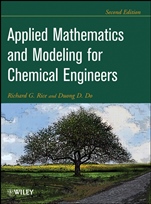
Applied Mathematics And Modeling For Chemical Engineers
ISBN 9781118024720
Autor: Richard G. Rice, Duong D. Do
Wydawca: Wiley
Dostępność: 3-6 tygodni
Cena: 656,25 zł
Przed złożeniem zamówienia prosimy o kontakt mailowy celem potwierdzenia ceny.
ISBN13: |
9781118024720 |
ISBN10: |
1118024729 |
Autor: |
Richard G. Rice, Duong D. Do |
Oprawa: |
Hardback |
Rok Wydania: |
2012-11-02 |
Numer Wydania: |
2nd Edition |
Ilość stron: |
396 |
Wymiary: |
281x223 |
Tematy: |
PB |
Enables chemical engineers to use mathematics to solve common on-the-job problems With its clear explanations, examples, and problem sets, Applied Mathematics and Modeling for Chemical Engineers has enabled thousands of chemical engineers to apply mathematical principles to successfully solve practical problems. The book introduces traditional techniques to solve ordinary differential equations as well as analytical methods to deal with important classes of finite-difference equations. It then explores techniques for solving partial differential equations from classical methods to finite-transforms, culminating with??numerical methods??including orthogonal collocation. This Second Edition demonstrates how classical mathematics solves a broad range of new applications that have arisen since the publication of the acclaimed first edition. Readers will find new materials and problems dealing with such topics as: Brain implant drug delivery Carbon dioxide storage Chemical reactions in nanotubes Dissolution of pills and pharmaceutical capsules Honeycomb reactors used in catalytic converters New models of physical phenomena such as bubble coalescence Like the first edition, this Second Edition provides plenty of worked examples that explain each step on the way to finding a problem's solution. Homework problems at the end of each chapter are designed to encourage readers to more deeply examine the underlying logic of the mathematical techniques used to arrive at the answers. Readers can refer to the references, also at the end of each chapter, to explore individual topics in greater depth. Finally, the text's appendices provide additional information on numerical methods for solving algebraic equations as well as a detailed explanation of numerical integration algorithms. Applied Mathematics and Modeling for Chemical Engineers is recommended for all students in chemical engineering as well as professional chemical engineers who want to improve their ability to use mathematics to solve common on-the-job problems.
Preface to the Second Edition xi Part I. 1 1. Formulation of Physicochemical Problems 3 1.1 Introduction 3 1.2 Illustration of the Formulation Process (Cooling of Fluids) 3 1.3 Combining Rate and Equilibrium Concepts (Packed Bed Adsorber) 7 1.4 Boundary Conditions and Sign Conventions 8 1.5 Models with Many Variables: Vectors and Matrices 10 1.6 Matrix Definition 10 1.7 Types of Matrices 11 1.8 Matrix Algebra 12 1.9 Useful Row Operations 13 1.10 Direct Elimination Methods 14 1.11 Iterative Methods 18 1.12 Summary of the Model Building Process 19 1.13 Model Hierarchy and its Importance in Analysis 19 Problems 25 2. Solution Techniques for Models Yielding Ordinary Differential Equations 31 2.1 Geometric Basis and Functionality 31 2.2 Classification of ODE 32 2.3 First–Order Equations 32 2.4 Solution Methods for Second–Order Nonlinear Equations 37 2.5 Linear Equations of Higher Order 42 2.6 Coupled Simultaneous ODE 55 2.7 Eigenproblems 59 2.8 Coupled Linear Differential Equations 59 2.9 Summary of Solution Methods for ODE 60 Problems 60 References 73 3. Series Solution Methods and Special Functions 75 3.1 Introduction to Series Methods 75 3.2 Properties of Infinite Series 76 3.3 Method of Frobenius 77 3.4 Summary of the Frobenius Method 85 3.5 Special Functions 86 Problems 93 References 95 4. Integral Functions 97 4.1 Introduction 97 4.2 The Error Function 97 4.3 The Gamma and Beta Functions 98 4.4 The Elliptic Integrals 99 4.5 The Exponential and Trigonometric Integrals 101 Problems 102 References 104 5. Staged–Process Models: The Calculus of Finite Differences 105 5.1 Introduction 105 5.2 Solution Methods for Linear Finite Difference Equations 106 5.3 Particular Solution Methods 109 5.4 Nonlinear Equations (Riccati Equations) 111 Problems 112 References 115 6. Approximate Solution Methods for ODE: Perturbation Methods 117 6.1 Perturbation Methods 117 6.2 The Basic Concepts 120 6.3 The Method of Matched Asymptotic Expansion 122 6.4 Matched Asymptotic Expansions for Coupled Equations 125 Problems 128 References 136 Part II. 137 7. Numerical Solution Methods (Initial Value Problems) 139 7.1 Introduction 139 7.2 Type of Method 142 7.3 Stability 142 7.4 Stiffness 147 7.5 Interpolation and Quadrature 149 7.6 Explicit Integration Methods 150 7.7 Implicit Integration Methods 152 7.8 Predictor–Corrector Methods and Runge–Kutta Methods 152 7.9 Runge–Kutta Methods 153 7.10 Extrapolation 155 7.11 Step Size Control 155 7.12 Higher Order Integration Methods 156 Problems 156 References 159 8. Approximate Methods for Boundary Value Problems: Weighted Residuals 161 8.1 The Method of Weighted Residuals 161 8.2 Jacobi Polynomials 179 8.3 Lagrange Interpolation Polynomials 172 8.4 Orthogonal Collocation Method 172 8.5 Linear Boundary Value Problem: Dirichlet Boundary Condition 175 8.6 Linear Boundary Value Problem: Robin Boundary Condition 177 8.7 Nonlinear Boundary Value Problem: Dirichlet Boundary Condition 179 8.8 One–Point Collocation 181 8.9 Summary of Collocation Methods 182 8.10 Concluding Remarks 183 Problems 184 References 192 9. Introduction to Complex Variables and Laplace Transforms 193 9.1 Introduction 193 9.2 Elements of Complex Variables 193 9.3 Elementary Functions of Complex Variables 194 9.4 Multivalued Functions 195 9.5 Continuity Properties for Complex Variables: Analyticity 196 9.6 Integration: Cauchy’s Theorem 198 9.7 Cauchy’s Theory of Residues 201 9.8 Inversion of Laplace Transforms by Contour Integration 202 9.9 Laplace Transformations: Building Blocks 204 9.10 Practical Inversion Methods 209 9.11 Applications of Laplace Transforms for Solutions of ODE 211 9.12 Inversion Theory for Multivalued Functions: the Second Bromwich Path 215 9.13 Numerical Inversion Techniques 218 Problems 221 References 225 10. Solution Techniques for Models Producing PDEs 227 10.1 Introduction 227 10.2 Particular Solutions for PDES 231 10.3 Combination of Variables Method 233 10.4 Separation of Variables Method 238 10.5 Orthogonal Functions and Sturm–Liouville Conditions 241 10.6 Inhomogeneous Equations 245 10.7 Applications of Laplace Transforms for Solutions of PDES 248 Problems 254 References 271 11. Transform Methods for Linear PDEs 273 11.1 Introduction 273 11.2 Transforms in Finite Domain: Sturm–Liouville Transforms 273 11.3 Generalized Sturm–Liouville Integral Transforms 289 Problems 297 References 301 12. Approximate and Numerical Solution Methods for PDEs 303 12.1 Polynomial Approximation 303 12.2 Singular Perturbation 310 12.3 Finite Difference 315 12.4 Orthogonal Collocation for Solving PDEs 324 12.5 Orthogonal Collocation on Finite Elements 330 Problems 335 References 342 Appendix A. Review of Methods for Nonlinear Algebraic Equations 343 Appendix B. Derivation of the Fourier–Mellin Inversion Theorem 351 Appendix C. Table of Laplace Transforms 357 Appendix D. Numerical Integration 363 References 372 Appendix E. Nomenclature 373 Postface 377 Index 379
RICHARD G. RICE, PhD, is Emeritus Professor at Louisiana State University and widely published in the areas of chemical separations and two-phase flow. DUONG D. DO, PhD, is University Professor at the University of Queensland, Australia, and is well-known in the area of adsorption science.
“Interested readers should have at least some knowledge on mathematical principles suitable for solving chemical questions. Otherwise they would hardly find the appropriate part within this very useful book.” ( Materials and Corrosion , 1 August 2013)
Koszyk
Książek w koszyku: 0 szt.
Wartość zakupów: 0,00 zł
Informacje


Kontakt
Gambit
Centrum Oprogramowania
i Szkoleń Sp. z o.o.
Al. Pokoju 29b/22-24
31-564 Kraków
Siedziba Księgarni
ul. Kordylewskiego 1
31-542 Kraków
+48 12 410 5991
+48 12 410 5987
+48 12 410 5989
Subskrypcje
Administratorem danych osobowych jest firma Gambit COiS Sp. z o.o. Na podany adres będzie wysyłany wyłącznie biuletyn informacyjny.
Autoryzacja płatności

Informacje na temat autoryzacji płatności poprzez PayU.

© Copyright 2012: GAMBIT COiS Sp. z o.o. Wszelkie prawa zastrzeżone.
Projekt i wykonanie: Alchemia Studio Reklamy