


Wydawcy
Katalog tematyczny
- Archeologia (109)
- Ekonomia, finanse, business (13704)
- Filozofia (1445)
- Historia (3040)
- Języki i językoznawstwo (2356)
- Lifestyle, hobby i rozrywka (475)
- Medycyna (9704)
- Nauki humanistyczne (4)
- Nauki o Ziemi i środowisku (2638)
- Nauki ścisłe (20412)
- Nauki społeczne (8486)
- Nauki techniczne (13450)
- Prawo (1696)
- Publikacje informacyjne i interdyscyplinarne (1288)
- Religia i wierzenia (917)
- Technika komputerowa (4067)
- Bazy danych (75)
- Bezpieczeństwo komputerowe (454)
- Certyfikacja komputerowa (1)
- Grafika i media cyfrowe (32)
- Informatyka (779)
- Komputery, ogólnie (74)
- Programowanie (351)
- Programy komercyjne (49)
- Sieci komputerowe (350)
- Sprzęt komputerowy (4)
- Systemy operacyjne (32)
- Technika cyfrowa na co dzień (7)
- Zdrowie, relacje międzyludzkie i rozwój osobisty (657)





Informacje szczegółowe o książce
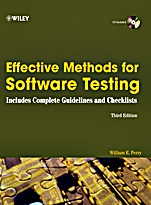
Effective Methods for Software Testing: Includes Complete Guidelines, Checklists, and Templates
ISBN 9780764598371
Autor: William E. Perry
Wydawca: Wiley
Dostępność: 3-6 tygodni
Cena: 341,25 zł
Przed złożeniem zamówienia prosimy o kontakt mailowy celem potwierdzenia ceny.
ISBN13: |
9780764598371 |
ISBN10: |
0764598376 |
Autor: |
William E. Perry |
Oprawa: |
Hardback |
Rok Wydania: |
2006-05-12 |
Numer Wydania: |
3rd Edition |
Ilość stron: |
1008 |
Wymiary: |
239x194 |
Tematy: |
UP |
Stop looking for needles in haystacks.
There′s a better way.
The Sarbanes–Oxley Act has made quality testing crucial to the software development process. William Perry′s Quality Assurance Institute has developed a proven set of guidelines and checklists to help you filter out defects and produce software that works effectively, saving you time, money, and hassle. The tools are provided on the CD–ROM, and this comprehensive manual shows you how to use them.
Instead of a generalized what–to–do format, you′ll find clear how–to directions for building an effective testing system and procedure. You′ll learn to establish baseline assessments, create an effective testing environment, set up a seven–step testing process, and make it serve your needs.Use self–assessment tools to evaluate your organization′s current level of performanceDefine the software testing system your organization needsSet up a plan for getting from where you are to where you want to beDevelop a testing process, select tools, and build the competency of your testersDiscover how to adapt your testing to the developmental methodology used to build the softwareIncorporate agile methods into the testing processEnsure the security of your testing procedures
What′s on the CD–ROM
The CD contains work papers and quality control checklists your organization needs to implement an effective software testing process.
Spis treści:
Introduction.
Part I: Assessing Testing Capabilities and Competencies.
Chapter 1: Assessing Capabilities, Staff Competency, and User Satisfaction.
The Three–Step Process to Becoming a World–Class Testing Organization.
Step 1: Define a World–Class Software Testing Model.
Step 2: Develop Baselines for Your Organization.
Assessment 1: Assessing the Test
Environment.
Assessment 2: Assessing the Capabilities of Your Existing.Test Processes.
Assessment 3: Assessing the Competency of Your Testers.
Step 3: Develop an Improvement Plan.
Summary.
Part II: Building a Software Testing Environment.
Chapter 2: Creating an Environment Supportive of Software Testing.
Chapter 3: Building the Software Testing Process.
Software Testing Guidelines.
Guideline #1: Testing Should Reduce Software Development.
Guideline #2: Testing Should Be Performed Effectively.
Guideline #3: Testing Should Uncover Defects.
Guideline #4: Testing Should Be Performed Using Business Logic.
Guideline #5: Testing Should Occur Throughout the Development Life Cycle.
Guideline #6: Testing Should Test Both Function and Structure.
Chapter 4: Selecting and Installing Software Testing Tools.
Chapter 5: Building Software Tester Competency.
Part III: The Seven–Step Testing Process.
Chapter 6: Overview of the Software Testing Process.
Chapter 7: Step 1: Organizing for Testing.
Task 1: Appoint the Test Manager.
Task 2: Define the Scope of Testing.
Task 3: Appoint the Test Team.
Task 4: Verify the Development Documentation.
Task 5: Validate the Test Estimate and Project Status.
Chapter 8: Step 2: Developing the Test Plan.
Task 1: Profile the Software Project.
Task 2: Understand the Project Risks.
Task 3: Select a Testing Technique.
Task 4: Plan Unit Testing and Analysis.
Task 5: Build the Test Plan.
Task 6: Inspect the Test Plan.
Chapter 9: Step 3: Verification Testing.
Task 1: Test During the Requirements Phase.
Task 2: Test During the Design Phase.
Task 3: Test During the Programming Phase.
Chapter 10: Step 4: Validation Testing.
Task 1: Build the Test Data.
Task 2: Execute Tests.
Task 3: Record Test Results.
Chapter 11: Step 5: Analyzing and Reporting
Test Results.
Task 1: Report Software Status.
Task 2: Report Interim Test Results.
Task 3: Report Final Test Results.
Chapter 12: Step 6: Acceptance and Operational Testing.
Task 1: Acceptance Testing.
Task 2: Pre–Operational Testing.
Task 3: Post–Operational Testing.
Chapter 13: Step 7: Post–Implementation Analysis.
Task 1: Establish Assessment Objectives.
Task 2: Identify What to Measure.
Task 3: Assign Measurement Responsibility.
Task 4: Select Evaluation Approach.
Task 5: Identify Needed Facts.
Task 6: Collect Evaluation Data.
Task 7: Assess the Effectiveness of Testing.
Part IV: Incorporating Specialized Testing Responsibilities.
Chapter 14: Software Development Methodologies.
Chapter 15: Testing Client/Server Systems.
Task 1: Assess Readiness.
Task 2: Assess Key Components.
Task 3: Assess Client Needs.
Chapter 16: Rapid Application Development Testing.
Task 1: Determine Appropriateness of RAD.
Task 2: Test Planning Iterations.
Task 3: Test Subsequent Planning Iterations.
Task 4: Test the Final Planning Iteration.
Chapter 17: Testing Internal Controls.
Task 1: Understand the System Being Tested.
Task 2: Identify Risks.
Task 3: Review Application Controls.
Task 4: Test Application Controls.
Task 5: Document Control Strengths and Weaknesses.
Chapter 18: Testing COTS and Contracted Software.
Task 1: Test Business Fit.
Step 1: Testing Needs Specification.
Step 2: Testing CSFs.
Task 2: Test Operational Fit.
Step 1: Test Compatibility.
Step 2: Integrate the Software into Existing Work Flows.
Step 3: Demonstrate the Software in Action.
Task 3: Test People Fit.
Task 4: Acceptance–Test the Software Process.
Step 1: Create Functional Test Conditions.
Step 2: Create Structural Test Conditions.
Chapter 19: Testing in a Multiplatform Environment.
Task 1: Define Platform Configuration Concerns.
Task 2: List Needed Platform Configurations.
Task 3: Assess Test Room Configurations.
Task 4: List Structural Components Affected by the Platform(s).
Task 5: List Interfaces the Platform Affects.
Task 6: Execute the Tests.
Chapter 20: Testing Software System Security.
Task 1: Establish a Security Baseline.
Chapter 21: Testing a Data Warehouse.
Task 1: Measure the Magnitude of Data Warehouse Concerns.
Task 2: Identify Data Warehouse Activity Processes to Test.
Chapter 22: Testing Web–Based Systems.
Task 1: Select Web–Based Risks to Include in the Test Plan.
Task 2: Select Web–Based Tests.
Task 3: Select Web–Based Test Tools.
Task 4: Test Web–Based Systems.
Part V: Building Agility into the Testing Process.
Chapter 23: Using Agile Methods to Improve Software Testing.
Chapter 24: Building Agility into the Testing Process.
Step 1: Measure Software Process Variability.
Step 2: Maximize Best Practices.
Step 3: Build on Strength, Minimize Weakness.
Step 4: Identify and Address Improvement Barriers.
Step 5: Identify and Address Cultural and Communication.
Management Cultures.
Culture 1: Manage People.
Culture 2: Manage by Process.
Culture 3: Manage Competencies.
Culture 4: Manage by Fact.
Culture 5: Manage Business Innovation.
Step 6: Identify Implementable Improvements.
Step 7: Develop and Execute an Implementation Plan.
Index.
Nota biograficzna:
WILLIAM E. PERRY is the founder and executive director of the Quality Assurance Institute, which sponsors professional certification for Quality Assurance, Software Testing, Software Project Leaders, and Business Analyst Professionals. He is a former examiner for the Malcolm Baldrige National Quality Award and has served on standards committees for several disciplines.
Okł
adka tylna:
Stop looking for needles in haystacks.
There′s a better way.
The Sarbanes–Oxley Act has made quality testing crucial to the software development process. William Perry′s Quality Assurance Institute has developed a proven set of guidelines and checklists to help you filter out defects and produce software that works effectively, saving you time, money, and hassle. The tools are provided on the CD–ROM, and this comprehensive manual shows you how to use them.
Instead of a generalized what–to–do format, you′ll find clear how–to directions for building an effective testing system and procedure. You′ll learn to establish baseline assessments, create an effective testing environment, set up a seven–step testing process, and make it serve your needs.Use self–assessment tools to evaluate your organization′s current level of performanceDefine the software testing system your organization needsSet up a plan for getting from where you are to where you want to beDevelop a testing process, select tools, and build the competency of your testersDiscover how to adapt your testing to the developmental methodology used to build the softwareIncorporate agile methods into the testing processEnsure the security of your testing procedures
What′s on the CD–ROM
The CD contains work papers and quality control checklists your organization needs to implement an effective software testing process.
Koszyk
Książek w koszyku: 0 szt.
Wartość zakupów: 0,00 zł
Informacje


Kontakt
Gambit
Centrum Oprogramowania
i Szkoleń Sp. z o.o.
Al. Pokoju 29b/22-24
31-564 Kraków
Siedziba Księgarni
ul. Kordylewskiego 1
31-542 Kraków
+48 12 410 5991
+48 12 410 5987
+48 12 410 5989
Subskrypcje
Administratorem danych osobowych jest firma Gambit COiS Sp. z o.o. Na podany adres będzie wysyłany wyłącznie biuletyn informacyjny.
Autoryzacja płatności

Informacje na temat autoryzacji płatności poprzez PayU.

© Copyright 2012: GAMBIT COiS Sp. z o.o. Wszelkie prawa zastrzeżone.
Projekt i wykonanie: Alchemia Studio Reklamy