


Wydawcy
Katalog tematyczny
- Archeologia (109)
- Ekonomia, finanse, business (13704)
- Filozofia (1445)
- Historia (3040)
- Języki i językoznawstwo (2356)
- Lifestyle, hobby i rozrywka (475)
- Medycyna (9704)
- Nauki humanistyczne (4)
- Nauki o Ziemi i środowisku (2638)
- Nauki ścisłe (20412)
- Nauki społeczne (8486)
- Nauki techniczne (13450)
- Prawo (1696)
- Publikacje informacyjne i interdyscyplinarne (1288)
- Religia i wierzenia (917)
- Technika komputerowa (4067)
- Bazy danych (75)
- Bezpieczeństwo komputerowe (454)
- Certyfikacja komputerowa (1)
- Grafika i media cyfrowe (32)
- Informatyka (779)
- Komputery, ogólnie (74)
- Programowanie (351)
- Programy komercyjne (49)
- Sieci komputerowe (350)
- Sprzęt komputerowy (4)
- Systemy operacyjne (32)
- Technika cyfrowa na co dzień (7)
- Zdrowie, relacje międzyludzkie i rozwój osobisty (657)





Informacje szczegółowe o książce
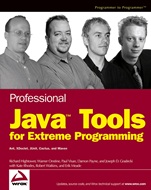
Professional JavaTM Tools for Extreme Programming: Ant, XDoclet, JUnit, Cactus, and Maven
ISBN 9780764556173
Autor: Richard Hightower, Warner Onstine, Paul Visan, Damon Payne, Joseph D. Gradecki, Kate Rhodes, Robert
Wydawca: Wiley
Dostępność: 3-6 tygodni
Cena: 246,75 zł
Przed złożeniem zamówienia prosimy o kontakt mailowy celem potwierdzenia ceny.
ISBN13: |
9780764556173 |
ISBN10: |
0764556177 |
Autor: |
Richard Hightower, Warner Onstine, Paul Visan, Damon Payne, Joseph D. Gradecki, Kate Rhodes, Robert |
Oprawa: |
Paperback |
Rok Wydania: |
2004-04-23 |
Ilość stron: |
768 |
Wymiary: |
234x191 |
Tematy: |
UP |
The Extreme Programming (XP) methodology enables you to build and test enterprise systems quickly without sacrificing quality. In the last few years, open source developers have created or significantly improved a host of Java XP tools, from XDoclet, Maven, AntHill, and Eclipse to Ant, JUnit, and Cactus. This practical, code–intensive guide shows you how to put these tools to work–and capitalize on the benefits of Extreme Programming.
Using an example pet store application, our expert Java developers demonstrate how to harness the latest versions of Ant and XDoclet for automated building and continuous integration. They then explain how to automate the testing process using JUnit, Cactus, and other tools, and to enhance project management and continuous integration through Maven and AntHill. Finally, they show you how to work with XP tools in the new Eclipse IDE.
Complete with real–world advice on how to implement the principles and practices of effective developers, this book delivers everything you need to harness the power of Extreme Programming in your own projects.
What you will learn from this bookHow to automate the building of J2EETM apps and components with Ant and XDocletTechniques for automating Java testing using JUnitProcedures for automating servlet, JSP, and other J2EE testing using CactusWays to automate Swing testing with Jemmy, JFCUnit, and AbbotHow to manage projects using MavenTechniques for automating continuous integration with AntHill and Cruise ControlHow to harness plugins for JUnit, Cactus, and Ant in the Eclipse IDEWays to implement Extreme Programming best practices
Who this book is for
This book is for enterprise Java developers who have a general familiarity with the XP methodology and want to put leading Java XP tools to work in the development process.
Wrox Professional guides are planned and written by wor
king programmers to meet the real–world needs of programmers, developers, and IT professionals. Focused and relevant, they address the issues technology professionals face every day. They provide examples, practical solutions, and expert education in new technologies, all designed to help programmers do a better job.
Spis treści:
Introduction.
Part I: Key Concepts.
Chapter 1: Introduction to Extreme Programming.
Chapter 2: J2EE Deployment Concepts.
Chapter 3: Storing and Managing Code with CVS.
Part II: Automated Building and Continuous Integration.
Chapter 4: Ant Primer.
Chapter 5: Building Java Applications with Ant.
Chapter 6: Building J2EE Applications with Ant.
Chapter 7: XDoclet Primer.
Chapter 8: Building J2EE Web Components with Ant and XDoclet.
Chapter 9: Building EJBs with Ant and XDoclet.
Chapter 10: Building Struts Apps with Ant and XDoclet.
Chapter 11: Creating Custom Ant Tasks.
Chapter 12: Creating XDoclet Custom Tags and Templates.
Part III: Automated Java Testing.
Chapter 13: Unit Testing with JUnit.
Chapter 14: Load Testing with JunitPerf.
Chapter 15: Defect Tracking with Bugzilla.
Part IV: Automated J2EE Testing.
Chapter 16: Functional Testing with HttpUnit.
Chapter 17: Performance Testing with Jmeter.
Chapter 18: Cactus Primer.
Chapter 19: Testing Servlets and Filters with Cactus.
Chapter 20: JspTestCases and Testing Custom Tags with Cactus.
Chapter 21: Testing EJBs with Cactus.
Chapter 22: Code Coverage with jcoverage.
Part V: Automated Swing Testing.
Chapter 23: Swing Testing with Jemmy.
Chapter 24: Swing Testing with jfcUnit.
Chapter 25: Swing Testing with Abbot.
Part VI: Continuous Integration, Project Management, and IDEs.
Chapter 26: Managing Projects with Maven.
Chapter 27: Automating Continuous Integration with CruiseControl.
Chapter 28: Automating Continuous Integration with AntHill.
Part VII: API Tag Refer
ence.
Chapter 29: Ant Tag Reference.
Chapter 30: Ant API Reference.
Chapter 31: JUnit API Reference.
Chapter 32: Cactus API Reference.
Chapter 33: HttpUnit API Reference.
Chapter 34: JUnitPerf API Reference.
Part VIII: Appendix.
Appendix A: Example Applications Used in This Book.
Index.
Nota biograficzna:
Richard Hightower is Chief Mentor/Consultant for ArcMind, a full–service software development company. Rick is a software engineer by training who specializes in software development tools and processes, and developing enterprise applications using J2EE, XML, UML, JDBC, SQL, and open source technologies. Formerly he was the Senior Software Engineer for Java Architecture at Intel’s Enterprise Architecture Lab. Rick is the co–author of Professional Jakarta Struts, and he contributed two chapters to the book Mastering Tomcat.
Rick has spoken at a variety of industry conferences and events, including JavaOne, TheServerSide.com Software Symposium JDJEdge, WebServicesEdge, and the Complete Programmer Network software symposiums.
Warner Onstine is a founder and CTO of Interface Guru, a leading Web Usability firm where he consults on back–end technology issues with specific emphasis on how technology and usability work together to present the user with an easy–to–use interface. Warner also runs his own custom development shop, Sandcast Software, which focuses on community and team–oriented software.
Warner got his first computer, a TI–99 4/A, when he was 9 and almost immediately attempted to program a game in Basic on it, which did not work. He stubbornly refuses to get rid of that machine though, along with his trusty NeXT Turbo MonoStation, upon which he got his first taste of Objective–C. This eventually led to Java, skipping right over C++.
His strong community background soon led him to open source, where he has had the chance to m
eet and interact with several incredible individuals from Jakarta and other open source communities. This also has helped him to keep an open eye on the trends that will soon shape the new landscape—one of his specialties.
Another skill he has is in assisting companies with making the right choices at the right time, utilizing XP, in–depth knowledge of their subject area, and the currently available tools germane to their problem. Warner is also a co–founder and President of the Tucson Java Users Group, which he helped form in 2001, which keeps him rather busy at times. Previously, Warner worked at eBlox, Inc. (a Web development company), Intalio, Inc. (a bay–area Business Process Management Server company), and the University of Arizona Main Library on the Digital Library Team.
Paul Visan is an expert J2EE developer. He serves as a Principal Software Engineer for eBlox, Inc, where he finds that open source tools are invaluable to his work. Paul is a proud Romanian native, now living in the heart of Tucson Arizona. He is a regular contributor to IBM’s developerWorks, for which he has written a series of tutorials on Java Web Services. Paul would like to thank Andrew Barton, Nicholas Lesiecki, Tim Ryan, and Victoria McSherry for helping with this book.
Damon Payne currently works as the Microsoft Business Group manager for Centare Group, Ltd. in Milwaukee, WI. Damon is very passionate about open source technology in the Java and Microsoft .NET worlds. His other professional interests include Mobile development, data persistence patterns, and product development. When not programming or speaking Damon enjoys raising his wonderful daughter, Brooke, home theater, and music.
Joseph D. Gradecki is a software engineer at Comprehensive Software Solutions, where he works on their SABIL product, a enterprise–level securities processing system. He has built numerous dynamic, enterprise applications using Jav
Koszyk
Książek w koszyku: 0 szt.
Wartość zakupów: 0,00 zł
Informacje


Kontakt
Gambit
Centrum Oprogramowania
i Szkoleń Sp. z o.o.
Al. Pokoju 29b/22-24
31-564 Kraków
Siedziba Księgarni
ul. Kordylewskiego 1
31-542 Kraków
+48 12 410 5991
+48 12 410 5987
+48 12 410 5989
Subskrypcje
Administratorem danych osobowych jest firma Gambit COiS Sp. z o.o. Na podany adres będzie wysyłany wyłącznie biuletyn informacyjny.
Autoryzacja płatności

Informacje na temat autoryzacji płatności poprzez PayU.

© Copyright 2012: GAMBIT COiS Sp. z o.o. Wszelkie prawa zastrzeżone.
Projekt i wykonanie: Alchemia Studio Reklamy