


Wydawcy
Katalog tematyczny
- Archeologia (109)
- Ekonomia, finanse, business (13704)
- Filozofia (1445)
- Historia (3040)
- Języki i językoznawstwo (2356)
- Lifestyle, hobby i rozrywka (475)
- Medycyna (9704)
- Nauki humanistyczne (4)
- Nauki o Ziemi i środowisku (2638)
- Nauki ścisłe (20412)
- Astronomia (294)
- Biologia (5119)
- Chemia (6540)
- Fizyka (3309)
- Matematyka (4574)
- Algebra (171)
- Analiza matematyczna (902)
- Filozofia matematyki (1)
- Geometria (237)
- Historia matematyki (57)
- Kombinatoryka, teoria grafów (67)
- Matematyka dyskretna (35)
- Matematyka stosowana (555)
- Optymalizacja (104)
- Podstawy matematyki (129)
- Statystyka, prawdopodobieństwo (296)
- Teoria grup (63)
- Teoria liczb (77)
- Topologia (66)
- Nauki ścisłe, ogólnie (503)
- Nauki społeczne (8486)
- Nauki techniczne (13450)
- Prawo (1696)
- Publikacje informacyjne i interdyscyplinarne (1288)
- Religia i wierzenia (917)
- Technika komputerowa (4067)
- Zdrowie, relacje międzyludzkie i rozwój osobisty (657)





Informacje szczegółowe o książce
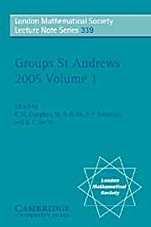
Groups St Andrews 2005
ISBN 9780521694698
Autor: Edited by C. M. Campbell , M. R. Quick , E. F. Robertson , G. C. Smith
Wydawca: Cambridge University Press
Dostępność: 3-6 tygodni
Cena: 362,25 zł
Przed złożeniem zamówienia prosimy o kontakt mailowy celem potwierdzenia ceny.
ISBN13: |
9780521694698 |
ISBN10: |
0521694698 |
Autor: |
Edited by C. M. Campbell , M. R. Quick , E. F. Robertson , G. C. Smith |
Oprawa: |
Paperback |
Rok Wydania: |
2007-01-04 |
Ilość stron: |
366 |
Wymiary: |
228 x 152 mm |
Tematy: |
Algebra |
Groups St Andrews 2005 was held in the University of St Andrews in August 2005 and this first volume of a two-volume book contains selected papers from the international conference.
Four main lecture courses were given at the conference, and articles based on their lectures form a substantial part of the Proceedings.
This volume contains the contributions by Peter Cameron (Queen Mary, London) and Rostislav Grogorchuk (Texas A&M, USA).
Apart from the main speakers, refereed survey and research articles were contributed by other conference participants.
Arranged in alphabetical order, these articles cover a wide spectrum of modern group theory.
The regular Proceedings of Groups St Andrews conferences have provided snapshots of the state of research in group theory throughout the past 25 years.
Earlier volumes have had a major impact on the development of group theory and it is anticipated that this volume will be equally important.
Spis treści:
Introduction
1. Aspects of infinite permutation groups Peter J. Cameron
2. Self-similarity and branching in group theory Rostislav Grigorchuk and Zoran Sunic
3. On surface groups, motivating examples in combinatorial group theory Peter Ackermann, Benjamin Fine and Gerhard Rosenberger
4. Nilpotent p-algebras and factorized p-groups Bernhard Amberg and Lev Kazarin
5. Classification of finite groups by the number of element centralizers Ali Reza Ashrafi and Bijan Taeri
6. Algorithmic use of the Malcev correspondence Bjoern Assmann
7. Minimal but inefficient presentations for semi-direct products of finite cyclic monoids Firat Ates and A. Sinan Ç evik
8. The modular isomorphism problem for finite p-groups with a cyclic subgroup of index p2 Czeslaw Baginski and Alexander Konovalov
9. On one-generated formations A. Ballester-Bolinches, Clara Calvo and R. Esteban-Romero
10. New results on products of finite groups A. Ballester-Bolinches, John Cossey and M. C. Pedraza-Aguilera
11. Radical locally finite T-groups A. Ballester-Bolinches, H. Heineken and Tatiana Pedraza
12. Explicit tilting complexes for the Broué conjecture on 3-blocks Ayala Bar-Ilan, Tzviya Berrebi, Genadi Chereshnya, Ruth Leabovich, Mikhal Cohen and Mary Schaps
13. Conjugacy classes of p-regular elements in p-solvable groups Antonio Beltrán and Maria José Felipé
14. An algorithm for the unit group of the Burnside ring of a finite group Robert Boltje and Götz Pfeiffer
15. Integral group ring of the first Mathieu simple group Victor Bovdi and Alexander Konovalov
16. Embedding properties in direct products B. Brewster, A. Martinez-Pastor and M. D. Pérez-Ramos
17. Malcev presentations for subsemigroups of groups - a survey Alan J. Cain
18. Finite groups with extremal conditions on sizes of conjugacy classes and on degrees of irreducible characters David Chillag and Marcel Herzog
19. Conjugacy class structure in simple algebraic groups Martin Cook
20. On automorphisms of products of groups Jill Dietz
21. Linear groups with infinite central dimension Martyn R. Dixon and Leonid A. Kurdachenko
22. G-automata, counter languages and the Chomsky hierarchy Murray Elder
23. An embedding theorem for groups universally equivalent to free nilpotent groups Benjamin Fine, Anthony M. Gaglione and Dennis Spellman
24. Irreducible word problems in groups Ana R. Fonseca, Duncan W. Parkes and Richard M. Thomas
25. Recent growth results Eric M. Freden and Teresa Knudson.
Koszyk
Książek w koszyku: 0 szt.
Wartość zakupów: 0,00 zł
Informacje


Kontakt
Gambit
Centrum Oprogramowania
i Szkoleń Sp. z o.o.
Al. Pokoju 29b/22-24
31-564 Kraków
Siedziba Księgarni
ul. Kordylewskiego 1
31-542 Kraków
+48 12 410 5991
+48 12 410 5987
+48 12 410 5989
Subskrypcje
Administratorem danych osobowych jest firma Gambit COiS Sp. z o.o. Na podany adres będzie wysyłany wyłącznie biuletyn informacyjny.
Autoryzacja płatności

Informacje na temat autoryzacji płatności poprzez PayU.

© Copyright 2012: GAMBIT COiS Sp. z o.o. Wszelkie prawa zastrzeżone.
Projekt i wykonanie: Alchemia Studio Reklamy