


Wydawcy
Katalog tematyczny
- Archeologia (109)
- Ekonomia, finanse, business (13704)
- Filozofia (1445)
- Historia (3040)
- Języki i językoznawstwo (2356)
- Lifestyle, hobby i rozrywka (475)
- Medycyna (9704)
- Nauki humanistyczne (4)
- Nauki o Ziemi i środowisku (2638)
- Nauki ścisłe (20412)
- Astronomia (294)
- Biologia (5119)
- Chemia (6540)
- Fizyka (3309)
- Matematyka (4574)
- Algebra (171)
- Analiza matematyczna (902)
- Filozofia matematyki (1)
- Geometria (237)
- Historia matematyki (57)
- Kombinatoryka, teoria grafów (67)
- Matematyka dyskretna (35)
- Matematyka stosowana (555)
- Optymalizacja (104)
- Podstawy matematyki (129)
- Statystyka, prawdopodobieństwo (296)
- Teoria grup (63)
- Teoria liczb (77)
- Topologia (66)
- Nauki ścisłe, ogólnie (503)
- Nauki społeczne (8486)
- Nauki techniczne (13450)
- Prawo (1696)
- Publikacje informacyjne i interdyscyplinarne (1288)
- Religia i wierzenia (917)
- Technika komputerowa (4067)
- Zdrowie, relacje międzyludzkie i rozwój osobisty (657)





Informacje szczegółowe o książce
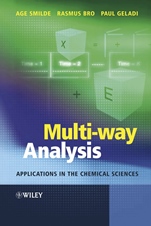
Multi–way Analysis: Applications in the Chemical Sciences
ISBN 9780471986911
Autor: Age Smilde, Rasmus Bro, Paul Geladi
Wydawca: Wiley
Dostępność: 3-6 tygodni
Cena: 830,55 zł
Przed złożeniem zamówienia prosimy o kontakt mailowy celem potwierdzenia ceny.
ISBN13: |
9780471986911 |
ISBN10: |
0471986917 |
Autor: |
Age Smilde, Rasmus Bro, Paul Geladi |
Oprawa: |
Hardback |
Rok Wydania: |
2004-08-20 |
Ilość stron: |
396 |
Wymiary: |
244x168 |
Tematy: |
PB |
This book presents a detailed description of three–way and multi–way arrays, their properties and the methods utilised to model these arrays mathematically. Multi–way component analysis is introduced by its two most important models – Tucker3 and PARAFAC. In addition, intermediate and derived models are included. Multi–way regression methods receive special attention and a number of algorithms are presented. The book includes detailed accounts of diagnostics, visualization of results and handling of residuals. Appropriate attention is given to the preprocessing of data. Mathematical rigor is applied where necessary and numerous proofs are included. The book concludes with an overview of the different application fields of multi–way analysis, including analytical chemistry, process monitoring, environmental analysis and three–way data resulting from ANOVA or designed experiments. The relationship of these methods to chemistry is always emphasized.
The book is aimed at researchers who are interested in theoretical and practical aspects of data analysis. It is directly relevant to chemical sciences such as analytical, environmental, clinical and physical chemistry. In addition, it is pertinent to chemometrics, bioinformatics, biochemistry, process analysis, food chemistry and sensory analysis.
Spis treści:
Foreword.
Preface.
Nomenclature and Conventions.
1 Introduction.
1.1 What is multi–way analysis?
1.2 Conceptual aspects of multi–way data analysis.
1.3 Hierarchy of multivariate data structures in chemistry.
1.4 Principal component analysis and PARAFAC.
1.5 Summary.
2 Array definitions and properties.
2.1 Introduction.
2.2 Rows, columns and tubes; frontal, lateral and horizontal slices.
2.3 Elementary operations.
2.4 Linearity concepts.
2.5 Rank of two–way arrays.
2.6 Rank of three–way arrays.
2.7 Algebra of multi&#
8211;way analysis.
2.8 Summary.
Appendix 2.A.
3 Two–way component and regression models.
3.1 Models for two–way one–block data analysis: component models.
3.2 Models for two–way two–block data analysis: regression models.
3.3 Summary.
Appendix 3.A: some PCA results.
Appendix 3.B: PLS algorithms.
4 Three–way component and regression models.
4.1 Historical introduction to multi–way models.
4.2 Models for three–way one–block data: three–way component models.
4.3 Models for three–way two–block data: three–way regression models.
4.4 Summary.
Appendix 4.A: alternative notation for the PARAFAC model.
Appendix 4.B: alternative notations for the Tucker3 model.
5 Some properties of three–way component models.
5.1 Relationships between three–way component models.
5.2 Rotational freedom and uniqueness in three–way component models.
5.3 Properties of Tucker3 models.
5.4 Degeneracy problem in PARAFAC models.
5.5 Summary.
6 Algorithms.
6.1 Introduction.
6.2 Optimization techniques.
6.3 PARAFAC algorithms.
6.4 Tucker3 algorithms.
6.5 Tucker2 and Tucker1 algorithms.
6.6 Multi–linear partial least squares regression.
6.7 Multi–way covariates regression models.
6.8 Core rotation in Tucker3 models.
6.9 Handling missing data.
6.10 Imposing non–negativity.
6.11 Summary.
Appendix 6.A: closed–form solution for the PARAFAC model.
Appendix 6.B: proof that the weights in trilinear PLS1 can be obtained from a singular value decomposition.
7 Validation and diagnostics.
7.1 What is validation?
7.2 Test–set and cross–validation.
7.3 Selecting which model to use.
7.4 Selecting the number of components.
7.5 Residual and influence analysis.
7.6 Summary.
8 Visualization.
8.1 Introduction.
8.2 His
tory of plotting in three–way analysis.
8.3 History of plotting in chemical three–way analysis.
8.4 Scree plots.
8.5 Line plots.
8.6 Scatter plots.
8.7 Problems with scatter plots.
8.8 Image analysis.
8.9 Dendrograms.
8.10 Visualizing the Tucker core array.
8.11 Joint plots.
8.12 Residual plots.
8.13 Leverage plots.
8.14 Visualization of large data sets.
8.15 Summary.
9 Preprocessing.
9.1 Background.
9.2 Two–way centering.
9.3 Two–way scaling.
9.4 Simultaneous two–way centering and scaling.
9.5 Three–way preprocessing.
9.6 Summary.
Appendix 9.A: other types of preprocessing.
Appendix 9.B: geometric view of centering.
Appendix 9.C: fitting bilinear model plus offsets across one mode equals fitting a bilinear model to centered data.
Appendix 9.D: rank reduction and centering.
Appendix 9.E: centering data with missing values.
Appendix 9.F: incorrect centering introduces artificial variation.
Appendix 9.G: alternatives to centering.
10 Applications.
10.1 Introduction.
10.2 Curve resolution of fluorescence data.
10.3 Second–order calibration.
10.4 Multi–way regression.
10.5 Process chemometrics.
10.6 Exploratory analysis in chromatography.
10.7 Exploratory analysis in environmental sciences.
10.8 Exploratory analysis of designed data.
10.9 Analysis of variance of data with complex interactions.
Appendix 10.A: an illustration of the generalized rank annihilation method.
Appendix 10.B: other types of second–order calibration problems.
Appendix 10.C: the multiple standards calibration model of the second–order calibration example.
References.
Index.
Okładka tylna:
This book presents a detailed description of three–way and multi–way arrays, their properties and the methods utilised to model these arrays mathematically. Multi–way component
analysis is introduced by its two most important models – Tucker3 and PARAFAC. In addition, intermediate and derived models are included. Multi–way regression methods receive special attention and a number of algorithms are presented. The book includes detailed accounts of diagnostics, visualization of results and handling of residuals. Appropriate attention is given to the preprocessing of data. Mathematical rigor is applied where necessary and numerous proofs are included. The book concludes with an overview of the different application fields of multi–way analysis, including analytical chemistry, process monitoring, environmental analysis and three–way data resulting from ANOVA or designed experiments. The relationship of these methods to chemistry is always emphasized.
The book is aimed at researchers who are interested in theoretical and practical aspects of data analysis. It is directly relevant to chemical sciences such as analytical, environmental, clinical and physical chemistry. In addition, it is pertinent to chemometrics, bioinformatics, biochemistry, process analysis, food chemistry and sensory analysis.
Koszyk
Książek w koszyku: 0 szt.
Wartość zakupów: 0,00 zł
Informacje


Kontakt
Gambit
Centrum Oprogramowania
i Szkoleń Sp. z o.o.
Al. Pokoju 29b/22-24
31-564 Kraków
Siedziba Księgarni
ul. Kordylewskiego 1
31-542 Kraków
+48 12 410 5991
+48 12 410 5987
+48 12 410 5989
Subskrypcje
Administratorem danych osobowych jest firma Gambit COiS Sp. z o.o. Na podany adres będzie wysyłany wyłącznie biuletyn informacyjny.
Autoryzacja płatności

Informacje na temat autoryzacji płatności poprzez PayU.

© Copyright 2012: GAMBIT COiS Sp. z o.o. Wszelkie prawa zastrzeżone.
Projekt i wykonanie: Alchemia Studio Reklamy