


Wydawcy
Katalog tematyczny
- Archeologia (109)
- Ekonomia, finanse, business (13704)
- Filozofia (1445)
- Historia (3040)
- Języki i językoznawstwo (2356)
- Lifestyle, hobby i rozrywka (475)
- Medycyna (9704)
- Nauki humanistyczne (4)
- Nauki o Ziemi i środowisku (2638)
- Nauki ścisłe (20412)
- Astronomia (294)
- Biologia (5119)
- Chemia (6540)
- Fizyka (3309)
- Matematyka (4574)
- Algebra (171)
- Analiza matematyczna (902)
- Filozofia matematyki (1)
- Geometria (237)
- Historia matematyki (57)
- Kombinatoryka, teoria grafów (67)
- Matematyka dyskretna (35)
- Matematyka stosowana (555)
- Optymalizacja (104)
- Podstawy matematyki (129)
- Statystyka, prawdopodobieństwo (296)
- Teoria grup (63)
- Teoria liczb (77)
- Topologia (66)
- Nauki ścisłe, ogólnie (503)
- Nauki społeczne (8486)
- Nauki techniczne (13450)
- Prawo (1696)
- Publikacje informacyjne i interdyscyplinarne (1288)
- Religia i wierzenia (917)
- Technika komputerowa (4067)
- Zdrowie, relacje międzyludzkie i rozwój osobisty (657)





Informacje szczegółowe o książce
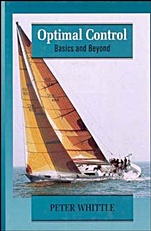
Optimal Control: Basics and Beyond
ISBN 9780471956792
Autor: Peter Whittle
Wydawca: Wiley
Dostępność: 3-6 tygodni
Cena: 1 858,50 zł
Przed złożeniem zamówienia prosimy o kontakt mailowy celem potwierdzenia ceny.
ISBN13: |
9780471956792 |
ISBN10: |
0471956791 |
Autor: |
Peter Whittle |
Oprawa: |
Hardback |
Rok Wydania: |
1995-12-15 |
Ilość stron: |
474 |
Wymiary: |
234x152 |
Tematy: |
PB |
The concept of a system as an entity in its own right has emerged with increasing force in the past few decades in, for example, the areas of electrical and control engineering, economics, ecology, urban structures, automaton theory, operational research and industry. The more definite concept of a large–scale system is implicit in these applications, but is particularly evident in fields such as the study of communication networks, computer networks and neural networks. The Wiley–Interscience Series in Systems and Optimization has been established to serve the needs of researchers in these rapidly developing fields. It is intended for works concerned with developments in quantitative systems theory, applications of such theory in areas of interest, or associated methodology.
This is the first book–length treatment of risk–sensitive control, with many new results. The quadratic cost function of the standard LQG (linear/quadratic/Gaussian) treatment is replaced by the exponential of a quadratic, giving the so–called LEQG formulation allowing for a degree of optimism or pessimism on the part of the optimiser. The author is the first to achieve formulation and proof of risk–sensitive versions of the certainty–equivalence and separation principles. Further analysis allows one to formulate the optimization as the extremization of a path integral and to characterize the solution in terms of canonical factorization. It is thus possible to achieve the long–sought goal of an operational stochastic maximum principle, valid for a higher–order model, and in fact only evident when the models are extended to the risk–sensitive class. Additional results include deduction of compact relations between value functions and canonical factors, the exploitation of the equivalence between policy improvement and Newton Raphson methods and the direct relation of LEQG methods to the H??? and minimum–entropy methods. This
book will prove essential reading for all graduate students, researchers and practitioners who have an interest in control theory including mathematicians, engineers, economists, physicists and psychologists. 1990 Stochastic Programming Peter Kall, University of Zürich, Switzerland and Stein W. Wallace, University of Trondheim, Norway Stochastic Programming is the first textbook to provide a thorough and self–contained introduction to the subject. Carefully written to cover all necessary background material from both linear and non–linear programming, as well as probability theory, the book draws together the methods and techniques previously described in disparate sources. After introducing the terms and modelling issues when randomness is introduced in a deterministic mathematical programming model, the authors cover decision trees and dynamic programming, recourse problems, probabilistic constraints, preprocessing and network problems. Exercises are provided at the end of each chapter. Throughout, the emphasis is on the appropriate use of the techniques, rather than on the underlying mathematical proofs and theories, making the book ideal for researchers and students in mathematical programming and operations research who wish to develop their skills in stochastic programming. 1994
Spis treści:
BASICS.
Deterministic Models.
Stochastic Models.
BEYOND.
Risk–Sensitive and H infinity Criteria.
Time–Integral Methods and Optimal Stationary Policies.
Near–Determinism and Large Deviation Theory.
Appendices.
References.
Index.
Nota biograficzna:
About the author Professor Whittle was born and educated in Wellington, New Zealand. In 1951 he was awarded his PhD at the University of Uppsala, Sweden. He was then employed in the New Zealand DSIR until he took up an appointment as Lecturer in Mathematics at Cambridge University in 1959. After two years he became Professor of M
athematical Statistics at Manchester University, and in 1967 was appointed Churchill Professor of the Mathematics of Operational Research at Cambridge University. Professor Whittle was elected Fellow of the Royal Society in 1978, and an Honorary Fellow of the Royal Society of New Zealand in 1981. He was awarded the Lanchester Prize of the Operations Research Society of America in 1987 for his book Systems in Stochastic Equilibrium and received the Sylvester Prize of the Royal Society in 1994.
Okładka tylna:
The concept of a system as an entity in its own right has emerged with increasing force in the past few decades in, for example, the areas of electrical and control engineering, economics, ecology, urban structures, automaton theory, operational research and industry. The more definite concept of a large–scale system is implicit in these applications, but is particularly evident in fields such as the study of communication networks, computer networks and neural networks. The Wiley–Interscience Series in Systems and Optimization has been established to serve the needs of researchers in these rapidly developing fields. It is intended for works concerned with developments in quantitative systems theory, applications of such theory in areas of interest, or associated methodology.
This is the first book–length treatment of risk–sensitive control, with many new results. The quadratic cost function of the standard LQG (linear/quadratic/Gaussian) treatment is replaced by the exponential of a quadratic, giving the so–called LEQG formulation allowing for a degree of optimism or pessimism on the part of the optimiser. The author is the first to achieve formulation and proof of risk–sensitive versions of the certainty–equivalence and separation principles. Further analysis allows one to formulate the optimization as the extremization of a path integral and to characterize the solution in terms of canonical
factorization. It is thus possible to achieve the long–sought goal of an operational stochastic maximum principle, valid for a higher–order model, and in fact only evident when the models are extended to the risk–sensitive class. Additional results include deduction of compact relations between value functions and canonical factors, the exploitation of the equivalence between policy improvement and Newton Raphson methods and the direct relation of LEQG methods to the H??? and minimum–entropy methods. This book will prove essential reading for all graduate students, researchers and practitioners who have an interest in control theory including mathematicians, engineers, economists, physicists and psychologists. 1990 Stochastic Programming Peter Kall, University of Zürich, Switzerland and Stein W. Wallace, University of Trondheim, Norway Stochastic Programming is the first textbook to provide a thorough and self–contained introduction to the subject. Carefully written to cover all necessary background material from both linear and non–linear programming, as well as probability theory, the book draws together the methods and techniques previously described in disparate sources. After introducing the terms and modelling issues when randomness is introduced in a deterministic mathematical programming model, the authors cover decision trees and dynamic programming, recourse problems, probabilistic constraints, preprocessing and network problems. Exercises are provided at the end of each chapter. Throughout, the emphasis is on the appropriate use of the techniques, rather than on the underlying mathematical proofs and theories, making the book ideal for researchers and students in mathematical programming and operations research who wish to develop their skills in stochastic programming. 1994
Koszyk
Książek w koszyku: 0 szt.
Wartość zakupów: 0,00 zł
Informacje


Kontakt
Gambit
Centrum Oprogramowania
i Szkoleń Sp. z o.o.
Al. Pokoju 29b/22-24
31-564 Kraków
Siedziba Księgarni
ul. Kordylewskiego 1
31-542 Kraków
+48 12 410 5991
+48 12 410 5987
+48 12 410 5989
Subskrypcje
Administratorem danych osobowych jest firma Gambit COiS Sp. z o.o. Na podany adres będzie wysyłany wyłącznie biuletyn informacyjny.
Autoryzacja płatności

Informacje na temat autoryzacji płatności poprzez PayU.

© Copyright 2012: GAMBIT COiS Sp. z o.o. Wszelkie prawa zastrzeżone.
Projekt i wykonanie: Alchemia Studio Reklamy