


Wydawcy
Katalog tematyczny
- Archeologia (109)
- Ekonomia, finanse, business (13704)
- Filozofia (1445)
- Historia (3040)
- Języki i językoznawstwo (2356)
- Lifestyle, hobby i rozrywka (475)
- Medycyna (9704)
- Nauki humanistyczne (4)
- Nauki o Ziemi i środowisku (2638)
- Nauki ścisłe (20412)
- Astronomia (294)
- Biologia (5119)
- Chemia (6540)
- Fizyka (3309)
- Matematyka (4574)
- Algebra (171)
- Analiza matematyczna (902)
- Filozofia matematyki (1)
- Geometria (237)
- Historia matematyki (57)
- Kombinatoryka, teoria grafów (67)
- Matematyka dyskretna (35)
- Matematyka stosowana (555)
- Optymalizacja (104)
- Podstawy matematyki (129)
- Statystyka, prawdopodobieństwo (296)
- Teoria grup (63)
- Teoria liczb (77)
- Topologia (66)
- Nauki ścisłe, ogólnie (503)
- Nauki społeczne (8486)
- Nauki techniczne (13450)
- Prawo (1696)
- Publikacje informacyjne i interdyscyplinarne (1288)
- Religia i wierzenia (917)
- Technika komputerowa (4067)
- Zdrowie, relacje międzyludzkie i rozwój osobisty (657)





Informacje szczegółowe o książce
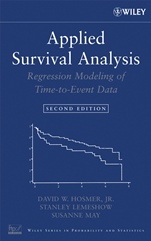
Applied Survival Analysis: Regression Modeling of Time–to–Event Data
ISBN 9780471754992
Autor: David W. Hosmer Jr., Stanley Lemeshow, Susanne May
Wydawca: Wiley
Dostępność: 3-6 tygodni
Cena: 718,20 zł
Przed złożeniem zamówienia prosimy o kontakt mailowy celem potwierdzenia ceny.
ISBN13: |
9780471754992 |
ISBN10: |
0471754994 |
Autor: |
David W. Hosmer Jr., Stanley Lemeshow, Susanne May |
Oprawa: |
Hardback |
Rok Wydania: |
2008-04-15 |
Numer Wydania: |
2nd Edition |
Ilość stron: |
416 |
Wymiary: |
251x150 |
Tematy: |
PB |
THE MOST PRACTICAL, UP–TO–DATE GUIDE TO MODELLING AND ANALYZING TIME–TO–EVENT DATA—NOW IN A VALUABLE NEW EDITION
Since publication of the first edition nearly a decade ago, analyses using time–to–event methods have increase considerably in all areas of scientific inquiry mainly as a result of model–building methods available in modern statistical software packages. However, there has been minimal coverage in the available literature to9 guide researchers, practitioners, and students who wish to apply these methods to health–related areas of study. Applied Survival Analysis, Second Edition provides a comprehensive and up–to–date introduction to regression modeling for time–to–event data in medical, epidemiological, biostatistical, and other health–related research.
This book places a unique emphasis on the practical and contemporary applications of regression modeling rather than the mathematical theory. It offers a clear and accessible presentation of modern modeling techniques supplemented with real–world examples and case studies. Key topics covered include: variable selection, identification of the scale of continuous covariates, the role of interactions in the model, assessment of fit and model assumptions, regression diagnostics, recurrent event models, frailty models, additive models, competing risk models, and missing data.
Features of the Second Edition include:Expanded coverage of interactions and the covariate–adjusted survival functionsThe use of the Worchester Heart Attack Study as the main modeling data set for illustrating discussed concepts and techniquesNew discussion of variable selection with multivariable fractional polynomialsFurther exploration of time–varying covariates, complex with examplesAdditional treatment of the exponential, Weibull, and log–logistic parametric regression model
sIncreased emphasis on interpreting and using results as well as utilizing multiple imputation methods to analyze data with missing valuesNew examples and exercises at the end of each chapter
Analyses throughout the text are performed using Stata® Version 9, and an accompanying FTP site contains the data sets used in the book. Applied Survival Analysis, Second Edition is an ideal book for graduate–level courses in biostatistics, statistics, and epidemiologic methods. It also serves as a valuable reference for practitioners and researchers in any health–related field or for professionals in insurance and government.
Spis treści:
Preface.
1. Introduction to Regression Modeling of Survival Data.
1.1 Introduction.
1.2 Typical Censoring Mechanisms.
1.3 Example Data Sets.
Exercises.
2. Descriptive Methods for Survival Data.
2.1 Introduction.
2.2 Estimating the Survival Function.
2.3 Using the Estimated Survival Function.
2.4 Comparison of Survival Functions.
2.5 Other Functions of Survival Time and Their Estimators.
Exercises.
3. Regression Models for Survival Data.
3.1 Introduction.
3.2 Semi–Parametric Regression Models.
3.3 Fitting the Proportional Hazards Regression Model.
3.4 Fitting the Proportional Hazards Model with Tied Survival Times.
3.5 Estimating the Survival Function of the Proportional Hazards Regression Model.
Exercises.
4. Interpretation of a Fitted Proportional Hazards Regression Model.
4.1 Introduction.
4.2 Nominal Scale Covariate.
4.3 Continuous Scale Covariate.
4.4 Multiple–Covariate Models.
4.5 Interpreting and Using the Estimated Covariate–Adjusted Survival Function.
Exercises.
5. Model Development.
5.1 Introduction.
5.2 Purposeful Selection of Covariates.
5.2.1 Methods to examine the scale of continuous covariates in the log hazard.
5.2.2 An ex
ample of purposeful selection of covariates.
5.3 Stepwise, Best–Subsets and Multivariable Fractional Polynomial Methods of Selecting Covariates.
5.3.1 Stepwise selection of covariates.
5.3.2 Best subsets selection of covariates.
5.3.3 Selecting covariates and checking their scale using multivariable fractional polynomials.
5.4 Numerical Problems.
Exercises.
6. Assessment of Model Adequacy.
6.1 Introduction.
6.2 Residuals.
6.3 Assessing the Proportional Hazards Assumption.
6.4 Identification of Influential and Poorly Fit Subjects.
6.5 Assessing Overall Goodness–of–Fit.
6.6 Interpreting and Presenting Results From the Final Model.
Exercises.
7. Extensions of the Proportional Hazards Model.
7.1 Introduction.
7.2 The Stratified Proportional Hazards Model.
7.3 Time–Varying Covariates.
7.4 Truncated, Left Censored and Interval Censored Data.
Exercises.
8. Parametric Regression Models.
8.1 Introduction.
8.2 The Exponential Regression Model.
8.3 The Weibull Regression Model.
8.4 The Log–Logistic Regression Model.
8.5 Other Parametric Regression Models.
Exercises.
9. Other Models and Topics.
9.1 Introduction.
9.2 Recurrent Event Models.
9.3 Frailty Models.
9.4 Nested Case–Control Studies.
9.5 Additive Models.
9.6 Competing Risk Models.
9.7 Sample Size and Power.
9.8 Missing Data.
Exercises.
Appendix 1: The Delta Method.
Appendix 2: An Introduction to the Counting Process Approach to Survival Analysis.
Appendix 3: Percentiles for Computation of the Hall and Wellner Confidence Band.
References.
Index.
Nota biograficzna:
David W. Hosmer, PhD, is Professor Emeritus of Biostatistics in the School of Public Health and Heatlth Sciences at the University of Massachusetts Amherst. Dr. Hosmer is the coauthor of Applied Logistic Regression, published by Wiley.
S
tanley Lemeshow, PhD, is Professor and Dean of the College of Public Health at The Ohio State University. Dr. Lemeshow has over thirty–five years of academic experience in the areas of regression, categorical data methods, and sampling methods. He is the coauthor of Sampling of Population: Methods and Application and Applied Logistic Regression, both published by Wiley.
Susanne May, PhD, is Assistant Professor of Biostatistics at the University of California, San Diego. Dr. May has over twelve years of experience in providing statistical support for health–related research projects.
Okładka tylna:
THE MOST PRACTICAL, UP–TO–DATE GUIDE TO MODELLING AND ANALYZING TIME–TO–EVENT DATA—NOW IN A VALUABLE NEW EDITION
Since publication of the first edition nearly a decade ago, analyses using time–to–event methods have increase considerably in all areas of scientific inquiry mainly as a result of model–building methods available in modern statistical software packages. However, there has been minimal coverage in the available literature to9 guide researchers, practitioners, and students who wish to apply these methods to health–related areas of study. Applied Survival Analysis, Second Edition provides a comprehensive and up–to–date introduction to regression modeling for time–to–event data in medical, epidemiological, biostatistical, and other health–related research.
This book places a unique emphasis on the practical and contemporary applications of regression modeling rather than the mathematical theory. It offers a clear and accessible presentation of modern modeling techniques supplemented with real–world examples and case studies. Key topics covered include: variable selection, identification of the scale of continuous covariates, the role of interactions in the model, assessment of fit and model assu
Koszyk
Książek w koszyku: 0 szt.
Wartość zakupów: 0,00 zł
Informacje


Kontakt
Gambit
Centrum Oprogramowania
i Szkoleń Sp. z o.o.
Al. Pokoju 29b/22-24
31-564 Kraków
Siedziba Księgarni
ul. Kordylewskiego 1
31-542 Kraków
+48 12 410 5991
+48 12 410 5987
+48 12 410 5989
Subskrypcje
Administratorem danych osobowych jest firma Gambit COiS Sp. z o.o. Na podany adres będzie wysyłany wyłącznie biuletyn informacyjny.
Autoryzacja płatności

Informacje na temat autoryzacji płatności poprzez PayU.

© Copyright 2012: GAMBIT COiS Sp. z o.o. Wszelkie prawa zastrzeżone.
Projekt i wykonanie: Alchemia Studio Reklamy