


Wydawcy
Katalog tematyczny
- Archeologia (109)
- Ekonomia, finanse, business (13704)
- Filozofia (1445)
- Historia (3040)
- Języki i językoznawstwo (2356)
- Lifestyle, hobby i rozrywka (475)
- Medycyna (9704)
- Nauki humanistyczne (4)
- Nauki o Ziemi i środowisku (2638)
- Nauki ścisłe (20412)
- Astronomia (294)
- Biologia (5119)
- Chemia (6540)
- Fizyka (3309)
- Matematyka (4574)
- Algebra (171)
- Analiza matematyczna (902)
- Filozofia matematyki (1)
- Geometria (237)
- Historia matematyki (57)
- Kombinatoryka, teoria grafów (67)
- Matematyka dyskretna (35)
- Matematyka stosowana (555)
- Optymalizacja (104)
- Podstawy matematyki (129)
- Statystyka, prawdopodobieństwo (296)
- Teoria grup (63)
- Teoria liczb (77)
- Topologia (66)
- Nauki ścisłe, ogólnie (503)
- Nauki społeczne (8486)
- Nauki techniczne (13450)
- Prawo (1696)
- Publikacje informacyjne i interdyscyplinarne (1288)
- Religia i wierzenia (917)
- Technika komputerowa (4067)
- Zdrowie, relacje międzyludzkie i rozwój osobisty (657)





Informacje szczegółowe o książce
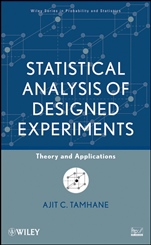
Statistical Analysis of Designed Experiments: Theory and Applications
ISBN 9780471750437
Autor: Ajit C. Tamhane
Wydawca: Wiley
Dostępność: 3-6 tygodni
Cena: 779,10 zł
Przed złożeniem zamówienia prosimy o kontakt mailowy celem potwierdzenia ceny.
ISBN13: |
9780471750437 |
ISBN10: |
0471750433 |
Autor: |
Ajit C. Tamhane |
Oprawa: |
Hardback |
Rok Wydania: |
2009-04-23 |
Ilość stron: |
720 |
Wymiary: |
242x165 |
Tematy: |
PB |
A indispensable guide to understanding and designing modern experiments
The tools and techniques of Design of Experiments (DOE) allow researchers to successfully collect, analyze, and interpret data across a wide array of disciplines. Statistical Analysis of Designed Experiments provides a modern and balanced treatment of DOE methodology with thorough coverage of the underlying theory and standard designs of experiments, guiding the reader through applications to research in various fields such as engineering, medicine, business, and the social sciences.
The book supplies a foundation for the subject, beginning with basic concepts of DOE and a review of elementary normal theory statistical methods. Subsequent chapters present a uniform, model–based approach to DOE. Each design is presented in a comprehensive format and is accompanied by a motivating example, discussion of the applicability of the design, and a model for its analysis using statistical methods such as graphical plots, analysis of variance (ANOVA), confidence intervals, and hypothesis tests.
Numerous theoretical and applied exercises are provided in each chapter, and answers to selected exercises are included at the end of the book. An appendix features three case studies that illustrate the challenges often encountered in real–world experiments, such as randomization, unbalanced data, and outliers. Minitab® software is used to perform analyses throughout the book, and an accompanying FTP site houses additional exercises and data sets.
With its breadth of real–world examples and accessible treatment of both theory and applications, Statistical Analysis of Designed Experiments is a valuable book for experimental design courses at the upper–undergraduate and graduate levels. It is also an indispensable reference for practicing statisticians, engineers, and scientists who would like to further their knowledge of DOE.
Spis treści:
1. Int
roduction.
1.1 Observational Studies and Experiments.
1.2 Brief Historical Remarks.
1.3 Basic Terminology and Concepts of Experimentation.
1.4 Basic Principles of Experimentation.
2. Review of Elementary Statistics.
2.1 Experiments for a Single Treatment.
2.2 Experiments for Comparing Two Treatments.
2.3 Linear Regression.
2.4 Chapter Summary.
Exercises.
3. Single Factor Experiments: Completely Randomized Designs.
3.1 Summary Statistics and Graphical Displays.
3.2 Model.
3.3 Statistical Analysis.
3.4 Model Diagnostics.
3.5 Data Transformations.
3.6 Power of the F–test and Sample Size Determination.
3.7 Quantitative Treatment Factors.
3.8 One–Way Analysis of Covariance.
3.9 Chapter Notes.
3.10 Chapter Summary.
Exercises.
4. Single Factor Experiments: Multiple Comparison and Selection Procedures.
4.1 Basic Concepts of Multiple Comparisons.
4.2 Pairwise Comparisons.
4.3 Comparisons with a Control.
4.4 General Contrasts.
4.5 Ranking and Selection Procedures.
4.6 Chapter Summary.
Exercises.
5. Randomized Block Designs and Extensions.
5.1 Randomized Block (RB) Designs.
5.2 Balanced Incomplete Block (BIB) Designs.
5.3 Youden Square (YSQ) Designs.
5.4 Latin Square (LSQ) Designs.
5.5 Chapter Notes.
5.6 Chapter Summary.
Exercises.
6. General Factorial Experiments.
6.1 Factorial vs. One–Factor–at–a–Time Experiments.
6.2 Balanced Two–Way Layouts.
6.3 Unbalanced Two–Way Layouts.
6.4 Chapter Notes.
6.5 Chapter Summary.
Exercises.
7. Two–Level Factorial Experiments.
7.1 Estimation of Main Effects and Interactions.
7.2 Statistical Analysis.
7.3 Single Replicate Case.
7.4 Factorial Designs in Incomplete Blocks: Confounding of Effects.
7.5 Chapter Notes.
7.6 Chapter Summary.
Exercises.
8. Two–Level Fractional Factorial Experiments .
8.1 Two–Level Fr
actional Factorial Experiments.
8.2 Plackett–Burman Designs.
8.3 Hadamard Designs.
8.4 Supersaturated Designs.
8.5 Orthogonal Arrays.
8.6 Sequential Assemblies of Fractional Factorials.
8.7 Chapter Summary.
Exercises.
9. Three–Level and Mixed–Level Factorial Designs.
9.1 Three–Level Full Factorial Designs.
9.2 Three–Level Fractional Factorial Designs.
9.3 Mixed–Level Factorial Designs.
9.4 Chapter Notes.
9.5 Chapter Summary.
Exercises.
10. Experiments for Response Optimization.
10.1 Response Surface Methodology.
10.2 Mixture.
10.3 The Taguchi Method of Quality Improvement.
10.4 Chapter Summary.
Exercises.
11. Random and Mixed Crossed Factors Designs.
11.1 One–Way Layouts.
11.2 Two–Way Layouts.
11.3 Three–Way Layouts.
11.4 Chapter Notes.
11.5 Chapter Summary.
Exercises.
12. Nested, Crossed–Nested and Split Plot Designs.
12.1 Two–Stage Nested Designs.
12.2 Three–Stage Nested Designs.
12.3 Crossed and Nested Designs.
12.4 Split Plot Designs.
12.5 Chapter Notes.
12.6 Chapter Summary.
Exercises.
13. Repeated Measures Designs.
13.1 Repeated Measures Designs: Univariate Approach.
13.2 Repeated Measures Designs: Multivariate Approach.
13.3 Chapter Notes.
13.4 Chapter Summary.
Exercises.
14. Linear Models with Fixed Effects.
14.1 Basic Linear Model and Least Squares Estimation.
14.2 Confidence Intervals and Hypothesis Testing.
14.3 Power of the F–Test.
14.4 Chapter Notes.
14.5 Chapter Summary.
Exercises.
A. Vector–Valued Random Variables and Some Distribution Theory.
A.1 Mean Vector and Covariance Matrix of a Random Vector.
A.2 Covariance Matrix of a Linear Transformation of a Random Vector.
A.3 Multivariate Normal Distribution.
A.4 Chi–Square, F and t–Distributions.
A.5 Distributions of Quadratic Forms.
A.6 Multivari
ate t–Distribution.
A.7 Multivariate Normal Sampling Distribution Theory.
B. Case Studies.
B.1 Case Study 1: Effects of Field Strength and Flip Angle on MRI Contrast.
B.1.1 Background.
B.1.2 Design.
B.1.3 Data Analysis.
B.1.4 Results.
B.2 Case Study 2: Growing Stem Cells for Bone Implants.
B.2.1 Background.
B.2.2 Design.
B.2.3 Data Analysis.
B.2.4 Results.
B.3 Case Study 3: Router Bit Experiment.
B.3.1 Background.
B.3.2 Design.
B.3.3 Data Analysis.
B.3.4 Results.
Nota biograficzna:
Ajit C. Tamhane, PhD, is Professor of Industrial Engineering and Management Sciences and Senior Associate Dean of the McCormick School of Engineering and Applied Science at Northwestern University. A Fellow of the American Statistical Society, Dr. Tamhane has over thirty years of academic and consulting experience in the areas of applied and mathematical statistics. He is the coauthor of Multiple Comparison Procedures, also published by Wiley.
Okładka tylna:
A indispensable guide to understanding and designing modern experiments
The tools and techniques of Design of Experiments (DOE) allow researchers to successfully collect, analyze, and interpret data across a wide array of disciplines. Statistical Analysis of Designed Experiments provides a modern and balanced treatment of DOE methodology with thorough coverage of the underlying theory and standard designs of experiments, guiding the reader through applications to research in various fields such as engineering, medicine, business, and the social sciences.
The book supplies a foundation for the subject, beginning with basic concepts of DOE and a review of elementary normal theory statistical methods. Subsequent chapters present a uniform, model–based approach to DOE. Each design is presented in a comprehensive format and is accompanied by a motivating example, discussion of the applicability of the design, and a model for
Koszyk
Książek w koszyku: 0 szt.
Wartość zakupów: 0,00 zł
Informacje


Kontakt
Gambit
Centrum Oprogramowania
i Szkoleń Sp. z o.o.
Al. Pokoju 29b/22-24
31-564 Kraków
Siedziba Księgarni
ul. Kordylewskiego 1
31-542 Kraków
+48 12 410 5991
+48 12 410 5987
+48 12 410 5989
Subskrypcje
Administratorem danych osobowych jest firma Gambit COiS Sp. z o.o. Na podany adres będzie wysyłany wyłącznie biuletyn informacyjny.
Autoryzacja płatności

Informacje na temat autoryzacji płatności poprzez PayU.

© Copyright 2012: GAMBIT COiS Sp. z o.o. Wszelkie prawa zastrzeżone.
Projekt i wykonanie: Alchemia Studio Reklamy