


Wydawcy
Katalog tematyczny
- Archeologia (109)
- Ekonomia, finanse, business (13704)
- Filozofia (1445)
- Historia (3040)
- Języki i językoznawstwo (2356)
- Lifestyle, hobby i rozrywka (475)
- Medycyna (9704)
- Nauki humanistyczne (4)
- Nauki o Ziemi i środowisku (2638)
- Nauki ścisłe (20412)
- Astronomia (294)
- Biologia (5119)
- Chemia (6540)
- Fizyka (3309)
- Matematyka (4574)
- Algebra (171)
- Analiza matematyczna (902)
- Filozofia matematyki (1)
- Geometria (237)
- Historia matematyki (57)
- Kombinatoryka, teoria grafów (67)
- Matematyka dyskretna (35)
- Matematyka stosowana (555)
- Optymalizacja (104)
- Podstawy matematyki (129)
- Statystyka, prawdopodobieństwo (296)
- Teoria grup (63)
- Teoria liczb (77)
- Topologia (66)
- Nauki ścisłe, ogólnie (503)
- Nauki społeczne (8486)
- Nauki techniczne (13450)
- Prawo (1696)
- Publikacje informacyjne i interdyscyplinarne (1288)
- Religia i wierzenia (917)
- Technika komputerowa (4067)
- Zdrowie, relacje międzyludzkie i rozwój osobisty (657)





Informacje szczegółowe o książce
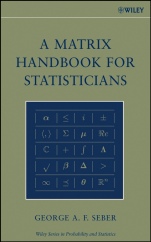
A Matrix Handbook for Statisticians
ISBN 9780471748694
Autor: George A. F. Seber
Wydawca: Wiley
Dostępność: 3-6 tygodni
Cena: 762,30 zł
Przed złożeniem zamówienia prosimy o kontakt mailowy celem potwierdzenia ceny.
ISBN13: |
9780471748694 |
ISBN10: |
0471748692 |
Autor: |
George A. F. Seber |
Oprawa: |
Hardback |
Rok Wydania: |
2007-12-18 |
Ilość stron: |
592 |
Wymiary: |
245x162 |
Tematy: |
PB |
A comprehensive, must–have handbook of matrix methods with a unique emphasis on statistical applications
This timely book, A Matrix Handbook for Statisticians, provides a comprehensive, encyclopedic treatment of matrices as they relate to both statistical concepts and methodologies. Written by an experienced authority on matrices and statistical theory, this handbook is organized by topic rather than mathematical developments and includes numerous references to both the theory behind the methods and the applications of the methods. A uniform approach is applied to each chapter, which contains four parts: a definition followed by a list of results; a short list of references to related topics in the book; one or more references to proofs; and references to applications. The use of extensive cross–referencing to topics within the book and external referencing to proofs allows for definitions to be located easily as well as interrelationships among subject areas to be recognized.
A Matrix Handbook for Statisticians addresses the need for matrix theory topics to be presented together in one book and features a collection of topics not found elsewhere under one cover. These topics include:
Complex matrices
A wide range of special matrices and their properties
Special products and operators, such as the Kronecker product
Partitioned and patterned matrices
Matrix analysis and approximation
Matrix optimization
Majorization
Random vectors and matrices
Inequalities, such as probabilistic inequalities
Additional topics, such as rank, eigenvalues, determinants, norms, generalized inverses, linear and quadratic equations, differentiation, and Jacobians, are also included. The book assumes a fundamental knowledge of vectors and matrices, maintains a reasonable level of abstraction when appropriate, and provides a comprehensive compen
dium of linear algebra results with use or potential use in statistics. A Matrix Handbook for Statisticians is an essential, one–of–a–kind book for graduate–level courses in advanced statistical studies including linear and nonlinear models, multivariate analysis, and statistical computing. It also serves as an excellent self–study guide for statistical researchers.
Spis treści:
Preface.
1. Notation.
1.1 General Definitions.
1.2 Some Continuous Univariate Distributions.
1.3 Glossary of Notation.
2. Vectors, Vector Spaces, and Convexity.
2.1 Vector Spaces.
2.1.1 Definitions.
2.1.2 Quadratic Subspaces.
2.1.3 Sums and Intersections of Subspaces.
2.1.4 Span and Basis.
2.1.5 Isomorphism.
2.2 Inner Products.
2.2.1 Definition and Properties.
2.2.2 Functionals.
2.2.3 Orthogonality.
2.2.4 Column and Null Spaces.
2.3 Projections.
2.3.1 General Projections.
2.3.2 Orthogonal Projections.
2.4 Metric Spaces.
2.5 Convex Sets and Functions.
2.6 Coordinate Geometry.
2.6.1 Hyperplanes and Lines.
2.6.2 Quadratics.
2.6.3 Miscellaneous Results.
3. Rank.
3.1 Some General Properties.
3.2 Matrix Products.
3.3 Matrix Cancellation Rules.
3.4 Matrix Sums.
3.5 Matrix Differences.
3.6 Partitioned Matrices.
3.7 Maximal and Minimal Ranks.
3.8 Matrix Index.
4. Matrix Functions: Inverse, Transpose, Trace, Determinant, and Norm.
4.1 Inverse.
4.2 Transpose.
4.3 Trace.
4.4 Determinants.
4.4.1 Introduction.
4.4.2 Adjoint Matrix.
4.4.3 Compound Matrix.
4.4.4 Expansion of a Determinant.
4.5 Permanents.
4.6 Norms.
4.6.1 Vector Norms.
4.6.2 Matrix Norms.
4.6.3 Unitarily Invariant Norms.
4.6.4 M,N–Invariant Norms.
4.6.5 Computational Accuracy.
5. Complex, Hermitian, and Related Matrices.
5.1 Complex Matrices.
5.1.1 Some General Results.
5.1.2 Determinants.
5.2 Hermitian Matrices.
5.3 Skew–Hermitian Matrices.
5.4 Complex Symmetric Matrices.
5.5 Real Skew–Symmetric Matrices.
5.6 Normal Matrices.
5.7 Quaternions.
6. Eigenvalues, Eigenvectors, and Singular Values.
6.1 Introduction and Definitions.
6.1.1 Characteristic Polynomial.
6.1.2 Eigenvalues.
6.1.3 Singular Values.
6.1.4 Functions of a Matrix.
6.1.5 Eigenvectors.
6.1.6 Hermitian Matrices.
6.1.7 Computational Methods.
6.1.8 Generalized Eigenvalues.
6.1.9 Matrix Products 103.
6.2 Variational Characteristics for Hermitian Matrices.
6.3 Separation Theorems.
6.4 Inequalities for Matrix Sums.
6.5 Inequalities for Matrix Differences.
6.6 Inequalities for Matrix Products.
6.7 Antieigenvalues and Antieigenvectors.
7. Generalized Inverses.
7.1 Definitions.
7.2 Weak Inverses.
7.2.1 General Properties.
7.2.2 Products.
7.2.3 Sums and Differences.
7.2.4 Real Symmetric Matrices.
7.2.5 Decomposition Methods.
7.3 Other Inverses.
7.3.1 Reflexive (g12) Inverse.
7.3.2 Minimum Norm (g14) Inverse.
7.3.3 Minimum Norm Reflexive (g124) Inverse.
7.3.4 Least Squares (g13) Inverse.
7.3.5 Least Squares Reflexive (g123) Inverse.
7.4 Moore–Penrose (g1234) Inverse.
7.4.1 General Properties.
7.4.2 Sums.
7.4.3 Products.
7.5 Group Inverse.
7.6 Some General Properties of Inverses.
8. Some Special Matrices.
8.1 Orthogonal and Unitary Matrices.
8.2 Permutation Matrices.
8.3 Circulant, Toeplitz, and Related Matrices.
8.3.1 Regular Circulant.
8.3.2 Symmetric Regular Circulant.
8.3.3 Symmetric Circulant.
8.3.4 Toeplitz Matrix.
8.3.5 Persymmetric Matrix.
8.3.6 Cross–Symmetric (Centrosymmetric) Matrix.
8.3.7 Block Circulant.
8.3.8 Hankel Matrix.
8.4 Diagonally Dominant Matrices.
8.5 Hadamard Matrices.
8.6 Idempotent Matrices.
8.6.1 General Properties.
8.6.2 Sums of Idempotent Matrices
and Extensions.
8.6.3 Products of Idempotent Matrices.
8.7 Tripotent Matrices.
8.8 Irreducible Matrices.
8.9 Triangular Matrices.
8.10 Hessenberg Matrices.
8.11 Tridiagonal Matrices.
8.12 Vandermonde and Fourier Matrices.
8.12.1 Vandermonde Matrix.
8.12.2 Fourier Matrix.
8.13 Zero–One (0,1) Matrices.
8.14 Some Miscellaneous Matrices and Arrays.
8.14.1 Krylov Matrix.
8.14.2 Nilpotent and Unipotent Matrices.
8.14.3 Payoff Matrix.
8.14.4 Stable and Positive Stable Matrices.
8.14.5 P–Matrix.
8.14.6 Z– and M–Matrices.
8.14.7 Three–Dimensional Arrays.
9. Non–Negative Vectors and Matrices.
9.1 Introduction.
9.1.1 Scaling.
9.1.2 Modulus of a Matrix.
9.2 Spectral Radius.
9.2.1 General Properties.
9.2.2 Dominant Eigenvalue.
9.3 Canonical Form of a Non–negative Matrix.
9.4 Irreducible Matrices.
9.4.1 Irreducible Non–negative Matrix.
9.4.2 Periodicity.
9.4.3 Non–negative and Non–positive Off–Diagonal Elements.
9.4.4 Perron Matrix.
9.4.5 Decomposable Matrix.
9.5 Leslie Matrix.
9.6 Stochastic Matrices.
9.6.1 Basic Properties.
9.6.2 Finite Homogeneous Markov Chain.
9.6.3 Countably Infinite Stochastic Matrix.
9.6.4 Infinite Irreducible Stochastic Matrix.
9.7 Doubly Stochastic Matrices.
10. Positive Definite and Non–negative Definite Matrices.
10.1 Introduction.
10.2 Non–negative Definite Matrices.
10.2.1 Some General Properties.
10.2.2 Gram Matrix.
10.2.3 Doubly Non–negative Matrix.
10.3 Positive Definite Matrices.
10.4 Pairs of Matrices.
10.4.1 Non–Negative or Positive Definite Difference.
10.4.2 One or More Non–Negative Definite Matrices.
11. Special Products and Operators.
11.1 Kronecker Product.
11.1.1 Two Matrices.
11.1.2 More Than Two Matrices.
11.2 Vec Operator.
11.3 Vec–Permutation (Commuta
Koszyk
Książek w koszyku: 0 szt.
Wartość zakupów: 0,00 zł
Informacje


Kontakt
Gambit
Centrum Oprogramowania
i Szkoleń Sp. z o.o.
Al. Pokoju 29b/22-24
31-564 Kraków
Siedziba Księgarni
ul. Kordylewskiego 1
31-542 Kraków
+48 12 410 5991
+48 12 410 5987
+48 12 410 5989
Subskrypcje
Administratorem danych osobowych jest firma Gambit COiS Sp. z o.o. Na podany adres będzie wysyłany wyłącznie biuletyn informacyjny.
Autoryzacja płatności

Informacje na temat autoryzacji płatności poprzez PayU.

© Copyright 2012: GAMBIT COiS Sp. z o.o. Wszelkie prawa zastrzeżone.
Projekt i wykonanie: Alchemia Studio Reklamy