


Wydawcy
Katalog tematyczny
- Archeologia (109)
- Ekonomia, finanse, business (13704)
- Filozofia (1445)
- Historia (3040)
- Języki i językoznawstwo (2356)
- Lifestyle, hobby i rozrywka (475)
- Medycyna (9704)
- Nauki humanistyczne (4)
- Nauki o Ziemi i środowisku (2638)
- Nauki ścisłe (20412)
- Astronomia (294)
- Biologia (5119)
- Chemia (6540)
- Fizyka (3309)
- Matematyka (4574)
- Algebra (171)
- Analiza matematyczna (902)
- Filozofia matematyki (1)
- Geometria (237)
- Historia matematyki (57)
- Kombinatoryka, teoria grafów (67)
- Matematyka dyskretna (35)
- Matematyka stosowana (555)
- Optymalizacja (104)
- Podstawy matematyki (129)
- Statystyka, prawdopodobieństwo (296)
- Teoria grup (63)
- Teoria liczb (77)
- Topologia (66)
- Nauki ścisłe, ogólnie (503)
- Nauki społeczne (8486)
- Nauki techniczne (13450)
- Prawo (1696)
- Publikacje informacyjne i interdyscyplinarne (1288)
- Religia i wierzenia (917)
- Technika komputerowa (4067)
- Zdrowie, relacje międzyludzkie i rozwój osobisty (657)





Informacje szczegółowe o książce
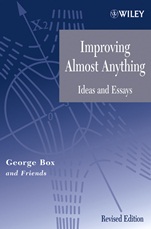
Improving Almost Anything: Ideas and Essays
ISBN 9780471727552
Autor: George E. P. Box
Wydawca: Wiley
Dostępność: 3-6 tygodni
Cena: 483,00 zł
Przed złożeniem zamówienia prosimy o kontakt mailowy celem potwierdzenia ceny.
ISBN13: |
9780471727552 |
ISBN10: |
0471727555 |
Autor: |
George E. P. Box |
Oprawa: |
Paperback |
Rok Wydania: |
2006-05-23 |
Ilość stron: |
598 |
Wymiary: |
234x156 |
Tematy: |
PB |
Masterworks in process improvement and quality technology— by George Box and friends
George Box has a unique ability to explain complex ideas simply and eloquently. This revised edition of his masterworks since 1982 clearly demonstrates the range of his wit and intellect. These fascinating readings represent the cornerstones in the theory and application of process improvement, product design, and process control. Readers will gain valuable insights into the fundamentals and philosophy of scientific method using statistics and how it can drive creativity and discovery.
The book is divided into five key parts:Part A, Some Thoughts on Quality Improvement, concerns the democratization of the scientific method and, in such papers as "When Murphy Speaks—Listen," advises managers to view operation of their processes as ongoing opportunities for improvement.Part B, Design of Experiments for Process Improvement, illustrates the enormous advantages offered by experimental design in the pursuit of better products and processes.Part C, Sequential Investigation and Discovery, shows how sequential assembly of designs allows the experimenter to match the difficulty of the problem with the effort needed to solve it.Part D, Control, describes application of feedback control in the Statistical Process Control (SPC) environment. A simple graphical technique using Box–Jenkins charts is set forth to appropriately adjust processes to target.Part E, Variance Reduction and Robustness, demonstrates how the existence of more than one source of variation may be used to achieve products robust to the environment in which they must function and emphasizes the importance of error transmission and data transformation in producing robust assemblies.
A Foreword by Dr. J. Stuart Hunter allows readers to gain insight into the workings of a remarkable mind and explains how these ideas can greatly catalyze their efforts in process improve
ment.
Spis treści:
Foreword by (J. Stuart Hunter).
Friends of George Box.
My Professional Life.
PART A: SOME THOUGHTS ON PROCESS AND QUALITY IMPROVEMENT.
Introduction.
Good Quality Costs Less? How Come?
When Murphy Speaks—Listen.
Changing Management Policy to Improve Quality and Productivity.
Scientific Method: The Generation of Knowledge.
PART B: DESIGN OF EXPERIMENTS FOR PROCESS IMPROVEMENT.
Introduction.
Do Interactions Matter?
Teaching Engineers Experimental Design with a Paper Helicopter.
What Can You Find Out from Eight Experimental Runs?
What Can You Find Out from Sixteen Experimental Runs?
What Can You Find Out from Twelve Experimental Runs?
Sequential Experimentation and Sequential Assembly of Designs.
Must We Randomize Our Experiment?
A Simple Way to Deal with Missing Observations from Designed Experiments.
Finding Bad Values in Factorial Designs.
How to Get Lucky.
Dispersion Effects from Fractional Designs.
The Importance of Practice in the Development of Statistics.
PART C: SEQUENTIAL INVESTIGATION AND DISCOVERY.
Introduction.
A Demonstration of Response Surface Methods.
Response Surface Methods: Some History.
Statistics as a Catalyst to Learning.
Experience as a Guide to Theoretical Development.
The Invention of the Composite Design.
Finding the Active Factors in Fractionated Screening Experiments.
Follow–up Designs to Resolve Confounding in Multifactor Experiments.
Projective Properties of Certain Orthogonal Arrays.
Choice of Response Surface Design and Alphabetic Optimality.
An Apology for Ecumenism in Statistics.
PART D: CONTROL.
Introduction.
Six Sigma, Process Drift, Capability Indices, and Feedback Adjustment.
Understanding Exponential Smoothing: A Simple Way to Forecast Sales and Inventory.
Feedback Control by Manual Adjustment.
Bounded Adjustment Charts.Statistical Process Monitoring and Feedback Adjustment—A Discussion.
Dicrete Proportional–Integral Control with Constrained Adjustment.
Dicrete Proportional–Integral Adjustment and Statistical Process Control.
Selection of Sampling Interval and Action Limit for Discrete Feedback Adjustment.
Use of Cusum Statistics in the Analysis of Data and in Process Monitoring.
Influence of the Sampling Interval, Decision Limit, and Autocorrelation on the Average Run Length in Cusum Charts.
Cumulative Score Charts.
PART E: VARIANCE REDUCTION AND ROBUSTNESS.
Introduction.
Multiple Sources of Variation: Variance Components.
The Importance of Data Transformation in Designd Experiments for Life Testing.
Is Your Robust Design Procedure Robust?
Split Plot Experiments.
Robustness in Statistics.
Split Plots for Robust Product and Process Experimentation.
Designing Products that Are Robust to the Experiment—A Response Surfacem Approach.
An Investigation of the Method of Accumulatin Analysis.
Signal–to–Noise Ratios, Performance Criteria, and Transformations.
PART F: SONG.
There′s No Theorem Like Bayes Theorem.
It′s distribution Free.
I Am the Very Model of a Professor Statistical.
References.
Biography.
Books and Articals Written by George Box from 1982 to 2005.
Index.
Nota biograficzna:
GEORGE BOX, PHD, DSC, FRS, is R. A. Fisher Professor Emeritus of Statistics and Industrial Engineering at the University of Wisconsin. He has been the director of research for investigators at Imperial Chemical Industries, Princeton University, and University of Wisconsin–Madison. He is a Fellow of the Royal Society of London and the American Academy of Arts and Sciences, and an Honorary Member and Shewhart and Deming Medalist of the American Society for Quality. He was awarded the Samuel S. Wilks Memorial Medal from the American Statistic
al Association and the Guy Medal in Gold from the Royal Statistical Society. He is the author of more than 200 published papers and more than a dozen critically acclaimed books.
Okładka tylna:
Masterworks in process improvement and quality technology— by George Box and friends
George Box has a unique ability to explain complex ideas simply and eloquently. This revised edition of his masterworks since 1982 clearly demonstrates the range of his wit and intellect. These fascinating readings represent the cornerstones in the theory and application of process improvement, product design, and process control. Readers will gain valuable insights into the fundamentals and philosophy of scientific method using statistics and how it can drive creativity and discovery.
The book is divided into five key parts:Part A, Some Thoughts on Quality Improvement, concerns the democratization of the scientific method and, in such papers as "When Murphy Speaks—Listen," advises managers to view operation of their processes as ongoing opportunities for improvement.Part B, Design of Experiments for Process Improvement, illustrates the enormous advantages offered by experimental design in the pursuit of better products and processes.Part C, Sequential Investigation and Discovery, shows how sequential assembly of designs allows the experimenter to match the difficulty of the problem with the effort needed to solve it.Part D, Control, describes application of feedback control in the Statistical Process Control (SPC) environment. A simple graphical technique using Box–Jenkins charts is set forth to appropriately adjust processes to target.Part E, Variance Reduction and Robustness, demonstrates how the existence of more than one source of variation may be used to achieve products robust to the environment in which they must function and emphasizes the importance of error transmission and data transformation in producing
Koszyk
Książek w koszyku: 0 szt.
Wartość zakupów: 0,00 zł
Informacje


Kontakt
Gambit
Centrum Oprogramowania
i Szkoleń Sp. z o.o.
Al. Pokoju 29b/22-24
31-564 Kraków
Siedziba Księgarni
ul. Kordylewskiego 1
31-542 Kraków
+48 12 410 5991
+48 12 410 5987
+48 12 410 5989
Subskrypcje
Administratorem danych osobowych jest firma Gambit COiS Sp. z o.o. Na podany adres będzie wysyłany wyłącznie biuletyn informacyjny.
Autoryzacja płatności

Informacje na temat autoryzacji płatności poprzez PayU.

© Copyright 2012: GAMBIT COiS Sp. z o.o. Wszelkie prawa zastrzeżone.
Projekt i wykonanie: Alchemia Studio Reklamy