


Wydawcy
Katalog tematyczny
- Archeologia (109)
- Ekonomia, finanse, business (13704)
- Filozofia (1445)
- Historia (3040)
- Języki i językoznawstwo (2356)
- Lifestyle, hobby i rozrywka (475)
- Medycyna (9704)
- Nauki humanistyczne (4)
- Nauki o Ziemi i środowisku (2638)
- Nauki ścisłe (20412)
- Astronomia (294)
- Biologia (5119)
- Chemia (6540)
- Fizyka (3309)
- Matematyka (4574)
- Algebra (171)
- Analiza matematyczna (902)
- Filozofia matematyki (1)
- Geometria (237)
- Historia matematyki (57)
- Kombinatoryka, teoria grafów (67)
- Matematyka dyskretna (35)
- Matematyka stosowana (555)
- Optymalizacja (104)
- Podstawy matematyki (129)
- Statystyka, prawdopodobieństwo (296)
- Teoria grup (63)
- Teoria liczb (77)
- Topologia (66)
- Nauki ścisłe, ogólnie (503)
- Nauki społeczne (8486)
- Nauki techniczne (13450)
- Prawo (1696)
- Publikacje informacyjne i interdyscyplinarne (1288)
- Religia i wierzenia (917)
- Technika komputerowa (4067)
- Zdrowie, relacje międzyludzkie i rozwój osobisty (657)





Informacje szczegółowe o książce
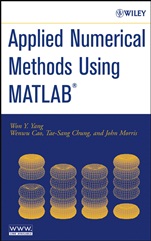
Applied Numerical Methods Using MATLAB
ISBN 9780471698333
Autor: Won Y. Yang, Wenwu Cao, Tae–Sang Chung, John Morris
Wydawca: Wiley
Dostępność: 3-6 tygodni
Cena: 707,70 zł
Przed złożeniem zamówienia prosimy o kontakt mailowy celem potwierdzenia ceny.
ISBN13: |
9780471698333 |
ISBN10: |
0471698334 |
Autor: |
Won Y. Yang, Wenwu Cao, Tae–Sang Chung, John Morris |
Oprawa: |
Hardback |
Rok Wydania: |
2005-06-03 |
Ilość stron: |
528 |
Wymiary: |
243x166 |
Tematy: |
PB |
Learn how to use MATLAB® to solve complex numerical problems
Increasingly, scientists and engineers favor MATLAB over conventional programming languages such as FORTRAN and C when they wish to solve complex problems. This book will enable readers to solve problems without needing to understand all the details of the underlying theory of numerical methods. By providing many examples of the uses of similar functions, it guides them towards the selection of the appropriate MATLAB functions for solving their problem efficiently.
The authors have incorporated existing MATLAB functions into a series of simplified, yet complete programs that may be readily adapted by students and practitioners to solve real–world engineering and science problems. Key features include:More than 100 supplemental codes Complete MATLAB programs to demonstrate solutions to real–life exercises and problems Downloadable MATLAB programs to correspond with the text Interactive demonstration programs that course instructors can use to produce visual presentations of the solution processes of some algorithms An overview of the Partial Differential Equation (PDE) toolbox An appendix with MATLAB commands/functions for symbolic computation
With very little prior programming experience, students and practitioners will find this approach invaluable to quickly learn how to solve their numerical problems.
Spis treści:
Preface.
1. MATLAB Usage and Computational Errors.
1.1 Basic Operations of MATLAB.
1.1.1 Input/Output of Data from MATLAB Command Window.
1.1.2 Input/Output of Data Through Files.
1.1.3 Input/Output of Data Using Keyboard.
1.1.4 2–D Graphic Input/Output.
1.1.5 3–D Graphic Output.
1.1.6 Mathematical Functions.
1.1.7 Operations on Vectors and Matrices.
1.1.8 Random Number Generators.
1.1.9 Flow Control.
1.2 Comp
uter Errors Versus Human Mistakes.
1.2.1 IEEE 64–bit Floating–Point Number Representation.
1.2.2 Various Kinds of Computing Errors.
1.2.3 Absolute/Relative Computing Errors.
1.2.4 Error Propagation.
1.2.5 Tips for Avoiding Large Errors.
1.3 Toward Good Program.
1.3.1 Nested Computing for Computational Efficiency.
1.3.2 Vector Operation Versus Loop Iteration.
1.3.3 Iterative Routine Versus Nested Routine.
1.3.4 To Avoid Runtime Error.
1.3.5 Parameter Sharing via Global Variables.
1.3.6 Parameter Passing Through Varargin.
1.3.7 Adaptive Input Argument List.
Problems.
2. System of Linear Equations.
2.1 Solution for a System of Linear Equations.
2.1.1 The Nonsingular Case (M = N).
2.1.2 The Underdetermined Case (M < N): Minimum–Norm Solution.
2.1.3 The Overdetermined Case (M > N): Least–Squares Error Solution.
2.1.4 RLSE (Recursive Least–Squares Estimation).
2.2 Solving a System of Linear Equations.
2.2.1 Gauss Elimination.
2.2.2 Partial Pivoting.
2.2.3 Gauss–Jordan Elimination.
2.3 Inverse Matrix.
2.4 Decomposition (Factorization).
2.4.1 LU Decomposition (Factorization): Triangularization.
2.4.2 Other Decomposition (Factorization): Cholesky, QR, and SVD.
2.5 Iterative Methods to Solve Equations.
2.5.1 Jacobi Iteration.
2.5.2 Gauss–Seidel Iteration.
2.5.3 The Convergence of Jacobi and Gauss–Seidel Iterations.
Problems.
3. Interpolation and Curve Fitting.
3.1 Interpolation by Lagrange Polynomial.
3.2 Interpolation by Newton Polynomial.
3.3 Approximation by Chebyshev Polynomial.
3.4 Pade Approximation by Rational Function.
3.5 Interpolation by Cubic Spline.
3.6 Hermite Interpolating Polynomial.
3.7 Two–dimensional Interpolation.
3.8 Curve Fitting.
3.8.1 Straight Line Fit: A Polynomial Function of First Degree.
3.8.2 Polynomial Curve Fit: A
Polynomial Function of Higher Degree.
3.8.3 Exponential Curve Fit and Other Functions.
3.9 Fourier Transform.
3.9.1 FFT Versus DFT.
3.9.2 Physical Meaning of DFT.
3.9.3 Interpolation by Using DFS.
Problems.
4. Nonlinear Equations.
4.1 Iterative Method Toward Fixed Point.
4.2 Bisection Method.
4.3 False Position or Regula Falsi Method.
4.4 Newton(–Raphson) Method.
4.5 Secant Method.
4.6 Newton Method for a System of Nonlinear Equations.
4.7 Symbolic Solution for Equations.
4.8 A Real–World Problem.
Problems.
5. Numerical Differentiation/Integration.
5.1 Difference Approximation for First Derivative.
5.2 Approximation Error of First Derivative.
5.3 Difference Approximation for Second and Higher Derivative.
5.4 Interpolating Polynomial and Numerical Differential.
5.5 Numerical Integration and Quadrature.
5.6 Trapezoidal Method and Simpson Method.
5.7 Recursive Rule and Romberg Integration.
5.8 Adaptive Quadrature.
5.9 Gauss Quadrature.
5.9.1 Gauss–Legendre Integration.
5.9.2 Gauss–Hermite Integration.
5.9.3 Gauss–Laguerre Integration.
5.9.4 Gauss–Chebyshev Integration.
5.10 Double Integral.
Problems.
6. Ordinary Differential Equations.
6.1 Euler’s Method.
6.2 Heun’s Method: Trapezoidal Method.
6.3 Runge–Kutta Method.
6.4 Predictor–Corrector Method.
6.4.1 Adams–Bashforth–Moulton Method.
6.4.2 Hamming Method.
6.4.3 Comparison of Methods.
6.5 Vector Differential Equations.
6.5.1 State Equation.
6.5.2 Discretization of LTI State Equation.
6.5.3 High–Order Differential Equation to State Equation.
6.5.4 Stiff Equation.
6.6 Boundary Value Problem (BVP).
6.6.1 Shooting Method.
6.6.2 Finite Difference Method.
Problems.
7. Optimization.
7.1 Unconstrained Optimization [L–2, Chapter 7].
7.1.1 Golden Search Method.
7.1.2 Quadratic Approximation Method.
7.1.3 Nelder–Mead Method [W–8].
7.1.4 Steepest Descent Method.
7.1.5 Newton Method.
7.1.6 Conjugate Gradient Method.
7.1.7 Simulated Annealing Method [W–7].
7.1.8 Genetic Algorithm [W–7].
7.2 Constrained Optimization [L–2, Chapter 10].
7.2.1 Lagrange Multiplier Method.
7.2.2 Penalty Function Method.
7.3 MATLAB Built–In Routines for Optimization.
7.3.1 Unconstrained Optimization.
7.3.2 Constrained Optimization.
7.3.3 Linear Programming (LP).
Problems.
8. Matrices and Eigenvalues.
8.1 Eigenvalues and Eigenvectors.
8.2 Similarity Transformation and Diagonalization.
8.3 Power Method.
8.3.1 Scaled Power Method.
8.3.2 Inverse Power Method.
8.3.3 Shifted Inverse Power Method.
8.4 Jacobi Method.
8.5 Physical Meaning of Eigenvalues/Eigenvectors.
8.6 Eigenvalue Equations.
Problems.
9. Partial Differential Equations.
9.1 Elliptic PDE.
9.2 Parabolic PDE.
9.2.1 The Explicit Forward Euler Method.
9.2.2 The Implicit Backward Euler Method.
9.2.3 The Crank–Nicholson Method.
9.2.4 Two–Dimensional Parabolic PDE.
9.3 Hyperbolic PDE.
9.3.1 The Explicit Central Difference Method.
9.3.2 Two–Dimensional Hyperbolic PDE.
9.4 Finite Element Method (FEM) for solving PDE.
9.5 GUI of MATLAB for Solving PDEs: PDETOOL.
9.5.1 Basic PDEs Solvable by PDETOOL.
9.5.2 The Usage of PDETOOL.
9.5.3 Examples of Using PDETOOL to Solve PDEs.
Problems.
Appendix A: Mean Value Theorem.
Appendix B: Matrix Operations/Properties.
Appendix C: Differentiation with Respect to a Vector.
Appendix D: Laplace Transform.
Appendix E: Fourier Transform.
Appendix F: Useful Formulas.
Appendix G: Symbolic Computation.
Appendix H: Sparse Matrices.
Appendix I: MATLAB.
References.
Subject Index.<
Koszyk
Książek w koszyku: 0 szt.
Wartość zakupów: 0,00 zł
Informacje


Kontakt
Gambit
Centrum Oprogramowania
i Szkoleń Sp. z o.o.
Al. Pokoju 29b/22-24
31-564 Kraków
Siedziba Księgarni
ul. Kordylewskiego 1
31-542 Kraków
+48 12 410 5991
+48 12 410 5987
+48 12 410 5989
Subskrypcje
Administratorem danych osobowych jest firma Gambit COiS Sp. z o.o. Na podany adres będzie wysyłany wyłącznie biuletyn informacyjny.
Autoryzacja płatności

Informacje na temat autoryzacji płatności poprzez PayU.

© Copyright 2012: GAMBIT COiS Sp. z o.o. Wszelkie prawa zastrzeżone.
Projekt i wykonanie: Alchemia Studio Reklamy