


Wydawcy
Katalog tematyczny
- Archeologia (109)
- Ekonomia, finanse, business (13704)
- Filozofia (1445)
- Historia (3040)
- Języki i językoznawstwo (2356)
- Lifestyle, hobby i rozrywka (475)
- Medycyna (9704)
- Nauki humanistyczne (4)
- Nauki o Ziemi i środowisku (2638)
- Nauki ścisłe (20412)
- Astronomia (294)
- Biologia (5119)
- Chemia (6540)
- Fizyka (3309)
- Matematyka (4574)
- Algebra (171)
- Analiza matematyczna (902)
- Filozofia matematyki (1)
- Geometria (237)
- Historia matematyki (57)
- Kombinatoryka, teoria grafów (67)
- Matematyka dyskretna (35)
- Matematyka stosowana (555)
- Optymalizacja (104)
- Podstawy matematyki (129)
- Statystyka, prawdopodobieństwo (296)
- Teoria grup (63)
- Teoria liczb (77)
- Topologia (66)
- Nauki ścisłe, ogólnie (503)
- Nauki społeczne (8486)
- Nauki techniczne (13450)
- Prawo (1696)
- Publikacje informacyjne i interdyscyplinarne (1288)
- Religia i wierzenia (917)
- Technika komputerowa (4067)
- Zdrowie, relacje międzyludzkie i rozwój osobisty (657)





Informacje szczegółowe o książce
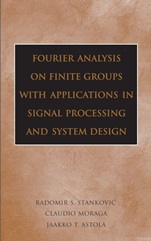
Fourier Analysis on Finite Groups with Applications in Signal Processing and System Design
ISBN 9780471694632
Autor: Radomir S. Stankovic, Claudio Moraga, Jaakko Astola
Wydawca: Wiley
Dostępność: 3-6 tygodni
Cena: 595,35 zł
Przed złożeniem zamówienia prosimy o kontakt mailowy celem potwierdzenia ceny.
ISBN13: |
9780471694632 |
ISBN10: |
0471694630 |
Autor: |
Radomir S. Stankovic, Claudio Moraga, Jaakko Astola |
Oprawa: |
Hardback |
Rok Wydania: |
2005-07-29 |
Ilość stron: |
264 |
Wymiary: |
239x166 |
Tematy: |
PB |
Discover applications of Fourier analysis on finite non–Abelian groups
The majority of publications in spectral techniques consider Fourier transform on Abelian groups. However, non–Abelian groups provide notable advantages in efficient implementations of spectral methods.
Fourier Analysis on Finite Groups with Applications in Signal Processing and System Design examines aspects of Fourier analysis on finite non–Abelian groups and discusses different methods used to determine compact representations for discrete functions providing for their efficient realizations and related applications. Switching functions are included as an example of discrete functions in engineering practice. Additionally, consideration is given to the polynomial expressions and decision diagrams defined in terms of Fourier transform on finite non–Abelian groups.
A solid foundation of this complex topic is provided by beginning with a review of signals and their mathematical models and Fourier analysis. Next, the book examines recent achievements and discoveries in:Matrix interpretation of the fast Fourier transformOptimization of decision diagramsFunctional expressions on quaternion groupsGibbs derivatives on finite groupsLinear systems on finite non–Abelian groupsHilbert transform on finite groups
Among the highlights is an in–depth coverage of applications of abstract harmonic analysis on finite non–Abelian groups in compact representations of discrete functions and related tasks in signal processing and system design, including logic design. All chapters are self–contained, each with a list of references to facilitate the development of specialized courses or self–study.
With nearly 100 illustrative figures and fifty tables, this is an excellent textbook for graduate–level students and researchers in signal processing, logic design, and system theory&#
151;as well as the more general topics of computer science and applied mathematics.
Spis treści:
Preface.
Acknowledgments.
Acronyms.
1 Signals and Their Mathematical Models.
1.1 Systems.
1.2 Signals.
1.3 Mathematical Models of Signals.
References.
2 Fourier Analysis.
2.1 Representations of Groups.
2.1.1 Complete Reducibility.
2.2 Fourier Transform on Finite Groups.
2.3 Properties of the Fourier Transform.
2.4 Matrix Interpretation of the Fourier Transform on Finite Non–Abelian Groups.
2.5 Fast Fourier Transform on Finite Non–Abelian Groups.
References.
3 Matrix Interpretation of the FFT.
3.1 Matrix Interpretation of FFT on Finite Non–Abelian Groups.
3.2 Illustrative Examples.
3.3 Complexity of the FFT.
3.3.1 Complexity of Calculations of the FFT.
3.3.2 Remarks on Programming Implememtation of FFT.
3.4 FFT Through Decision Diagrams.
3.4.1 Decision Diagrams.
3.4.2 FFT on Finite Non–Abelian Groups Through DDs.
3.4.3 MMTDs for the Fourier Spectrum.
3.4.4 Complexity of DDs Calculation Methods.
References.
4 Optimization of Decision Diagrams.
4.1 Reduction Possibilities in Decision Diagrams.
4.2 Group–Theoretic Interpretation of DD.
4.3 Fourier Decision Diagrams.
4.3.1 Fourier Decision Trees.
4.3.2 Fourier Decision Diagrams.
4.4 Discussion of Different Decompositions.
4.4.1 Algorithm for Optimization of DDs.
4.5 Representation of Two–Variable Function Generator.
4.6 Representation of Adders by Fourier DD.
4.7 Representation of Multipliers by Fourier DD.
4.8 Complexity of NADD.
4.9 Fourier DDs with Preprocessing.
4.9.1 Matrix–valued Functions.
4.9.2 Fourier Transform for Matrix–Valued Functions.
4.10 Fourier Decision Trees with Preprocessing.
4.11 Fourier Decision Diagrams with Preprocessing.
4.12 Construction of FNAPDD.
4.13 Algorithm for Construction
of FNAPDD.
4.13.1 Algorithm for Representation.
4.14 Optimization of FNAPDD.
References.
5 Functional Expressions on Quaternion Groups.
5.1 Fourier Expressions on Finite Dyadic Groups.
5.1.1 Finite Dyadic Groups.
5.2 Fourier Expressions on Q2.
5.3 Arithmetic Expressions.
5.4 Arithmetic Expressions from Walsh Expansions.
5.5 Arithmetic Expressions on Q2.
5.5.1 Arithmetic Expressions and Arithmetic–Haar Expressions.
5.5.2 Arithmetic–Haar Expressions and Kronecker Expressions.
5.6 Different Polarity Polynomials Expressions.
5.6.1 Fixed–Polarity Fourier Expressions in C(Q2).
5.6.2 Fixed–Polarity Arithmetic–Haar Expressions.
5.7 Calculation of the Arithmetic–Haar Coefficients.
5.7.1 FFT–like Algorithm.
5.7.2 Calculation of Arithmetic–Haar Coefficients Through Decision Diagrams.
References.
6 Gibbs Derivatives on Finite Groups.
6.1 Definition and Properties of Gibbs Derivatives on Finite Non–Abelian Groups.
6.2 Gibbs Anti–Derivative.
6.3 Partial Gibbs Derivatives.
6.4 Gibbs Differential Equations.
6.5 Matrix Interpretation of Gibbs Derivatives.
6.6 Fast Algorithms for Calculation of Gibbs Derivatives on Finite Groups.
6.6.1 Complexity of Calculation of Gibbs Derivatives.
6.7 Calculation of Gibbs Derivatives Through DDs.
6.7.1 Calculation of Partial Gibbs Derivatives.
References.
7 Linear Systems on Finite Non–Abelian Groups.
7.1 Linear Shift–Invariant Systems on Groups.
7.2 Linear Shift–Invariant Systems on Finite Non–Abelian Groups.
7.3 Gibbs Derivatives and Linear Systems.
7.3.1 Discussion.
References.
8 Hilbert Transform on Finite Groups.
8.1 Some Results of Fourier Analysis on Finite Non–Abelian Groups.
8.2 Hilbert Transform on Finite Non–Abelian Groups.
8.3 Hilbert Transform in Finite Field
s.
References.
Index.
Nota biograficzna:
RADOMIR S. STANKOVIC, PhD, is Professor, Department of Computer Science, Faculty of Electronics, University of Nis, Serbia.
CLAUDIO MORAGA, PhD, is Professor, Department of Computer Science, Dortmund University, Germany.
JAAKKO T. ASTOLA, PhD, is Professor, Institute of Signal Processing, Tampere University of Technology, Finland.
Okładka tylna:
Discover applications of Fourier analysis on finite non–Abelian groups
The majority of publications in spectral techniques consider Fourier transform on Abelian groups. However, non–Abelian groups provide notable advantages in efficient implementations of spectral methods.
Fourier Analysis on Finite Groups with Applications in Signal Processing and System Design examines aspects of Fourier analysis on finite non–Abelian groups and discusses different methods used to determine compact representations for discrete functions providing for their efficient realizations and related applications. Switching functions are included as an example of discrete functions in engineering practice. Additionally, consideration is given to the polynomial expressions and decision diagrams defined in terms of Fourier transform on finite non–Abelian groups.
A solid foundation of this complex topic is provided by beginning with a review of signals and their mathematical models and Fourier analysis. Next, the book examines recent achievements and discoveries in:Matrix interpretation of the fast Fourier transformOptimization of decision diagramsFunctional expressions on quaternion groupsGibbs derivatives on finite groupsLinear systems on finite non–Abelian groupsHilbert transform on finite groups
Among the highlights is an in–depth coverage of applications of abstract harmonic analysis on finite non–Abelian groups
Koszyk
Książek w koszyku: 0 szt.
Wartość zakupów: 0,00 zł
Informacje


Kontakt
Gambit
Centrum Oprogramowania
i Szkoleń Sp. z o.o.
Al. Pokoju 29b/22-24
31-564 Kraków
Siedziba Księgarni
ul. Kordylewskiego 1
31-542 Kraków
+48 12 410 5991
+48 12 410 5987
+48 12 410 5989
Subskrypcje
Administratorem danych osobowych jest firma Gambit COiS Sp. z o.o. Na podany adres będzie wysyłany wyłącznie biuletyn informacyjny.
Autoryzacja płatności

Informacje na temat autoryzacji płatności poprzez PayU.

© Copyright 2012: GAMBIT COiS Sp. z o.o. Wszelkie prawa zastrzeżone.
Projekt i wykonanie: Alchemia Studio Reklamy