


Wydawcy
Katalog tematyczny
- Archeologia (109)
- Ekonomia, finanse, business (13704)
- Filozofia (1445)
- Historia (3040)
- Języki i językoznawstwo (2356)
- Lifestyle, hobby i rozrywka (475)
- Medycyna (9704)
- Nauki humanistyczne (4)
- Nauki o Ziemi i środowisku (2638)
- Nauki ścisłe (20412)
- Astronomia (294)
- Biologia (5119)
- Chemia (6540)
- Fizyka (3309)
- Matematyka (4574)
- Algebra (171)
- Analiza matematyczna (902)
- Filozofia matematyki (1)
- Geometria (237)
- Historia matematyki (57)
- Kombinatoryka, teoria grafów (67)
- Matematyka dyskretna (35)
- Matematyka stosowana (555)
- Optymalizacja (104)
- Podstawy matematyki (129)
- Statystyka, prawdopodobieństwo (296)
- Teoria grup (63)
- Teoria liczb (77)
- Topologia (66)
- Nauki ścisłe, ogólnie (503)
- Nauki społeczne (8486)
- Nauki techniczne (13450)
- Prawo (1696)
- Publikacje informacyjne i interdyscyplinarne (1288)
- Religia i wierzenia (917)
- Technika komputerowa (4067)
- Zdrowie, relacje międzyludzkie i rozwój osobisty (657)





Informacje szczegółowe o książce
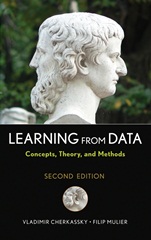
Learning from Data: Concepts, Theory, and Methods
ISBN 9780471681823
Autor: Vladimir Cherkassky, Filip M. Mulier
Wydawca: Wiley
Dostępność: 3-6 tygodni
Cena: 736,05 zł
Przed złożeniem zamówienia prosimy o kontakt mailowy celem potwierdzenia ceny.
ISBN13: |
9780471681823 |
ISBN10: |
0471681822 |
Autor: |
Vladimir Cherkassky, Filip M. Mulier |
Oprawa: |
Hardback |
Rok Wydania: |
2007-09-11 |
Numer Wydania: |
2nd Edition |
Ilość stron: |
560 |
Wymiary: |
232x170 |
Tematy: |
PB |
An interdisciplinary framework for learning methodologies—now revised and updated
Learning from Data provides a unified treatment of the principles and methods for learning dependencies from data. It establishes a general conceptual framework in which various learning methods from statistics, neural networks, and pattern recognition can be applied—showing that a few fundamental principles underlie most new methods being proposed today in statistics, engineering, and computer science.
Since the first edition was published, the field of data–driven learning has experienced rapid growth. This Second Edition covers these developments with a completely revised chapter on support vector machines, a new chapter on noninductive inference and alternative learning formulations, and an in–depth discussion of the VC theoretical approach as it relates to other paradigms.
Complete with over one hundred illustrations, case studies, examples, and chapter summaries, Learning from Data accommodates both beginning and advanced graduate students in engineering, computer science, and statistics. It is also indispensable for researchers and practitioners in these areas who must understand the principles and methods for learning dependencies from data.
Spis treści:
PREFACE.
NOTATION.
1 Introduction.
1.1 Learning and Statistical Estimation.
1.2 Statistical Dependency and Causality.
1.3 Characterization of Variables.
1.4 Characterization of Uncertainty.
1.5 Predictive Learning versus Other Data Analytical Methodologies.
2 Problem Statement, Classical Approaches, and Adaptive Learning.
2.1 Formulation of the Learning Problem.
2.1.1 Objective of Learning.
2.1.2 Common Learning Tasks.
2.1.3 Scope of the Learning Problem Formulation.
2.2 Classical Approaches.
2.2.1 Density Estimation.
2.2.2 Classification.
2.2.3 Regression.
2.2.4 Solving Problems with Finite Data.
2.2.5
Nonparametric Methods.
2.2.6 Stochastic Approximation.
2.3 Adaptive Learning: Concepts and Inductive Principles.
2.3.1 Philosophy, Major Concepts, and Issues.
2.3.2 A Priori Knowledge and Model Complexity.
2.3.3 Inductive Principles.
2.3.4 Alternative Learning Formulations.
2.4 Summary.
3 Regularization Framework.
3.1 Curse and Complexity of Dimensionality.
3.2 Function Approximation and Characterization of Complexity.
3.3 Penalization.
3.3.1 Parametric Penalties.
3.3.2 Nonparametric Penalties.
3.4 Model Selection (Complexity Control).
3.4.1 Analytical Model Selection Criteria.
3.4.2 Model Selection via Resampling.
3.4.3 Bias–Variance Tradeoff.
3.4.4 Example of Model Selection.
3.4.5 Function Approximation versus Predictive Learning.
3.5 Summary.
4 Statistical Learning Theory.
4.1 Conditions for Consistency and Convergence of ERM.
4.2 Growth Function and VC Dimension.
4.2.1 VC Dimension for Classification and Regression Problems.
4.2.2 Examples of Calculating VC Dimension.
4.3 Bounds on the Generalization.
4.3.1 Classification.
4.3.2 Regression.
4.3.3 Generalization Bounds and Sampling Theorem.
4.4 Structural Risk Minimization.
4.4.1 Dictionary Representation.
4.4.2 Feature Selection.
4.4.3 Penalization Formulation.
4.4.4 Input Preprocessing.
4.4.5 Initial Conditions for Training Algorithm.
4.5 Comparisons of Model Selection for Regression.
4.5.1 Model Selection for Linear Estimators.
4.5.2 Model Selection for k–Nearest–Neighbor Regression.
4.5.3 Model Selection for Linear Subset Regression.
4.5.4 Discussion.
4.6 Measuring the VC Dimension.
4.7 VC Dimension, Occam’s Razor, and Popper’s Falsifiability.
4.8 Summary and Discussion.
5 Nonlinear Optimization Strategies.
5.1 Stochastic Approximation Methods.
5.1.1 Linear Parameter Estimation.
5.1.2 Backpropagation Training of MLP N
etworks.
5.2 Iterative Methods.
5.2.1 EM Methods for Density Estimation.
5.2.2 Generalized Inverse Training of MLP Networks.
5.3 Greedy Optimization.
5.3.1 Neural Network Construction Algorithms.
5.3.2 Classification and Regression Trees.
5.4 Feature Selection, Optimization, and Statistical Learning Theory.
5.5 Summary.
6 Methods for Data Reduction and Dimensionality Reduction.
6.1 Vector Quantization and Clustering.
6.1.1 Optimal Source Coding in Vector Quantization.
6.1.2 Generalized Lloyd Algorithm.
6.1.3 Clustering.
6.1.4 EM Algorithm for VQ and Clustering.
6.1.5 Fuzzy Clustering.
6.2 Dimensionality Reduction: Statistical Methods.
6.2.1 Linear Principal Components.
6.2.2 Principal Curves and Surfaces.
6.2.3 Multidimensional Scaling.
6.3 Dimensionality Reduction: Neural Network Methods.
6.3.1 Discrete Principal Curves and Self–Organizing Map Algorithm.
6.3.2 Statistical Interpretation of the SOM Method.
6.3.3 Flow–Through Version of the SOM and Learning Rate Schedules.
6.3.4 SOM Applications and Modifications.
6.3.5 Self–Supervised MLP.
6.4 Methods for Multivariate Data Analysis.
6.4.1 Factor Analysis.
6.4.2 Independent Component Analysis.
6.5 Summary.
7 Methods for Regression.
7.1 Taxonomy: Dictionary versus Kernel Representation.
7.2 Linear Estimators.
7.2.1 Estimation of Linear Models and Equivalence of Representations.
7.2.2 Analytic Form of Cross–Validation.
7.2.3 Estimating Complexity of Penalized Linear Models.
7.2.4 Nonadaptive Methods.
7.3 Adaptive Dictionary Methods.
7.3.1 Additive Methods and Projection Pursuit Regression.
7.3.2 Multilayer Perceptrons and Backpropagation.
7.3.3 Multivariate Adaptive Regression Splines.
7.3.4 Orthogonal Basis Functions and Wavelet Signal Denoising.
7.4 Adaptive Kernel Methods and Local Risk Minimization.
7.4.1 Generalized Memory–Based Learning.
7
.4.2 Constrained Topological Mapping.
7.5 Empirical Studies.
7.5.1 Predicting Net Asset Value (NAV) of Mutual Funds.
7.5.2 Comparison of Adaptive Methods for Regression.
7.6 Combining Predictive Models.
7.7 Summary.
8 Classification.
8.1 Statistical Learning Theory Formulation.
8.2 Classical Formulation.
8.2.1 Statistical Decision Theory.
8.2.2 Fisher’s Linear Discriminant Analysis.
8.3 Methods for Classification.
8.3.1 Regression–Based Methods.
8.3.2 Tree–Based Methods.
8.3.3 Nearest–Neighbor and Prototype Methods.
8.3.4 Empirical Comparisons.
8.4 Combining Methods and Boosting.
8.4.1 Boosting as an Additive Model.
8.4.2 Boosting for Regression Problems.
8.5 Summary.
9 Support Vector Machines.
9.1 Motivation for Margin–Based Loss.
9.2 Margin–Based Loss, Robustness, and Complexity Control.
9.3 Optimal Separating Hyperplane.
9.4 High–Dimensional Mapping and Inner Product Kernels.
9.5 Support Vector Machine for Classification.
9.6 Support Vector Implementations.
9.7 Support Vector Regression.
9.8 SVM Model Selection.
9.9 Support Vector Machines and Regularization.
9.10 Single–Class SVM and Novelty Detection.
9.11 Summary and Discussion.
10 Noninductive Inference and Alternative Learning Formulations.
10.1 Sparse High–Dimensional Data.
10.2 Transduction.
10.3 Inference Through Contradictions.
10.4 Multiple–Model Estimation.
10.5 Summary.
11 Concluding Remarks.
Appendix A: Review of Nonlinear Optimization.
Appendix B: Eigenvalues and Singular Value Decomposition.
References.
Index.
Nota biograficzna:
Vladimir CherKassky, PhD, is Professor of Electrical and Computer Engineering at the University of Minnesota. He is internationally known for his research on neural networks and statistical learning.
Filip Mulier, PhD, has worked in the
Koszyk
Książek w koszyku: 0 szt.
Wartość zakupów: 0,00 zł
Informacje


Kontakt
Gambit
Centrum Oprogramowania
i Szkoleń Sp. z o.o.
Al. Pokoju 29b/22-24
31-564 Kraków
Siedziba Księgarni
ul. Kordylewskiego 1
31-542 Kraków
+48 12 410 5991
+48 12 410 5987
+48 12 410 5989
Subskrypcje
Administratorem danych osobowych jest firma Gambit COiS Sp. z o.o. Na podany adres będzie wysyłany wyłącznie biuletyn informacyjny.
Autoryzacja płatności

Informacje na temat autoryzacji płatności poprzez PayU.

© Copyright 2012: GAMBIT COiS Sp. z o.o. Wszelkie prawa zastrzeżone.
Projekt i wykonanie: Alchemia Studio Reklamy