


Wydawcy
Katalog tematyczny
- Archeologia (109)
- Ekonomia, finanse, business (13704)
- Filozofia (1445)
- Historia (3040)
- Języki i językoznawstwo (2356)
- Lifestyle, hobby i rozrywka (475)
- Medycyna (9704)
- Nauki humanistyczne (4)
- Nauki o Ziemi i środowisku (2638)
- Nauki ścisłe (20412)
- Astronomia (294)
- Biologia (5119)
- Chemia (6540)
- Fizyka (3309)
- Matematyka (4574)
- Algebra (171)
- Analiza matematyczna (902)
- Filozofia matematyki (1)
- Geometria (237)
- Historia matematyki (57)
- Kombinatoryka, teoria grafów (67)
- Matematyka dyskretna (35)
- Matematyka stosowana (555)
- Optymalizacja (104)
- Podstawy matematyki (129)
- Statystyka, prawdopodobieństwo (296)
- Teoria grup (63)
- Teoria liczb (77)
- Topologia (66)
- Nauki ścisłe, ogólnie (503)
- Nauki społeczne (8486)
- Nauki techniczne (13450)
- Prawo (1696)
- Publikacje informacyjne i interdyscyplinarne (1288)
- Religia i wierzenia (917)
- Technika komputerowa (4067)
- Zdrowie, relacje międzyludzkie i rozwój osobisty (657)





Informacje szczegółowe o książce
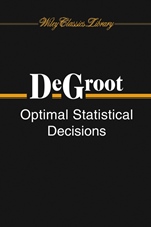
Optimal Statistical Decisions
ISBN 9780471680291
Autor: Morris H. DeGroot
Wydawca: Wiley
Dostępność: 3-6 tygodni
Cena: 703,50 zł
Przed złożeniem zamówienia prosimy o kontakt mailowy celem potwierdzenia ceny.
ISBN13: |
9780471680291 |
ISBN10: |
047168029X |
Autor: |
Morris H. DeGroot |
Oprawa: |
Paperback |
Rok Wydania: |
2004-05-28 |
Ilość stron: |
512 |
Wymiary: |
229x152 |
Tematy: |
PB |
The Wiley Classics Library consists of selected books that have become recognized classics in their respective fields. With these new unabridged and inexpensive editions, Wiley hopes to extend the life of these important works by making them available to future generations of mathematicians and scientists.
Spis treści:
Foreword.
Preface.
PART ONE. SURVEY OF PROBABILITY THEORY.
Chapter 1. Introduction.
Chapter 2. Experiments, Sample Spaces, and Probability.
2.1 Experiments and Sample Spaces.
2.2 Set Theory.
2.3 Events and Probability.
2.4 Conditional Probability.
2.5 Binomial Coefficients.
Exercises.
Chapter 3. Random Variables, Random Vectors, and Distributions Functions.
3.1 Random Variables and Their Distributions.
3.2 Multivariate Distributions.
3.3 Sums and Integrals.
3.4 Marginal Distributions and Independence.
3.5 Vectors and Matrices.
3.6 Expectations, Moments, and Characteristic Functions.
3.7 Transformations of Random Variables.
3.8 Conditional Distributions.
Exercises.
Chapter 4. Some Special Univariate Distributions.
4.1 Introduction.
4.2 The Bernoulli Distributions.
4.3 The Binomial Distribution.
4.4 The Poisson Distribution.
4.5 The Negative Binomial Distribution.
4.6 The Hypergeometric Distribution.
4.7 The Normal Distribution.
4.8 The Gamma Distribution.
4.9 The Beta Distribution.
4.10 The Uniform Distribution.
4.11 The Pareto Distribution.
4.12 The t Distribution.
4.13 The F Distribution.
Exercises.
Chapter 5. Some Special Multivariate Distributions.
5.1 Introduction.
5.2 The Multinomial Distribution.
5.3 The Dirichlet Distribution.
5.4 The Multivariate Normal Distribution.
5.5 The Wishart Distribution.
5.6 The Multivariate t Distribution.
5.7 The Bilateral Bivariate Pareto Distribution.
Exercises.
PART TWO. SUBJECTIVE PROBABILITY
AND UTILITY.
Chapter 6. Subjective Probability.
6.1 Introduction.
6.2 Relative Likelihood.
6.3 The Auxiliary Experiment.
6.4 Construction of the Probability Distribution.
6.5 Verification of the Properties of a Probability Distribution.
6.6 Conditional Likelihoods.
Exercises.
Chapter 7. Utility.
7.1 Preferences Among Rewards.
7.2 Preferences Among Probability Distributions.
7.3 The Definitions of a Utility Function.
7.4 Some Properties of Utility Functions.
7.5 The Utility of Monetary Rewards.
7.6 Convex and Concave Utility Functions.
7.7 The Anxiomatic Development of Utility.
7.8 Construction of the Utility Function.
7.9 Verification of the Properties of a Utility Function.
7.10 Extension of the Properties of a Utility Function to the Class ?E.
Exercises.
PART THREE. STATISTICAL DECISION PROBLEMS.
Chapter 8. Decision Problems.
8.1 Elements of a Decision Problem.
8.2 Bayes Risk and Bayes Decisions.
8.3 Nonnegative Loss Functions.
8.4 Concavity of the Bayes Risk.
8.5 Randomization and Mixed Decisions.
8.6 Convex Sets.
8.7 Decision Problems in Which ∼2 and D Are Finite.
8.8 Decision Problems with Observations.
8.9 Construction of Bayes Decision Functions.
8.10 The Cost of Observation.
8.11 Statistical Decision Problems in Which Both ? and D contains Two Points.
8.12 Computation of the Posterior Distribution When the Observations Are Made in More Than One Stage.
Exercises.
Chapter 9. Conjugate Prior Distributions.
9.1 Sufficient Statistics.
9.2 Conjugate Families of Distributions.
9.3 Construction of the Conjugate Family.
9.4 Conjugate Families for Samples from Various Standard Distributions.
9.5 Conjugate Families for Samples from a Normal Distribution.
9.6 Sampling from a Normal Distribution with Unknown Mean and Unknown Precision.
9.7 Sampling from a Uniform Distribution.
9.8 A Conjugate Fa
mily for Multinomial Observations.
9.9 Conjugate Families for Samples from a Multivariate Normal Distribution.
9.10 Multivariate Normal Distributions with Unknown Mean Vector and Unknown Precision matrix.
9.11 The Marginal Distribution of the Mean Vector.
9.12 The Distribution of a Correlation.
9.13 Precision Matrices Having an Unknown Factor.
Exercises.
Chapter 10. Limiting Posterior Distributions.
10.1 Improper Prior Distributions.
10.2 Improper Prior Distributions for Samples from a Normal Distribution.
10.3 Improper Prior Distributions for Samples from a Multivariate Normal Distribution.
10.4 Precise Measurement.
10.5 Convergence of Posterior Distributions.
10.6 Supercontinuity.
10.7 Solutions of the Likelihood Equation.
10.8 Convergence of Supercontinuous Functions.
10.9 Limiting Properties of the Likelihood Function.
10.10 Normal Approximation to the Posterior Distribution.
10.11 Approximation for Vector Parameters.
10.12 Posterior Ratios.
Exercises.
Chapter 11. Estimation, Testing Hypotheses, and linear Statistical Models.
11.1 Estimation.
11.2 Quadratic Loss.
11.3 Loss Proportional to the Absolute Value of the Error.
11.4 Estimation of a Vector.
11.5 Problems of Testing Hypotheses.
11.6 Testing a Simple Hypothesis About the Mean of a Normal Distribution.
11.7 Testing Hypotheses about the Mean of a Normal Distribution.
11.8 Deciding Whether a Parameter Is Smaller or larger Than a Specific Value.
11.9 Deciding Whether the Mean of a Normal Distribution Is Smaller or larger Than a Specific Value.
11.10 Linear Models.
11.11 Testing Hypotheses in Linear Models.
11.12 Investigating the Hypothesis That Certain Regression Coefficients Vanish.
11.13 One–Way Analysis of Variance.
Exercises.
PART FOUR. SEQUENTIAL DECISIONS.
Chapter 12. Sequential Sampling.
12.1 Gains from Sequential Sampling.
12.2 Sequential Decision Procedures
.
12.3 The Risk of a Sequential Decision Procedure.
12.4 Backward Induction.
12.5 Optimal Bounded Sequential Decision procedures.
12.6 Illustrative Examples.
12.7 Unbounded Sequential Decision Procedures.
12.8 Regular Sequential Decision Procedures.
12.9 Existence of an Optimal Procedure.
12.10 Approximating an Optimal Procedure by Bounded Procedures.
12.11 Regions for Continuing or Terminating Sampling.
12.12 The Functional Equation.
12.13 Approximations and Bounds for the Bayes Risk.
12.14 The Sequential Probability–ratio Test.
12.15 Characteristics of Sequential Probability–ratio Tests.
12.16 Approximating the Expected Number of Observations.
Exercises.
Chapter 13. Optimal Stopping.
13.1 Introduction.
13.2 The Statistician’s Reward.
13.3 Choice of the Utility Function.
13.4 Sampling Without Recall.
13.5 Further Problems of Sampling with Recall and Sampling without Recall.
13.6 Sampling without Recall from a Normal Distribution with Unknown Mean.
13.7 Sampling with Recall from a Normal Distribution with Unknown Mean.
13.8 Existence of Optimal Stopping Rules.
13.9 Existence of Optimal Stopping Rules for Problems of Sampling with Recall and Sampling without Recall.
13.10 Martingales.
13.11 Stopping Rules for Martingales.
13.12 Uniformly Integrable Sequences of Random Variables.
13.13 Martingales Formed from Sums and Products of Random Variables.
13.14 Regular Supermartingales.
13.15 Supermartingales and General Problems of Optimal Stopping.
13.16 Markov Processes.
13.17 Stationary Stopping Rules for Markov Processes.
13.18 Entrance–fee Problems.
13.19 The Functional Equation for a Markov Process.
Exercises.
Chapter 14. Sequential Choice of Experiments.
14.1 Introduction.
14.2 Markovian Decision Processes with a Finite Number of Stages.
14.3 Markovian Decision Processes with an Infinite Number of Stages.
14.
Koszyk
Książek w koszyku: 0 szt.
Wartość zakupów: 0,00 zł
Informacje


Kontakt
Gambit
Centrum Oprogramowania
i Szkoleń Sp. z o.o.
Al. Pokoju 29b/22-24
31-564 Kraków
Siedziba Księgarni
ul. Kordylewskiego 1
31-542 Kraków
+48 12 410 5991
+48 12 410 5987
+48 12 410 5989
Subskrypcje
Administratorem danych osobowych jest firma Gambit COiS Sp. z o.o. Na podany adres będzie wysyłany wyłącznie biuletyn informacyjny.
Autoryzacja płatności

Informacje na temat autoryzacji płatności poprzez PayU.

© Copyright 2012: GAMBIT COiS Sp. z o.o. Wszelkie prawa zastrzeżone.
Projekt i wykonanie: Alchemia Studio Reklamy