


Wydawcy
Katalog tematyczny
- Archeologia (109)
- Ekonomia, finanse, business (13704)
- Filozofia (1445)
- Historia (3040)
- Języki i językoznawstwo (2356)
- Lifestyle, hobby i rozrywka (475)
- Medycyna (9704)
- Nauki humanistyczne (4)
- Nauki o Ziemi i środowisku (2638)
- Nauki ścisłe (20412)
- Astronomia (294)
- Biologia (5119)
- Chemia (6540)
- Fizyka (3309)
- Matematyka (4574)
- Algebra (171)
- Analiza matematyczna (902)
- Filozofia matematyki (1)
- Geometria (237)
- Historia matematyki (57)
- Kombinatoryka, teoria grafów (67)
- Matematyka dyskretna (35)
- Matematyka stosowana (555)
- Optymalizacja (104)
- Podstawy matematyki (129)
- Statystyka, prawdopodobieństwo (296)
- Teoria grup (63)
- Teoria liczb (77)
- Topologia (66)
- Nauki ścisłe, ogólnie (503)
- Nauki społeczne (8486)
- Nauki techniczne (13450)
- Prawo (1696)
- Publikacje informacyjne i interdyscyplinarne (1288)
- Religia i wierzenia (917)
- Technika komputerowa (4067)
- Zdrowie, relacje międzyludzkie i rozwój osobisty (657)





Informacje szczegółowe o książce
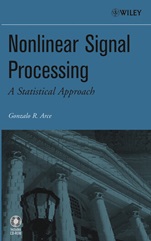
Nonlinear Signal Processing: A Statistical Approach
ISBN 9780471676249
Autor: Gonzalo R. Arce
Wydawca: Wiley
Dostępność: 3-6 tygodni
Cena: 675,15 zł
Przed złożeniem zamówienia prosimy o kontakt mailowy celem potwierdzenia ceny.
ISBN13: |
9780471676249 |
ISBN10: |
0471676241 |
Autor: |
Gonzalo R. Arce |
Oprawa: |
Hardback |
Rok Wydania: |
2004-11-19 |
Ilość stron: |
480 |
Wymiary: |
243x166 |
Tematy: |
PB |
A Unified Treatment of Non–Gaussian Processes and Nonlinear Signal Processing
Nonlinear signal processing methods are finding numerous applications in such fields as imaging, teletraffic, communications, hydrology, geology, and economics–fields where nonlinear systems and non–Gaussian processes emerge. Within a broad class of nonlinear signal processing methods, this book provides a unified treatment of optimal and adaptive signal processing tools that mirror those of Wiener and Widrow, extensively presented in the linear filter theory literature. The methods detailed in this book can thus be tailored to effectively exploit non–Gaussian signal statistics in a system or its inherent nonlinearities to overcome many of the limitations of the traditional practices used in signal processing.
Chapters include:A review of non–Gaussian models, with an emphasis on the class of generalized Gaussian distributions and the class of stable distributionsThe basic principles of order statisticsMaximum likelihood and robust estimation principlesSignal processing tools based on weighted medians and stack filtersFilters based on linear combinations of order statistics and various generalizationsSignal processing methods tailored for signals described by stable distributions
Numerous problems, examples, and case studies enable rapid mastery of the topics discussed, and over 60 MATLAB m–files allow the reader to quickly design and apply the algorithms to any application.
Spis treści:
Preface.
Acknowledgments.
Acronyms.
1. Introduction.
1.1 Non–Gaussian Random Processes.
1.1.1 Generalized Gaussian Distributions and Weighted Medians.
1.1.2 Stable Distributions and Weighted Myriads.
1.2 Statistical Foundations.
1.3 The Filtering Problem.
1.3.1 Moment Theory.
PART I: STATISTICAL FOUNDATIONS.
2. Non–Gau
ssian Models.
2.1 Generalized Gaussian Distributions.
2.2 Stable Distributions.
2.2.1 Definitions.
2.2.2 Symmetric Stable Distributions.
2.2.3 Generalized Central Limit Theorem.
2.2.4 Simulation of Stable Sequences.
2.3 Lower Order Moments.
2.3.1 Fractional Lower Order Moments.
2.3.2 Zero Order Statistics.
2.3.3 Parameter Estimation of Stable Distributions.
Problems.
3. Order Statistics.
3.1 Distributions of Order Statistics.
3.2 Moments of Order Statistics.
3.2.1 Order Statistics From Uniform Distributions.
3.2.2 Recurrence Relations.
3.3 Order Statistics Containing Outliers.
3.4 Joint Statistics of Ordered and Non–Ordered Samples.
Problems.
4. Statistical Foundations of Filtering.
4.1 Properties of Estimators.
4.2 Maximum Likelihood Estimation.
4.3 Robust Estimation.
Problems.
PART II: SIGNAL PROCESSING WITH ORDER STATISTICS.
5. Median and Weighted Median Smoothers.
5.1 Running Median Smoothers.
5.1.1 Statistical Properties.
5.1.2 Root Signals (Fixed Points).
5.2 Weighted Median Smoothers.
5.2.1 The Center Weighted Median Smoother.
5.2.2 Permutation Weighted Median Smoothers.
5.3 Threshold Decomposition Representation.
5.3.1 Stack Smoothers.
5.4 Weighted Medians in Least Absolute Deviation (LAD) Regression.
5.4.1 Foundation and Cost Functions.
5.4.2 LAD Regression with Weighted Medians.
5.4.3 Simulation.
Problems.
6. Weighted Median Filters.
6.1 Weighted Median Filters With Real–Valued Weights.
6.1.1 Permutation Weighted Median Filters.
6.2 Spectral Design of Weighted Median Filters.
6.2.1 Median Smoothers and Sample Selection Probabilities.
6.2.2 SSPs for Weighted Median Smoothers.
6.2.3 Synthesis of WM Smoothers.
6.2.4 General Iterative Solution.
6.2.5 Spectral Design of Weighted Median Filters Admitting Real–Valued Weights.
6.3 The Optimal Weighted Median Filt
ering Problem.
6.3.1 Threshold Decomposition for Real–Valued Signals.
6.3.2 The Least Mean Absolute (LMA) Algorithm.
6.4 Recursive Weighted Median Filters.
6.4.1 Threshold Decomposition Representation of Recursive WM Filters.
6.4.2 Optimal Recursive Weighted Median Filtering.
6.5 Mirrored Threshold Decomposition and Stack Filters.
6.5.1 Stack Filters.
6.5.2 Stack Filter Representation of Recursive WM Filters.
6.6 Complex Valued Weighted Median Filter.
6.6.1 Phase Coupled Complex WM Filters.
6.6.2 Marginal Phase Coupled Complex WM Filter.
6.6.3 Complex Threshold Decomposition.
6.6.4 Optimal Marginal Phase Coupled Complex WM.
6.6.5 Spectral Design of Complex Valued Weighted Medians.
6.7 Weighted Median Filters for Multichannel Signals.
6.7.1 Marginal WM Filter.
6.7.2 Vector WM Filter.
6.7.3 Weighted Multichannel Median Filtering Structures.
6.7.4 Filter Optimization.
Problems.
7. Linear Combination or Order Statistics.
7.1 L–Estimates of Location.
7.2 L–Smoothers.
7.3 Lℓ–Filters.
7.3.1 Design and Optimization of Lℓ Filters.
7.4 Ljℓ Permutation Filters.
7.5 Hybrid Median/Linear FIR Filters.
7.5.1 Median and FIR Affinity Trimming.
7.6 Linear Combination of Weighted Medians.
7.6.1 LCWM Filters.
7.6.2 Design of LCWM Filters.
7.6.3 Symmetric LCWM Filters.
Problems.
PART III: SIGNAL PROCESSING WITH THE STABLE MODEL.
8. Myriad Smoothers.
8.1 FLOM Smoothers.
8.2 Running Myriad Smoothers.
8.3 Optimality of the Sample Myriad.
8.4 Weighted Myriad Smoothers.
8.5 Fast Weighted Myriad Computation.
8.6 Weighted Myriad Smoother Design.
8.6.1 Center Weighted Myriads for Image Denoising.
8.6.2 Myriadization.
Problems.
9. Weighted Myriad Filters.
9.1 Weighted Myriad Filters with Real–Valued Weights.
9.2 Fast Real–Valued Weighted Myriad Co
mputation.
9.3 Weighted Myriad Filter Design.
9.3.1 Myriadization.
9.3.2 Optimization.
Problems.
References.
Appendix A: Software Guide.
Index.
Nota biograficzna:
GONZALO R. ARCE received a PhD degree in electrical engineering from Purdue University in 1982. Since 1982, he has been with the faculty of the Department of Electrical and Computer Engineering at the University of Delaware where he is currently Charles Black Evans Distinguished Professor and Chairman. He has held visiting professor appointments at the Unisys Corporate Research Center and at the International Center for Signal and Image Processing, Tampere University of Technology, in Tampere, Finland. He holds seven U.S. patents, and his research has been funded by DoD, NSF, and numerous industrial organizations. He is an IEEE Fellow for his contributions to the theory and applications of nonlinear signal processing.
Okładka tylna:
A Unified Treatment of Non–Gaussian Processes and Nonlinear Signal Processing
Nonlinear signal processing methods are finding numerous applications in such fields as imaging, teletraffic, communications, hydrology, geology, and economics–fields where nonlinear systems and non–Gaussian processes emerge. Within a broad class of nonlinear signal processing methods, this book provides a unified treatment of optimal and adaptive signal processing tools that mirror those of Wiener and Widrow, extensively presented in the linear filter theory literature. The methods detailed in this book can thus be tailored to effectively exploit non–Gaussian signal statistics in a system or its inherent nonlinearities to overcome many of the limitations of the traditional practices used in signal processing.
Chapters include:A review of non–Gaussian models, with an emphasis on the class of generalized Gaussian distributions and the class of stable distributionsThe basic principles
Koszyk
Książek w koszyku: 0 szt.
Wartość zakupów: 0,00 zł
Informacje


Kontakt
Gambit
Centrum Oprogramowania
i Szkoleń Sp. z o.o.
Al. Pokoju 29b/22-24
31-564 Kraków
Siedziba Księgarni
ul. Kordylewskiego 1
31-542 Kraków
+48 12 410 5991
+48 12 410 5987
+48 12 410 5989
Subskrypcje
Administratorem danych osobowych jest firma Gambit COiS Sp. z o.o. Na podany adres będzie wysyłany wyłącznie biuletyn informacyjny.
Autoryzacja płatności

Informacje na temat autoryzacji płatności poprzez PayU.

© Copyright 2012: GAMBIT COiS Sp. z o.o. Wszelkie prawa zastrzeżone.
Projekt i wykonanie: Alchemia Studio Reklamy