


Wydawcy
Katalog tematyczny
- Archeologia (109)
- Ekonomia, finanse, business (13704)
- Filozofia (1445)
- Historia (3040)
- Języki i językoznawstwo (2356)
- Lifestyle, hobby i rozrywka (475)
- Medycyna (9704)
- Nauki humanistyczne (4)
- Nauki o Ziemi i środowisku (2638)
- Nauki ścisłe (20412)
- Astronomia (294)
- Biologia (5119)
- Chemia (6540)
- Fizyka (3309)
- Matematyka (4574)
- Algebra (171)
- Analiza matematyczna (902)
- Filozofia matematyki (1)
- Geometria (237)
- Historia matematyki (57)
- Kombinatoryka, teoria grafów (67)
- Matematyka dyskretna (35)
- Matematyka stosowana (555)
- Optymalizacja (104)
- Podstawy matematyki (129)
- Statystyka, prawdopodobieństwo (296)
- Teoria grup (63)
- Teoria liczb (77)
- Topologia (66)
- Nauki ścisłe, ogólnie (503)
- Nauki społeczne (8486)
- Nauki techniczne (13450)
- Prawo (1696)
- Publikacje informacyjne i interdyscyplinarne (1288)
- Religia i wierzenia (917)
- Technika komputerowa (4067)
- Zdrowie, relacje międzyludzkie i rozwój osobisty (657)





Informacje szczegółowe o książce
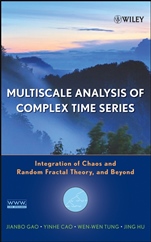
Multiscale Analysis of Complex Time Series: Integration of Chaos and Random Fractal Theory, and Beyond
ISBN 9780471654704
Autor: Jianbo Gao, Yinhe Cao, Wen–wen Tung, Jing Hu
Wydawca: Wiley
Dostępność: 3-6 tygodni
Cena: 597,45 zł
Przed złożeniem zamówienia prosimy o kontakt mailowy celem potwierdzenia ceny.
ISBN13: |
9780471654704 |
ISBN10: |
0471654701 |
Autor: |
Jianbo Gao, Yinhe Cao, Wen–wen Tung, Jing Hu |
Oprawa: |
Hardback |
Rok Wydania: |
2007-10-16 |
Ilość stron: |
368 |
Wymiary: |
238x167 |
Tematy: |
PB |
The only integrative approach to chaos and random fractal theory
Chaos and random fractal theory are two of the most important theories developed for data analysis. Until now, there has been no single book that encompasses all of the basic concepts necessary for researchers to fully understand the ever–expanding literature and apply novel methods to effectively solve their signal processing problems. Multiscale Analysis of Complex Time Series fills this pressing need by presenting chaos and random fractal theory in a unified manner.
Adopting a data–driven approach, the book covers:
DNA sequence analysis
EEG analysis
Heart rate variability analysis
Neural information processing
Network traffic modeling
Economic time series analysis
And more
Additionally, the book illustrates almost every concept presented through applications and a dedicated Web site is available with source codes written in various languages, including Java, Fortran, C, and MATLAB, together with some simulated and experimental data. The only modern treatment of signal processing with chaos and random fractals unified, this is an essential book for researchers and graduate students in electrical engineering, computer science, bioengineering, and many other fields.
Spis treści:
Preface.
1. Introduction.
1.1 Examples of multiscale phenomena.
1.2 Examples of challenging problems to be pursued.
1.3 Outline of the book.
1.4 Bibliographic notes.
2. Overview of fractal and chaos theory.
2.1 Prelude to fractal geometry.
2.2 Prelude to chaos theory.
2.3 Further reading and bibliographic notes.
2.4 Warming up exercises.
3. Basics of probability theory and stochastic processes.
3.1 Basic elements of probability theory.
3.1.1 Probability system.
3.1.2 Random variables.
3.1.3 Expectation.
3.1.4 Chara
cteristic function, moment generating function, Laplace.
transform, and probability generating function.
3.2 Commonly used distributions.
3.3 Stochastic processes.
3.3.1 Basic definitions.
3.3.2 Markov processes.
3.4 Special topic: How to find relevant information for a new field quickly?.
3.5 Bibliographic notes.
3.6 Exercises.
4. Fourier analysis and wavelet multiresolution analysis.
4.1 Fourier analysis.
4.1.1 Continuous–time signals.
4.1.2 Discrete–time signals.
4.1.3 Sampling theorem.
4.1.4 Discrete Fourier transform.
4.1.5 Fourier analysis of real data.
4.2 Wavelet multiresolution analysis.
4.3 Bibliographic notes.
4.4 Exercises.
5. Basics of fractal geometry.
5.1 The notion of dimension.
5.2 Geometrical fractals.
5.2.1 Cantor sets.
5.2.2 Von Koch curves.
5.3 Power–law and perception of self–similarity.
5.4 Bibliographical notes.
5.5 Exercises.
6. Self–similar stochastic processes.
6.1 General definition.
6.2 Brownian motion (Bm).
6.3 Fractional Brownian motion (fBm).
6.4 Dimensions of Bm and fBm processes.
6.5 Wavelet representation of fBm processes.
6.6 Synthesis of fBm processes.
6.7 Applications.
6.7.1 Network traffic modeling.
6.7.2 Modeling of rough surfaces.
6.8 Bibliographical notes.
6.9 Exercises.
7. Stable laws and Levy motions.
7.1 Stable distributions.
7.2 Summation of strictly stable random variables.
7.3 Tail probabilities and extreme events.
7.4 Generalized central limit theorem.
7.5 Levy motions.
7.6 Simulation of stable random variables.
7.7 Bibliographical notes.
7.8 Exercises.
8. Long memory processes and structure–function–based multifractal analysis.
8.1 Long memory: basic definitions.
8.2 Estimation of the Hurst parameter.
8.3 Random walk representation and structure function based multifractal analysis.
8.3.
1 Random walk representation.
8.3.2 Structure function based multifractal analysis.
8.3.3 Understanding the Hurst parameter through multifractal analysis.
8.4 Other random–walk based scaling parameter estimation.
8.5 Other formulations of multifractal analysis.
8.6 The notion of finite scaling and consistency of estimators.
8.7 Correlation structure of ON/OFF intermittency and Levy motions.
8.7.1 Correlation structure of ON/OFF intermittency.
8.7.2 Correlation structure of Levy motions.
8.8 Dimension reduction of fractal processes using Principal Component Analysis.
8.9 Broad applications.
8.9.1 Detection of low observable targets within sea clutter.
8.9.2 Deciphering the causal relation between neural inputs and movements by analyzing neuronal firings.
8.9.3 Protein coding region identification.
8.10 Bibliographic notes.
8.11 Exercises.
9. Multiplicative multifractals.
9.1 Definition.
9.2 Construction of multiplicative multifractals.
9.3 Properties of multiplicative multifractals.
9.4 Intermittency in fully developed turbulence.
9.4.1 Extended self–similarity.
9.4.2 The log–normal model.
9.4.3 The log–stable model.
9.4.4 The β–model.
9.4.5 The random β–model.
9.4.6 The p model.
9.4.7 The SL model and log–Poisson statistics of turbulence.
9.5 Applications.
9.5.1 Target detection within sea clutter.
9.5.2 Modeling and discrimination of human neuronal activity.
9.5.3 Analysis and modeling of network traffic.
9.6 Bibliographic notes.
9.7 Exercises.
10. Stage–dependent multiplicative processes.
10.1 Description of the model.
10.2 Cascade representation of 1/ƒβ processes.
10.3 Application: Modeling heterogeneous Internet traffic.
10.3.1 General considerations.
10.3.2 An example.
10.4 Bibliographic notes.
10.5 Exercises.
11. Models of power–
;law–type behavior.
11.1 Models for heavy–tailed distribution.
11.1.1 Power–law through queuing.
11.1.2 Power–law through approximation by log–normal distribution.
11.1.3 Power–law through transformation of exponential distribution.
11.1.4 Power–law through maximization of Tsallis nonextensive entropy.
11.1.5 Power–law through optimization.
11.2 Models for 1/ƒβ processes.
11.2.1 1/ƒβ processes from superposition of relaxation processes.
11.2.2 1/ƒβ processes modeled by ON/OFF trains.
11.2.3 1/ƒβ processes modeled by self–organized criticality.
11.3 Applications.
11.3.1 Mechanism for long–range–dependent network traffic.
11.3.2 Distributional analysis of sea clutter.
11.4 Bibliographic notes.
11.5 Exercises.
12. Bifurcation theory.
12.1 Bifurcations from a steady solution in continuous time systems.
12.1.1 General considerations.
12.1.2 Saddle–node bifurcation.
12.1.3 Transcritical bifurcation.
12.1.4 Pitchfork bifurcation.
12.2 Bifurcations from a steady solution in discrete maps.
12.3 Bifurcations in high–dimensional space.
12.4 Bifurcations and fault–tolerant computations.
12.4.1 Error threshold values for arbitrary K–input NAND gates.
12.4.2 Noisy majority gate.
12.4.3 Analysis of von Neumann′s multiplexing system.
12.5 Bibliographic notes.
12.6 Exercises.
13. Chaotic time series analysis.
13.1 Phase space reconstruction by the time delay embedding.
13.1.1 General considerations.
13.1.2 Defending against network intrusions and worms.
13.1.3 Optimal embedding.
13.2 Characterization of chaotic attractors.
13.2.1 Dimension.
13.2.2 Lyapunov exponents.
13.2.3 Entropy.
13.3 Test for low–dimensional chaos.
13.4 The importance of the concept of scale.<
Koszyk
Książek w koszyku: 0 szt.
Wartość zakupów: 0,00 zł
Informacje


Kontakt
Gambit
Centrum Oprogramowania
i Szkoleń Sp. z o.o.
Al. Pokoju 29b/22-24
31-564 Kraków
Siedziba Księgarni
ul. Kordylewskiego 1
31-542 Kraków
+48 12 410 5991
+48 12 410 5987
+48 12 410 5989
Subskrypcje
Administratorem danych osobowych jest firma Gambit COiS Sp. z o.o. Na podany adres będzie wysyłany wyłącznie biuletyn informacyjny.
Autoryzacja płatności

Informacje na temat autoryzacji płatności poprzez PayU.

© Copyright 2012: GAMBIT COiS Sp. z o.o. Wszelkie prawa zastrzeżone.
Projekt i wykonanie: Alchemia Studio Reklamy