


Wydawcy
Katalog tematyczny
- Archeologia (109)
- Ekonomia, finanse, business (13704)
- Filozofia (1445)
- Historia (3040)
- Języki i językoznawstwo (2356)
- Lifestyle, hobby i rozrywka (475)
- Medycyna (9704)
- Nauki humanistyczne (4)
- Nauki o Ziemi i środowisku (2638)
- Nauki ścisłe (20412)
- Astronomia (294)
- Biologia (5119)
- Chemia (6540)
- Fizyka (3309)
- Matematyka (4574)
- Algebra (171)
- Analiza matematyczna (902)
- Filozofia matematyki (1)
- Geometria (237)
- Historia matematyki (57)
- Kombinatoryka, teoria grafów (67)
- Matematyka dyskretna (35)
- Matematyka stosowana (555)
- Optymalizacja (104)
- Podstawy matematyki (129)
- Statystyka, prawdopodobieństwo (296)
- Teoria grup (63)
- Teoria liczb (77)
- Topologia (66)
- Nauki ścisłe, ogólnie (503)
- Nauki społeczne (8486)
- Nauki techniczne (13450)
- Prawo (1696)
- Publikacje informacyjne i interdyscyplinarne (1288)
- Religia i wierzenia (917)
- Technika komputerowa (4067)
- Zdrowie, relacje międzyludzkie i rozwój osobisty (657)





Informacje szczegółowe o książce
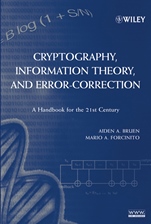
Cryptography, Information Theory, and Error–Correction: A Handbook for the 21st Century
ISBN 9780471653172
Autor: Aiden A. Bruen, Mario A. Forcinito
Wydawca: Wiley
Dostępność: 3-6 tygodni
Cena: 822,15 zł
Przed złożeniem zamówienia prosimy o kontakt mailowy celem potwierdzenia ceny.
ISBN13: |
9780471653172 |
ISBN10: |
0471653179 |
Autor: |
Aiden A. Bruen, Mario A. Forcinito |
Oprawa: |
Hardback |
Rok Wydania: |
2005-02-01 |
Ilość stron: |
496 |
Wymiary: |
260x187 |
Tematy: |
PB |
Discover the first unified treatment of today′s most essential information technologies— Compressing, Encrypting, and Encoding
With identity theft, cybercrime, and digital file sharing proliferating in today′s wired world, providing safe and accurate information transfers has become a paramount concern. The issues and problems raised in this endeavor are encompassed within three disciplines: cryptography, information theory, and error–correction. As technology continues to develop, these fields have converged at a practical level, increasing the need for a unified treatment of these three cornerstones of the information age.
Stressing the interconnections of the disciplines, Cryptography, Information Theory, and Error–Correction offers a complete, yet accessible account of the technologies shaping the 21st century. This book contains the most up–to–date, detailed, and balanced treatment available on these subjects. The authors draw on their experience both in the classroom and in industry, giving the book′s material and presentation a unique real–world orientation.
With its reader–friendly style and interdisciplinary emphasis, Cryptography, Information Theory, and Error–Correction serves as both an admirable teaching text and a tool for self–learning. The chapter structure allows for anyone with a high school mathematics education to gain a strong conceptual understanding, and provides higher–level students with more mathematically advanced topics. The authors clearly map out paths through the book for readers of all levels to maximize their learning.
This book:Is suitable for courses in cryptography, information theory, or error–correction as well as courses discussing all three areasProvides over 300 example problems with solutionsPresents new and exciting algorithms adopted by industryDiscusses potential applications in cell biologyDetails a new characterization of perfect secrecyFeatures in–depth coverage of linear feedback shift registers (LFSR), a staple of modern computingFollows a layered approach to facilitate discussion, with summaries followed by more detailed explanationsProvides a new perspective on the RSA algorithm
Cryptography, Information Theory, and Error–Correction is an excellent in–depth text for both graduate and undergraduate students of mathematics, computer science, and engineering. It is also an authoritative overview for IT professionals, statisticians, mathematicians, computer scientists, electrical engineers, entrepreneurs, and the generally curious.
Spis treści:
Preface.
I. CRYPTOGRAPHY.
1. History and Claude E. Shannon.
1.1 Historical Background.
1.2 Brief Biography of Claude E. Shannon.
1.3 Career.
1.4 Personal – Professional.
1.5 Scientific Legacy.
1.6 Modern Developments.
2. Classical Ciphers and Their Cryptanalysis.
2.1 Introduction.
2.2 The Caesar Cipher.
2.3 The Scytale Cipher.
2.4 The Vigenère Cipher.
2.5 Affine Ciphers.
2.6 The Enigma Machine and its Mathematics.
2.7 Frequency Analysis.
2.8 Breaking the Vigenère Cipher.
2.9 Modern Enciphering Systems.
2.10 Problems.
2.11 Solutions.
3. RSA and Key Searches.
3.1 Background.
3.2 The Basic Idea.
3.3 Public–key Cryptography and RSA on a Calculator.
3.4 The General RSA Algorithm.
3.5 Public Key Versus Symmetric Key.
3.6 Attacks, Security of DES.
3.7 Summary.
3.8 Problems.
3.9 Solutions.
4. The Fundamentals of Modern Cryptography.
4.1 Encryption Re–visited.
4.2 Block Ciphers, Shannon’s Confusion and Diffusion.
4.3 Perfect Secrecy, Stream Ciphers, One–Time Pad.
4.4 Hash Functions.
4.5 Message Integrity Using Symmetric Cryptography.
4.6 General Pub
lic–Key Cryptosystems.
4.7 Electronic Signatures.
4.8 The Diffie–Hellman Key Exchange.
4.9 Quantum Encryption.
4.10 Key Management and Kerberos.
4.11 DES.
4.12 Problems.
4.13 Solutions.
5. DES, AES and Operating Modes.
5.1 The Data Encryption Standard Code.
5.2 Triple DES.
5.3 DES and Unix.
5.4 The Advanced Encryption Standard Code.
5.5 Problems.
5.6 Solutions.
6. Elliptic Curve Cryptography (ECC).
6.1 Abelian Integrals, Fields, Groups.
6.2 Curves, Cryptography.
6.3 Non–singularity.
6.4 The Hasse Theorem, and an Example.
6.5 More Examples.
6.6 The Group Law on Elliptic Curves.
6.7 Key Exchange Using Elliptic Curves.
6.8 Elliptic Curves Mod n.
6.9 Encoding Plain Text.
6.10 Security of ECC.
6.11 More Geometry of Cubic Curves.
6.12 Cubic Curves and Arcs.
6.13 Homogeneous Coordinates.
6.14 Fermat’s Last Theorem, Elliptic Curves. Gerhard Frey.
6.15 Problems.
6.16 Solutions.
7. General and Mathematical Attacks in Cryptography.
7.1 Cryptanalysis.
7.2 Soft Attacks.
7.3 Brute Force Attacks.
7.4 Man–In–The–Middle Attacks.
7.5 Known Plain–Text Attacks.
7.6 Known Cipher–Text Attacks.
7.7 Chosen Plain–Text Attacks.
7.8 Chosen Cipher–Text Attacks.
7.9 Replay Attacks.
7.10 Birthday Attacks.
7.11 Birthday Attack on Digital Signatures.
7.12 Birthday Attack on the Discrete Log–Problem.
7.13 Attacks on RSA.
7.14 Attacks on RSA Using Low–Exponents.
7.15 Timing–Attack.
7.16 Differential Cryptanalysis.
7.17 Implementation Errors and Unforeseen States.
8. Topical Issues in Cryptography and Communications.
8.1 Introduction.
8.2 Hot Issues.
8.3 Authentication.
8.4 e–commerce.
8.5 e–government.
8.6 Key Lengths.
8.7 Digital Rights.
8.8 Wireless Networks.
8.9 Communication Protocols.
II. INF
ORMATION THEORY.
9. Information Theory and Its Applications.
9.1 Axioms, Physics, Computation.
9.2 Entropy.
9.3 Information Gained, Cryptography.
9.4 Practical Applications of Information Theory.
9.5 Information Theory and Physics.
9.6 Axiomatics.
9.7 Number Bases, Erdos and the Hand of God.
9.8 Weighing Problems and Your MBA.
9.9 Shannon Bits, the Big Picture.
10. Random Variables and Entropy.
10.1 Random Variables.
10.2 Mathematics of Entropy.
10.3 Calculating Entropy.
10.4 Conditional Probability.
10.5 Bernoulli Trials.
10.6 Typical Sequences.
10.7 Law of Large Numbers.
10.8 Joint and Conditional Entropy.
10.9 Applications of Entropy.
10.10 Calculation of Mutual Information.
10.11 Mutual Information and Channels.
10.12 The Entropy of X + Y.
10.13 Subadditivity of the Function x log x.
10.14 Entropy and Cryptography.
10.15 Problems.
10.16 Solutions.
11. Source Coding, Data Compression, Redundancy.
11.1 Introduction, Source Extensions.
11.2 Encodings, Kraft, McMillan.
11.3 Block Coding, The Oracle, 20 Questions.
11.4 Optimal Codes.
11.5 Huffman Coding.
11.6 Optimality of Huffman Encoding.
11.7 Data Compression, Lempel–Ziv Coding, Redundancy.
11.8 Problems.
11.9 Solutions.
12. Channels, Capacity, the Fundamental Theorem.
12.1 Abstract Channels.
12.2 More Specific Channels.
12.3 New Channels from Old, Cascades.
12.4 Input Probability, Channel Capacity.
12.5 Capacity for General Binary Channels, Entropy.
12.6 Hamming Distance.
12.7 Improving Reliability of a Binary Symmetric Channel.
12.8 Error Correction, Error Reduction, Good Redundancy.
12.9 The Fundamental Theorem of Information Theory.
12.10 Summary, the Big Picture.
12.11 Problems.
12.12 Solutions.
13. Signals, Sampling, S/N Ratio, Coding Gain.
13.1 Continuous Signals, Shannon’s S
Koszyk
Książek w koszyku: 0 szt.
Wartość zakupów: 0,00 zł
Informacje


Kontakt
Gambit
Centrum Oprogramowania
i Szkoleń Sp. z o.o.
Al. Pokoju 29b/22-24
31-564 Kraków
Siedziba Księgarni
ul. Kordylewskiego 1
31-542 Kraków
+48 12 410 5991
+48 12 410 5987
+48 12 410 5989
Subskrypcje
Administratorem danych osobowych jest firma Gambit COiS Sp. z o.o. Na podany adres będzie wysyłany wyłącznie biuletyn informacyjny.
Autoryzacja płatności

Informacje na temat autoryzacji płatności poprzez PayU.

© Copyright 2012: GAMBIT COiS Sp. z o.o. Wszelkie prawa zastrzeżone.
Projekt i wykonanie: Alchemia Studio Reklamy