


Wydawcy
Katalog tematyczny
- Archeologia (109)
- Ekonomia, finanse, business (13704)
- Filozofia (1445)
- Historia (3040)
- Języki i językoznawstwo (2356)
- Lifestyle, hobby i rozrywka (475)
- Medycyna (9704)
- Nauki humanistyczne (4)
- Nauki o Ziemi i środowisku (2638)
- Nauki ścisłe (20412)
- Astronomia (294)
- Biologia (5119)
- Chemia (6540)
- Fizyka (3309)
- Matematyka (4574)
- Algebra (171)
- Analiza matematyczna (902)
- Filozofia matematyki (1)
- Geometria (237)
- Historia matematyki (57)
- Kombinatoryka, teoria grafów (67)
- Matematyka dyskretna (35)
- Matematyka stosowana (555)
- Optymalizacja (104)
- Podstawy matematyki (129)
- Statystyka, prawdopodobieństwo (296)
- Teoria grup (63)
- Teoria liczb (77)
- Topologia (66)
- Nauki ścisłe, ogólnie (503)
- Nauki społeczne (8486)
- Nauki techniczne (13450)
- Prawo (1696)
- Publikacje informacyjne i interdyscyplinarne (1288)
- Religia i wierzenia (917)
- Technika komputerowa (4067)
- Zdrowie, relacje międzyludzkie i rozwój osobisty (657)





Informacje szczegółowe o książce
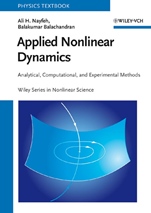
Applied Nonlinear Dynamics: Analytical, Computational, and Experimental Methods
ISBN 9780471593485
Autor: Ali H. Nayfeh, Balakumar Balachandran
Wydawca: Wiley
Dostępność: 3-6 tygodni
Cena: 882,00 zł
Przed złożeniem zamówienia prosimy o kontakt mailowy celem potwierdzenia ceny.
ISBN13: |
9780471593485 |
ISBN10: |
0471593486 |
Autor: |
Ali H. Nayfeh, Balakumar Balachandran |
Oprawa: |
Hardback |
Rok Wydania: |
1995-03-29 |
Ilość stron: |
700 |
Wymiary: |
243x184 |
Tematy: |
PBWD |
Since Poincaré′s early work on the nonlinear dynamics of the n–body problem in celestial mechanics, the twentieth century has seen an explosion of interest in nonlinear systems. Lorenz′s study of a deterministic, third–order system of weather dynamics showed that this system demonstrated a random–like behavior called chaos. Through numerical simulations made possible by modern computers, and through experiments with physical systems, the presence of chaos has been discovered in many dynamical systems. The phenomenon of chaos has, in turn, spurred a great revival of interest in nonlinear dynamics.
Applied Nonlinear Dynamics provides a coherent and unified treatment of analytical, computational, and experimental methods and concepts of nonlinear dynamics. Analytical approaches based on perturbation methods and dynamical systems theory are presented and illustrated through applications to a wide range of nonlinear systems. Geometrical concepts, such as Poincaré maps, are also treated at length. A thorough discussion of stability and local and global bifurcation analyses for systems of differential equations and algebraic equations is conducted with the aid of examples and illustrations. Continuation methods for fixed points and periodic solutions and homotopy methods for determining fixed points are detailed. Bifurcations of fixed points, limit cycles, tori, and chaos are discussed. The fascinating phenomenon of chaos is explored, and the many routes to chaos are treated at length. Methods of controlling bifurcations and chaos are described. Numerical methods and tools to characterize motions are examined in detail. Poincaré sections, Fourier spectra, polyspectra, autocorrelation functions, Lyapunov exponents, and dimension calculations are presented as analytical and experimental tools for analyzing the motion of nonlinear systems.
This book contains numerous worked–out examples that illustrate the new concepts
of nonlinear dynamics. Moreover, it contains many exercises that can be used both to reinforce concepts discussed in the chapters and to assess the progress of students. Students who thoroughly cover this book will be well prepared to make significant contributions in research efforts.
Unlike most other texts, which emphasize either classical methods, experiments and physics, geometrical methods, computational methods, or applied mathematics, Applied Nonlinear Dynamics blends these approaches to provide a unified treatment of nonlinear dynamics. Further, it presents mathematical concepts in a manner comprehensible to engineers and applied scientists. The synthesis of analytical, experimental, and numerical methods and the inclusion of many exercises and worked–out examples will make this the textbook of choice for classroom teaching. Moreover, the inclusion of an extensive and up–to–date bibliography will make it an invaluable text for professional reference.
Spis treści:
Equilibrium Solutions.
Periodic Solutions.
Quasiperiodic Solutions.
Chaos.
Numerical Methods.
Tools to Analyze Motions.
Control.
Bibliography.
Subject Index.
Nota biograficzna:
Ali H. Nayfeh is a University Distinguished Professor of Engineering Science and Mechanics at the Virginia Polytechnic Institute and State University, Blacksburg, Virginia. Professor Nayfeh is the Editor–in–Chief of the journal Nonlinear Dynamics and the Journal of Vibration and Control. He is the author of Perturbation Methods (Wiley, 1973), Nonlinear Oscillations (coauthored with Dean T. Mook; Wiley,1979), Introduction to Perturbation techniques (Wiley, 1981), Problems in Perturbation (Wiley, 1985), and Method of Normal Forms (Wiley, 1993). Professor Nayfeh′s areas of interest include nonlinear vibrations and dynamics, wave propagation, ship and submarine motions, structural dynamics, acoustics, aerodynamic/dynamic/struc
ture/control interactions, flight mechanics, and transition from laminar to turbulent flows.
Balakumar Balachandran is Assistant Professor of Mechanical Engineering at the University of Maryland, College Park, Maryland. His areas of interest include vibration and acoustics control, nonlinear dynamics, structural dynamics, and system identification.
Okładka tylna:
Since Poincaré′s early work on the nonlinear dynamics of the n–body problem in celestial mechanics, the twentieth century has seen an explosion of interest in nonlinear systems. Lorenz′s study of a deterministic, third–order system of weather dynamics showed that this system demonstrated a random–like behavior called chaos. Through numerical simulations made possible by modern computers, and through experiments with physical systems, the presence of chaos has been discovered in many dynamical systems. The phenomenon of chaos has, in turn, spurred a great revival of interest in nonlinear dynamics.
Applied Nonlinear Dynamics provides a coherent and unified treatment of analytical, computational, and experimental methods and concepts of nonlinear dynamics. Analytical approaches based on perturbation methods and dynamical systems theory are presented and illustrated through applications to a wide range of nonlinear systems. Geometrical concepts, such as Poincaré maps, are also treated at length. A thorough discussion of stability and local and global bifurcation analyses for systems of differential equations and algebraic equations is conducted with the aid of examples and illustrations. Continuation methods for fixed points and periodic solutions and homotopy methods for determining fixed points are detailed. Bifurcations of fixed points, limit cycles, tori, and chaos are discussed. The fascinating phenomenon of chaos is explored, and the many routes to chaos are treated at length. Methods of controlling bifurcations and chaos are described.
Numerical methods and tools to characterize motions are examined in detail. Poincaré sections, Fourier spectra, polyspectra, autocorrelation functions, Lyapunov exponents, and dimension calculations are presented as analytical and experimental tools for analyzing the motion of nonlinear systems.
This book contains numerous worked–out examples that illustrate the new concepts of nonlinear dynamics. Moreover, it contains many exercises that can be used both to reinforce concepts discussed in the chapters and to assess the progress of students. Students who thoroughly cover this book will be well prepared to make significant contributions in research efforts.
Unlike most other texts, which emphasize either classical methods, experiments and physics, geometrical methods, computational methods, or applied mathematics, Applied Nonlinear Dynamics blends these approaches to provide a unified treatment of nonlinear dynamics. Further, it presents mathematical concepts in a manner comprehensible to engineers and applied scientists. The synthesis of analytical, experimental, and numerical methods and the inclusion of many exercises and worked–out examples will make this the textbook of choice for classroom teaching. Moreover, the inclusion of an extensive and up–to–date bibliography will make it an invaluable text for professional reference.
Koszyk
Książek w koszyku: 0 szt.
Wartość zakupów: 0,00 zł
Informacje


Kontakt
Gambit
Centrum Oprogramowania
i Szkoleń Sp. z o.o.
Al. Pokoju 29b/22-24
31-564 Kraków
Siedziba Księgarni
ul. Kordylewskiego 1
31-542 Kraków
+48 12 410 5991
+48 12 410 5987
+48 12 410 5989
Subskrypcje
Administratorem danych osobowych jest firma Gambit COiS Sp. z o.o. Na podany adres będzie wysyłany wyłącznie biuletyn informacyjny.
Autoryzacja płatności

Informacje na temat autoryzacji płatności poprzez PayU.

© Copyright 2012: GAMBIT COiS Sp. z o.o. Wszelkie prawa zastrzeżone.
Projekt i wykonanie: Alchemia Studio Reklamy