


Wydawcy
Katalog tematyczny
- Archeologia (109)
- Ekonomia, finanse, business (13704)
- Filozofia (1445)
- Historia (3040)
- Języki i językoznawstwo (2356)
- Lifestyle, hobby i rozrywka (475)
- Medycyna (9704)
- Nauki humanistyczne (4)
- Nauki o Ziemi i środowisku (2638)
- Nauki ścisłe (20412)
- Astronomia (294)
- Biologia (5119)
- Chemia (6540)
- Fizyka (3309)
- Matematyka (4574)
- Algebra (171)
- Analiza matematyczna (902)
- Filozofia matematyki (1)
- Geometria (237)
- Historia matematyki (57)
- Kombinatoryka, teoria grafów (67)
- Matematyka dyskretna (35)
- Matematyka stosowana (555)
- Optymalizacja (104)
- Podstawy matematyki (129)
- Statystyka, prawdopodobieństwo (296)
- Teoria grup (63)
- Teoria liczb (77)
- Topologia (66)
- Nauki ścisłe, ogólnie (503)
- Nauki społeczne (8486)
- Nauki techniczne (13450)
- Prawo (1696)
- Publikacje informacyjne i interdyscyplinarne (1288)
- Religia i wierzenia (917)
- Technika komputerowa (4067)
- Zdrowie, relacje międzyludzkie i rozwój osobisty (657)





Informacje szczegółowe o książce
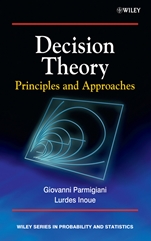
Decision Theory: Principles and Approaches
ISBN 9780471496571
Autor: Giovanni Parmigiani, Lurdes Inoue
Wydawca: Wiley
Dostępność: 3-6 tygodni
Cena: 457,80 zł
Przed złożeniem zamówienia prosimy o kontakt mailowy celem potwierdzenia ceny.
ISBN13: |
9780471496571 |
ISBN10: |
047149657X |
Autor: |
Giovanni Parmigiani, Lurdes Inoue |
Oprawa: |
Hardback |
Rok Wydania: |
2009-04-14 |
Ilość stron: |
404 |
Wymiary: |
229x152 |
Tematy: |
PB |
Decision theory provides a formal framework for making logical choices in the face of uncertainty. Given a set of alternatives, a set of consequences, and a correspondence between those sets, decision theory offers conceptually simple procedures for choice. This book presents an overview of the fundamental concepts and outcomes of rational decision making under uncertainty, highlighting the implications for statistical practice.
The authors have developed a series of self contained chapters focusing on bridging the gaps between the different fields that have contributed to rational decision making and presenting ideas in a unified framework and notation while respecting and highlighting the different and sometimes conflicting perspectives.
This book:
Provides a rich collection of techniques and procedures.Discusses the foundational aspects and modern day practice.Links foundations to practical applications in biostatistics, computer science, engineering and economics.Presents different perspectives and controversies to encourage readers to form their own opinion of decision making and statistics.
Decision Theory is fundamental to all scientific disciplines, including biostatistics, computer science, economics and engineering. Anyone interested in the whys and wherefores of statistical science will find much to enjoy in this book.
Spis treści:
Preface.
Acknowledgments.
1 Introduction.
1.1 Controversies.
1.2 A guided tour of decision theory.
Part One: Foundations.
2 Coherence.
2.1 The “Dutch Book” theorem.
2.2 Temporal coherence.
2.3 Scoring rules and the axioms of probabilities.
2.4 Exercises.
3 Utility.
3.1 St. Petersburg paradox.
3.2 Expected utility theory and the theory of means.
3.3 The expected utility principle.
3.4 The von Neumann–Morgenstern representation theorem.
3.5 Allais’ critic
ism.
3.6 Extensions.
3.7 Exercises.
4 Utility in action.
4.1 The “standard gamble”.
4.2 Utility of money.
4.3 Utility functions for medical decisions.
4.4 Exercises.
5 Ramsey and Savage.
5.1 Ramsey’s theory.
5.2 Savage’s theory.
5.3 Allais revisited.
5.4 Ellsberg paradox.
5.5 Exercises.
6 State independence.
6.1 Horse lotteries.
6.2 State–dependent utilities.
6.3 State–independent utilities.
6.4 Anscombe–Aumann representation theorem.
6.5 Exercises.
Part Two Statistical Decision Theory.
7 Decision functions.
7.1 Basic concepts.
7.2 Data–based decisions.
7.3 The travel insurance example.
7.4 Randomized decision rules.
7.5 Classification and hypothesis tests.
7.6 Estimation.
7.7 Minimax–Bayes connections.
7.8 Exercises.
8 Admissibility.
8.1 Admissibility and completeness.
8.2 Admissibility and minimax.
8.3 Admissibility and Bayes.
8.4 Complete classes.
8.5 Using the same α level across studies with different sample sizes is inadmissible.
8.6 Exercises.
9 Shrinkage.
9.1 The Stein effect.
9.2 Geometric and empirical Bayes heuristics.
9.3 General shrinkage functions.
9.4 Shrinkage with different likelihood and losses.
9.5 Exercises.
10 Scoring rules.
10.1 Betting and forecasting.
10.2 Scoring rules.
10.3 Local scoring rules.
10.4 Calibration and refinement.
10.5 Exercises.
11 Choosing models.
11.1 The “true model” perspective.
11.2 Model elaborations.
11.3 Exercises.
Part Three Optimal Design.
12 Dynamic programming.
12.1 History.
12.2 The travel insurance example revisited.
12.3 Dynamic programming.
12.4 Trading off immediate gains and information.
12.5 Sequential clinical trials.
12.6 Variable selection in multiple regression.
12.7 Comp
uting.
12.8 Exercises.
13 Changes in utility as information.
13.1 Measuring the value of information.
13.2 Examples.
13.3 Lindley information.
13.4 Minimax and the value of information.
13.5 Exercises.
14 Sample size.
14.1 Decision–theoretic approaches to sample size.
14.2 Computing.
14.3 Examples.
14.4 Exercises.
15 Stopping.
15.1 Historical note.
15.2 A motivating example.
15.3 Bayesian optimal stopping.
15.4 Examples.
15.5 Sequential sampling to reduce uncertainty.
15.6 The stopping rule principle.
15.7 Exercises.
Appendix.
A.1 Notation.
A.2 Relations.
A.3 Probability (density) functions of some distributions.
A.4 Conjugate updating.
References.
Index.
Okładka tylna:
Decision theory provides a formal framework for making logical choices in the face of uncertainty. Given a set of alternatives, a set of consequences, and a correspondence between those sets, decision theory offers conceptually simple procedures for choice. This book presents an overview of the fundamental concepts and outcomes of rational decision making under uncertainty, highlighting the implications for statistical practice.
The authors have developed a series of self contained chapters focusing on bridging the gaps between the different fields that have contributed to rational decision making and presenting ideas in a unified framework and notation while respecting and highlighting the different and sometimes conflicting perspectives.
This book:
Provides a rich collection of techniques and procedures.Discusses the foundational aspects and modern day practice.Links foundations to practical applications in biostatistics, computer science, engineering and economics.Presents different perspectives and controversies to encourage readers to form their own opinion of decision making and statistics.
Decision Theory is
fundamental to all scientific disciplines, including biostatistics, computer science, economics and engineering. Anyone interested in the whys and wherefores of statistical science will find much to enjoy in this book.
Koszyk
Książek w koszyku: 0 szt.
Wartość zakupów: 0,00 zł
Informacje


Kontakt
Gambit
Centrum Oprogramowania
i Szkoleń Sp. z o.o.
Al. Pokoju 29b/22-24
31-564 Kraków
Siedziba Księgarni
ul. Kordylewskiego 1
31-542 Kraków
+48 12 410 5991
+48 12 410 5987
+48 12 410 5989
Subskrypcje
Administratorem danych osobowych jest firma Gambit COiS Sp. z o.o. Na podany adres będzie wysyłany wyłącznie biuletyn informacyjny.
Autoryzacja płatności

Informacje na temat autoryzacji płatności poprzez PayU.

© Copyright 2012: GAMBIT COiS Sp. z o.o. Wszelkie prawa zastrzeżone.
Projekt i wykonanie: Alchemia Studio Reklamy