


Wydawcy
Katalog tematyczny
- Archeologia (1)
- Ekonomia, finanse, business (698)
- Filozofia (20)
- Historia (57)
- Języki i językoznawstwo (4)
- Lifestyle, hobby i rozrywka (32)
- Medycyna (1025)
- Nauki humanistyczne (2)
- Nauki o Ziemi i środowisku (430)
- Nauki ścisłe (1681)
- Astronomia (219)
- Biologia (486)
- Chemia (9)
- Fizyka (440)
- Matematyka (422)
- Algebra (47)
- Analiza matematyczna (126)
- Filozofia matematyki (1)
- Geometria (33)
- Historia matematyki (2)
- Kombinatoryka, teoria grafów (14)
- Matematyka dyskretna (11)
- Matematyka stosowana (60)
- Optymalizacja (11)
- Podstawy matematyki (28)
- Statystyka, prawdopodobieństwo (13)
- Teoria grup (7)
- Teoria liczb (15)
- Topologia (18)
- Nauki ścisłe, ogólnie (91)
- Nauki społeczne (1297)
- Nauki techniczne (530)
- Prawo (1437)
- Publikacje informacyjne i interdyscyplinarne (32)
- Religia i wierzenia (15)
- Technika komputerowa (237)
- Zdrowie, relacje międzyludzkie i rozwój osobisty (4)





Informacje szczegółowe o książce
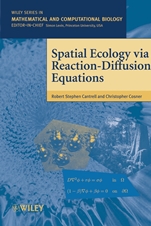
Spatial Ecology via Reaction–Diffusion Equations
ISBN 9780471493013
Autor: Robert Stephen Cantrell, Chris Cosner
Wydawca: Wiley
Dostępność: 3-6 tygodni
Cena: 954,45 zł
Przed złożeniem zamówienia prosimy o kontakt mailowy celem potwierdzenia ceny.
ISBN13: |
9780471493013 |
ISBN10: |
0471493015 |
Autor: |
Robert Stephen Cantrell, Chris Cosner |
Oprawa: |
Hardback |
Rok Wydania: |
2003-09-23 |
Ilość stron: |
428 |
Wymiary: |
251x171 |
Tematy: |
PB |
Many ecological phenomena involve space as well as time and arise from a combination of random and deterministic processes. Such phenomena include the effects of habitat fragmentation, which is a common result of human activity and a major problem in biological conservation. Reaction–diffusion models provide one approach to describing how random movements and deterministic interactions between individuals combine to influence the dynamics of populations and the structure of ecological communities. Spatial Ecology via Reaction–Diffusion Equations addresses the problem of modeling spatial effects in ecology and population dynamics using reaction–diffusion models. Provides broad coverage of a rapidly expanding area of research for ecologists and applied mathematicians.Provides a unified and coherent account of methods developed to study spatial ecology via reaction–diffusion models.Provides the reader with the tools needed to construct and interpret models.Includes specific applications of both the models and the methods described.
Spatial Ecology via Reaction–Diffusion Equations provides a practical introduction to the subject for graduate students and researchers working in spatial modeling from mathematics, statistics, ecology, geography and biology.
Spis treści:
Preface.
Series Preface.
1 Introduction.
1.1 Introductory Remarks.
1.2 Nonspatial Models for a Single Species.
1.3 Nonspatial Models For Interacting Species.
1.3.1 Mass–Action and Lotka–Volterra Models.
1.3.2 Beyond Mass–Action: The Functional Response.
1.4 Spatial Models: A General Overview.
1.5 Reaction–Diffusion Models.
1.5.1 Deriving Diffusion Models.
1.5.2 Diffusion Models Via Interacting Particle Systems: The Importance of Being Smooth.
1.5.3 What Can Reaction–Diffusion Models Tell Us?
1.5.4 Edges, Boundary Conditions,
and Environmental Heterogeneity.
1.6 Mathematical Background.
1.6.1 Dynamical Systems.
1.6.2 Basic Concepts in Partial Differential Equations: An Example.
1.6.3 Modern Approaches to Partial Differential Equations: Analogies with Linear Algebra and Matrix Theory.
1.6.4 Elliptic Operators: Weak Solutions, State Spaces, and Mapping Properties.
1.6.5 Reaction–Diffusion Models as Dynamical Systems.
1.6.6 Classical Regularity Theory for Parabolic Equations.
1.6.7 Maximum Principles and Monotonicity.
2 Linear Growth Models for a Single Species: Averaging Spatial Effects Via Eigenvalues.
2.1 Eigenvalues, Persistence, and Scaling in Simple Models.
2.1.1 An Application: Species–Area Relations.
2.2 Variational Formulations of Eigenvalues: Accounting for Heterogeneity.
2.3 Effects of Fragmentation and Advection/Taxis in Simple Linear Models.
2.3.1 Fragmentation.
2.3.2 Advection/Taxis.
2.4 Graphical Analysis in One Space Dimension.
2.4.1 The Best Location for a Favorable Habitat Patch.
2.4.2 Effects of Buffer Zones and Boundary Behavior.
2.5 Eigenvalues and Positivity.
2.5.1 Advective Models.
2.5.2 Time Periodicity.
2.5.3 Additional Results on Eigenvalues and Positivity.
2.6 Connections with Other Topics and Models.
2.6.1 Eigenvalues, Solvability, and Multiplicity.
2.6.2 Other Model Types: Discrete Space and Time.
Appendix.
3 Density Dependent Single–Species Models.
3.1 The Importance of Equilibria in Single Species Models.
3.2 Equilibria and Stability: Sub– and Supersolutions.
3.2.1 Persistence and Extinction.
3.2.2 Minimal Patch Sizes.
3.2.3 Uniqueness of Equilibria.
3.3 Equilibria and Scaling: One Space Dimension.
3.3.1 Minimum Patch Size Revisited.
3.4 Continuation and Bifurcation of Equilibria.
3.4.1 Continuation.
3.4.2 Bifurcation Results.
3.4.3 Discussion and Conclusions.
3.5 Applications and Properties of Single Speci
es Models.
3.5.1 How Predator Incursions Affect Critical Patch Size.
3.5.2 Diffusion and Allee Effects.
3.5.3 Properties of Equilibria.
3.6 More General Single Species Models.
Appendix.
4 Permanence.
4.1 Introduction.
4.1.1 Ecological Overview.
4.1.2 ODEModels as Examples.
4.1.3 A Little Historical Perspective.
4.2 Definition of Permanence.
4.2.1 Ecological Permanence.
4.2.2 Abstract Permanence.
4.3 Techniques for Establishing Permanence.
4.3.1 Average Lyapunov Function Approach.
4.3.2 Acyclicity Approach.
4.4 Invasibility Implies Coexistence.
4.4.1 Acyclicity and an ODE Competition Model.
4.4.2 A Reaction–Diffusion Analogue.
4.4.3 Connection to Eigenvalues.
4.5 Permanence in Reaction–Diffusion Models for Predation.
4.6 Ecological Permanence and Equilibria.
4.6.1 Abstract Permanence Implies Ecological Permanence.
4.6.2 Permanence Implies the Existence of a Componentwise Positive Equilibrium.
Appendix.
5 Beyond Permanence: More Persistence Theory.
5.1 Introduction.
5.2 Compressivity.
5.3 Practical Persistence.
5.4 Bounding Transient Orbits.
5.5 Persistence in Nonautonomous Systems.
5.6 Conditional Persistence.
5.7 Extinction Results.
Appendix.
6 Spatial Heterogeneity in Reaction–Diffusion Models.
6.1 Introduction.
6.2 Spatial Heterogeneity within the Habitat Patch.
6.2.1 How Spatial Segregation May Facilitate Coexistence.
6.2.2 Some Disparities Between Local and Global Competition.
6.2.3 Coexistence Mediated by the Shape of the Habitat Patch.
6.3 Edge Mediated Effects.
6.3.1 A Note About Eigenvalues.
6.3.2 Competitive Reversals Inside Ecological Reserves Via External Habitat Degradation: Effects of Boundary Conditions.
6.3.3 Cross–Edge Subsidies and the Balance of Competition in Nature Preserves.
6.3.4 Competition Mediated by Pathogen Transmission.
6.4 Estimates and Consequences.
App
endix.
7 Nonmonotone Systems.
7.1 Introduction.
7.2 Predator Mediated Coexistence.
7.3 Three Species Competition.
7.3.1 How Two Dominant Competitors May Mediate the Persistence of an Inferior Competitor.
7.3.2 The May–Leonard Example Revisited.
7.4 Three Trophic Level Models.
Appendix.
References.
Index.
Okładka tylna:
Many ecological phenomena involve space as well as time and arise from a combination of random and deterministic processes. Such phenomena include the effects of habitat fragmentation, which is a common result of human activity and a major problem in biological conservation. Reaction–diffusion models provide one approach to describing how random movements and deterministic interactions between individuals combine to influence the dynamics of populations and the structure of ecological communities. Spatial Ecology via Reaction–Diffusion Equations addresses the problem of modeling spatial effects in ecology and population dynamics using reaction–diffusion models. Provides broad coverage of a rapidly expanding area of research for ecologists and applied mathematicians.Provides a unified and coherent account of methods developed to study spatial ecology via reaction–diffusion models.Provides the reader with the tools needed to construct and interpret models.Includes specific applications of both the models and the methods described.
Spatial Ecology via Reaction–Diffusion Equations provides a practical introduction to the subject for graduate students and researchers working in spatial modeling from mathematics, statistics, ecology, geography and biology.
Koszyk
Książek w koszyku: 0 szt.
Wartość zakupów: 0,00 zł
Informacje


Kontakt
Gambit
Centrum Oprogramowania
i Szkoleń Sp. z o.o.
Al. Pokoju 29b/22-24
31-564 Kraków
Siedziba Księgarni
ul. Kordylewskiego 1
31-542 Kraków
+48 12 410 5991
+48 12 410 5987
+48 12 410 5989
Subskrypcje
Administratorem danych osobowych jest firma Gambit COiS Sp. z o.o. Na podany adres będzie wysyłany wyłącznie biuletyn informacyjny.
Autoryzacja płatności

Informacje na temat autoryzacji płatności poprzez PayU.

© Copyright 2012: GAMBIT COiS Sp. z o.o. Wszelkie prawa zastrzeżone.
Projekt i wykonanie: Alchemia Studio Reklamy