


Wydawcy
Katalog tematyczny
- Archeologia (109)
- Ekonomia, finanse, business (13704)
- Filozofia (1445)
- Historia (3040)
- Języki i językoznawstwo (2356)
- Lifestyle, hobby i rozrywka (475)
- Medycyna (9704)
- Nauki humanistyczne (4)
- Nauki o Ziemi i środowisku (2638)
- Nauki ścisłe (20412)
- Astronomia (294)
- Biologia (5119)
- Chemia (6540)
- Fizyka (3309)
- Matematyka (4574)
- Algebra (171)
- Analiza matematyczna (902)
- Filozofia matematyki (1)
- Geometria (237)
- Historia matematyki (57)
- Kombinatoryka, teoria grafów (67)
- Matematyka dyskretna (35)
- Matematyka stosowana (555)
- Optymalizacja (104)
- Podstawy matematyki (129)
- Statystyka, prawdopodobieństwo (296)
- Teoria grup (63)
- Teoria liczb (77)
- Topologia (66)
- Nauki ścisłe, ogólnie (503)
- Nauki społeczne (8486)
- Nauki techniczne (13450)
- Prawo (1696)
- Publikacje informacyjne i interdyscyplinarne (1288)
- Religia i wierzenia (917)
- Technika komputerowa (4067)
- Zdrowie, relacje międzyludzkie i rozwój osobisty (657)





Informacje szczegółowe o książce
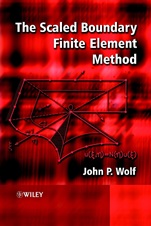
The Scaled Boundary Finite Element Method
ISBN 9780471486824
Autor: John P. Wolf
Wydawca: Wiley
Dostępność: 3-6 tygodni
Cena: 745,50 zł
Przed złożeniem zamówienia prosimy o kontakt mailowy celem potwierdzenia ceny.
ISBN13: |
9780471486824 |
ISBN10: |
0471486825 |
Autor: |
John P. Wolf |
Oprawa: |
Hardback |
Rok Wydania: |
2003-01-14 |
Ilość stron: |
378 |
Wymiary: |
255x179 |
Tematy: |
PB |
The Scaled Boundary Finite Element Method describes a fundamental solution–less boundary element method, based on finite elements. As such, it combines the advantages of the boundary element method:
∗ spatial discretisation reduced by one
∗ boundary condition at infinity satisfied exactly
with those of the finite element method:
∗ no fundamental solution required
∗ no singular integrals
∗ the processing of anisotropic material without any additional computational effort
Other benefits include the fact that the analytical solution inside the domain permits stress singularities to be determined directly, and also that there is no spatial discretisation of certain boundaries such as crack faces and free surfaces and interfaces between different materials.
The scaled boundary finite element method can be used to analyse any bounded and unbounded media governed by linear elliptic, parabolic and hyperbolic partial differential equations.
The book serves two goals which can be pursued independently. Part I is a primer, with a model problem addressing the simplest wave propagation but still containing all essential features. Part II derives the fundamental equations for statics, elastodynamics and diffusion, and discusses the solution procedures from scratch in great detail.
In summary this comprehensive text presents a novel procedure which will be of interest not only to engineers, researchers and students working in engineering mechanics, acoustics, heat–transfer, earthquake engineering, electromagnetism, and computational mathematics, but also consulting engineers dealing with nuclear structures, offshore platforms, hardened structures, critical facilities, dams, machine foundations and other structures subjected to earthquakes, wave loads, explosions and traffic.
Spis treści:
Foreword.
Preface.
Fundamentals of Numerical Analysis.
Novel Computational Procedure.
PAR
T I: MODEL PROBLEM: LINE ELEMENT FOR SCALAR WAVE EQUATION.
Concepts of Scaled Boundary Transformation of Geometry and Similarity.
Wedge and Truncated Semi–Infinite Wedge of Shear Plate.
Scaled Boundary Transformation–Based Derivation.
Mechanically–Based Derivation.
Modelisation with Single Line Finite Element.
Statics.
Mass of Wedge.
High–Frequency Asymptotic Expansion for Dynamic Stiffness of Truncated Semi–Infinite Wedge.
Numerical Solution of Dynamic Stiffness, Unit–Impulse Response and Displacement of Truncated Semi–Infinite Wedge.
Analytical Solution in Frequency Domain.
Implementation.
Conclusions.
Appendix A: Solid Modelling.
Appendix B: Harmonic Motion and Fourier Transformation.
Appendix C: Dynamic Unbounded Medium–Structure Interaction.
Appendix D: Historical Note.
PART II: TWO– AND THREE–DIMENSIONAL ELASTODYNAMICS, STATICS AND DIFFUSION.
Fundamental Equations.
Statics.
Mass Matrix of Bounded Medium.
High–Frequency Asymptotic Expansion for Dynamic Stiffness of Unbounded Medium.
Numerical Solution of Dynamic Stiffness, Unit–Impulse Response and Displacement of Unbounded Medium.
Analytical Solution in Frequency Domain.
Extensions.
Substructuring.
Examples for Bounded Media.
Examples for Unbounded Media.
Error Estimation and Adaptivity.
Concluding Remarks.
References.
Index.
Okładka tylna:
The Scaled Boundary Finite Element Method describes a fundamental solution–less boundary element method, based on finite elements. As such, it combines the advantages of the boundary element method:
∗ spatial discretisation reduced by one
∗ boundary condition at infinity satisfied exactly
with those of the finite element method:
∗ no fundamental solution required
∗ no singular integrals
∗ the processing of anisotropic material wit
hout any additional computational effort
Other benefits include the fact that the analytical solution inside the domain permits stress singularities to be determined directly, and also that there is no spatial discretisation of certain boundaries such as crack faces and free surfaces and interfaces between different materials.
The scaled boundary finite element method can be used to analyse any bounded and unbounded media governed by linear elliptic, parabolic and hyperbolic partial differential equations.
The book serves two goals which can be pursued independently. Part I is a primer, with a model problem addressing the simplest wave propagation but still containing all essential features. Part II derives the fundamental equations for statics, elastodynamics and diffusion, and discusses the solution procedures from scratch in great detail.
In summary this comprehensive text presents a novel procedure which will be of interest not only to engineers, researchers and students working in engineering mechanics, acoustics, heat–transfer, earthquake engineering, electromagnetism, and computational mathematics, but also consulting engineers dealing with nuclear structures, offshore platforms, hardened structures, critical facilities, dams, machine foundations and other structures subjected to earthquakes, wave loads, explosions and traffic.
Koszyk
Książek w koszyku: 0 szt.
Wartość zakupów: 0,00 zł
Informacje


Kontakt
Gambit
Centrum Oprogramowania
i Szkoleń Sp. z o.o.
Al. Pokoju 29b/22-24
31-564 Kraków
Siedziba Księgarni
ul. Kordylewskiego 1
31-542 Kraków
+48 12 410 5991
+48 12 410 5987
+48 12 410 5989
Subskrypcje
Administratorem danych osobowych jest firma Gambit COiS Sp. z o.o. Na podany adres będzie wysyłany wyłącznie biuletyn informacyjny.
Autoryzacja płatności

Informacje na temat autoryzacji płatności poprzez PayU.

© Copyright 2012: GAMBIT COiS Sp. z o.o. Wszelkie prawa zastrzeżone.
Projekt i wykonanie: Alchemia Studio Reklamy