


Wydawcy
Katalog tematyczny
- Archeologia (109)
- Ekonomia, finanse, business (13704)
- Filozofia (1445)
- Historia (3040)
- Języki i językoznawstwo (2356)
- Lifestyle, hobby i rozrywka (475)
- Medycyna (9704)
- Nauki humanistyczne (4)
- Nauki o Ziemi i środowisku (2638)
- Nauki ścisłe (20412)
- Astronomia (294)
- Biologia (5119)
- Chemia (6540)
- Fizyka (3309)
- Matematyka (4574)
- Algebra (171)
- Analiza matematyczna (902)
- Filozofia matematyki (1)
- Geometria (237)
- Historia matematyki (57)
- Kombinatoryka, teoria grafów (67)
- Matematyka dyskretna (35)
- Matematyka stosowana (555)
- Optymalizacja (104)
- Podstawy matematyki (129)
- Statystyka, prawdopodobieństwo (296)
- Teoria grup (63)
- Teoria liczb (77)
- Topologia (66)
- Nauki ścisłe, ogólnie (503)
- Nauki społeczne (8486)
- Nauki techniczne (13450)
- Prawo (1696)
- Publikacje informacyjne i interdyscyplinarne (1288)
- Religia i wierzenia (917)
- Technika komputerowa (4067)
- Zdrowie, relacje międzyludzkie i rozwój osobisty (657)





Informacje szczegółowe o książce
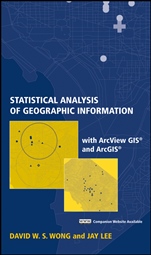
Statistical Analysis of Geographic Information with ArcView GIS and ArcGIS
ISBN 9780471468998
Autor: David W. S. Wong, Jay Lee
Wydawca: Wiley
Dostępność: 3-6 tygodni
Cena: 693,00 zł
Przed złożeniem zamówienia prosimy o kontakt mailowy celem potwierdzenia ceny.
ISBN13: |
9780471468998 |
ISBN10: |
0471468991 |
Autor: |
David W. S. Wong, Jay Lee |
Oprawa: |
Hardback |
Rok Wydania: |
2005-11-11 |
Ilość stron: |
464 |
Wymiary: |
241x164 |
Tematy: |
PB |
The fully revised and updated book on statistical and spatial analyses in a GIS environment
It′s been four years since the publication of the groundbreaking Statistical Analysis with ArcView GIS®, and ArcView continues to be one of the most popular desktop GIS among geographers and other GIS users because of its capabilities for spatial–quantitative synthesis. Now, David Wong and Jay Lee update their comprehensive handbook with Statistical Analysis of Geographic Information with ArcView GIS® and ArcGIS®. This revised and expanded guide features classic statistical methods supported by numerous new examples and worked problems.
Employing points, lines, and polygons to model real–world geographic forms, this easy–to–use resource provides geographers, researchers, and practitioners a valuable bridge between theory and the necessary software to apply it. It contains sections on point distribution, point pattern analysis, linear features, network analysis, and spatial autocorrelation analysis. This new edition:Covers a full range of statistical methods, including classical techniques, probability, and statistical testingFeatures dozens of new exercises for use with tools and procedures packaged as ArcView extensions and data setsProvides a CD–ROM offering immediate access to ready–to–use ArcView extensions for use with the book and with real–world data setsIncludes updated discussions on implementing spatial analysis in ArcGIS 9.X
Spis treści:
PREFACE.
ACKNOWLEDGMENTS.
1 INTRODUCTION.
1.1 Why Statistics and Sampling?
1.2 What Are Special about Spatial Data?
1.3 Spatial Data and the Need for Spatial Analysis/ Statistics.
1.4 Fundamentals of Spatial Analysis and Statistics.
1.5 ArcView Notes—Data Model and Examples.
PART I: CLASSICAL STATISTICS.
2 DISTRIBUTION DESCRIPTORS: ONE VARIABLE (UNIV
ARIATE).
2.1 Measures of Central Tendency.
2.2 Measures of Dispersion.
2.3 ArcView Examples.
2.4 Higher Moment Statistics.
2.5 ArcView Examples.
2.6 Application Example.
2.7 Summary.
3 RELATIONSHIP DESCRIPTORS: TWO VARIABLES (BIVARIATE).
3.1 Correlation Analysis.
3.2 Correlation: Nominal Scale.
3.3 Correlation: Ordinal Scale.
3.4 Correlation: Interval /Ratio Scale.
3.5 Trend Analysis.
3.6 ArcView Notes.
3.7 Application Examples.
4 HYPOTHESIS TESTERS.
4.1 Probability Concepts.
4.2 Probability Functions.
4.3 Central Limit Theorem and Confidence Intervals.
4.4 Hypothesis Testing.
4.5 Parametric Test Statistics.
4.6 Difference in Means.
4.7 Difference Between a Mean and a Fixed Value.
4.8 Significance of Pearson’s Correlation Coefficient.
4.9 Significance of Regression Parameters.
4.10 Testing Nonparametric Statistics.
4.11 Summary.
PART II: SPATIAL STATISTICS.
5 POINT PATTERN DESCRIPTORS.
5.1 The Nature of Point Features.
5.2 Central Tendency of Point Distributions.
5.3 Dispersion and Orientation of Point Distributions.
5.4 ArcView Notes.
5.5 Application Examples.
6 POINT PATTERN ANALYZERS.
6.1 Scale and Extent.
6.2 Quadrat Analysis.
6.3 Ordered Neighbor Analysis.
6.4 K–Function.
6.5 Spatial Autocorrelation of Points.
6.6 Application Examples.
7 LINE PATTERN ANALYZERS.
7.1 The Nature of Linear Features: Vectors and Networks.
7.2 Characteristics and Attributes of Linear Features.
7.3 Directional Statistics.
7.4 Network Analysis.
7.5 Application Examples.
8 POLYGON PATTERN ANALYZERS.
8.1 Introduction.
8.2 Spatial Relationships.
8.3 Spatial Dependency.
8.4 Spatial Weights Matrices.
8.5 Spatial Autocorrelation Statistics and Notations.
8.6 Joint Count Statistics.
8.7 Spatial Autocorrelation Global Statistics.
8.8 Local Spatial Autocorre
lation Statistics.
8.9 Moran Scatterplot.
8.10 Bivariate Spatial Autocorrelation.
8.11 Application Examples.
8.12 Summary.
APPENDIX: ArcGIS Spatial Statistics Tools.
ABOUT THE CD–ROM.
INDEX.
Nota biograficzna:
David W. S. Wong, PhD, is Professor and Chair of the Earth Systems and GeoInformation Sciences Program at George Mason University in Fairfax, Virginia.
Jay Lee, PhD, is Professor and Chair of the Department of Geography at Kent State University in Kent, Ohio.
Okładka tylna:
The fully revised and updated book on statistical and spatial analyses in a GIS environment
It′s been four years since the publication of the groundbreaking Statistical Analysis with ArcView GIS®, and ArcView continues to be one of the most popular desktop GIS among geographers and other GIS users because of its capabilities for spatial–quantitative synthesis. Now, David Wong and Jay Lee update their comprehensive handbook with Statistical Analysis of Geographic Information with ArcView GIS® and ArcGIS®. This revised and expanded guide features classic statistical methods supported by numerous new examples and worked problems.
Employing points, lines, and polygons to model real–world geographic forms, this easy–to–use resource provides geographers, researchers, and practitioners a valuable bridge between theory and the necessary software to apply it. It contains sections on point distribution, point pattern analysis, linear features, network analysis, and spatial autocorrelation analysis. This new edition:Covers a full range of statistical methods, including classical techniques, probability, and statistical testingFeatures dozens of new exercises for use with tools and procedures packaged as ArcView extensions and data setsProvides a CD–ROM offering immediate access to ready–to–use ArcView extensions for use with t
he book and with real–world data setsIncludes updated discussions on implementing spatial analysis in ArcGIS 9.X
Koszyk
Książek w koszyku: 0 szt.
Wartość zakupów: 0,00 zł
Informacje


Kontakt
Gambit
Centrum Oprogramowania
i Szkoleń Sp. z o.o.
Al. Pokoju 29b/22-24
31-564 Kraków
Siedziba Księgarni
ul. Kordylewskiego 1
31-542 Kraków
+48 12 410 5991
+48 12 410 5987
+48 12 410 5989
Subskrypcje
Administratorem danych osobowych jest firma Gambit COiS Sp. z o.o. Na podany adres będzie wysyłany wyłącznie biuletyn informacyjny.
Autoryzacja płatności

Informacje na temat autoryzacji płatności poprzez PayU.

© Copyright 2012: GAMBIT COiS Sp. z o.o. Wszelkie prawa zastrzeżone.
Projekt i wykonanie: Alchemia Studio Reklamy