


Wydawcy
Katalog tematyczny
- Archeologia (109)
- Ekonomia, finanse, business (13704)
- Filozofia (1445)
- Historia (3040)
- Języki i językoznawstwo (2356)
- Lifestyle, hobby i rozrywka (475)
- Medycyna (9704)
- Nauki humanistyczne (4)
- Nauki o Ziemi i środowisku (2638)
- Nauki ścisłe (20412)
- Astronomia (294)
- Biologia (5119)
- Chemia (6540)
- Fizyka (3309)
- Matematyka (4574)
- Algebra (171)
- Analiza matematyczna (902)
- Filozofia matematyki (1)
- Geometria (237)
- Historia matematyki (57)
- Kombinatoryka, teoria grafów (67)
- Matematyka dyskretna (35)
- Matematyka stosowana (555)
- Optymalizacja (104)
- Podstawy matematyki (129)
- Statystyka, prawdopodobieństwo (296)
- Teoria grup (63)
- Teoria liczb (77)
- Topologia (66)
- Nauki ścisłe, ogólnie (503)
- Nauki społeczne (8486)
- Nauki techniczne (13450)
- Prawo (1696)
- Publikacje informacyjne i interdyscyplinarne (1288)
- Religia i wierzenia (917)
- Technika komputerowa (4067)
- Zdrowie, relacje międzyludzkie i rozwój osobisty (657)





Informacje szczegółowe o książce
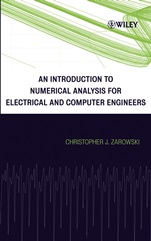
An Introduction to Numerical Analysis for Electrical and Computer Engineers
ISBN 9780471467373
Autor: Christopher J. Zarowski
Wydawca: Wiley
Dostępność: 3-6 tygodni
Cena: 990,15 zł
Przed złożeniem zamówienia prosimy o kontakt mailowy celem potwierdzenia ceny.
ISBN13: |
9780471467373 |
ISBN10: |
0471467375 |
Autor: |
Christopher J. Zarowski |
Oprawa: |
Hardback |
Rok Wydania: |
2004-05-11 |
Ilość stron: |
604 |
Wymiary: |
242x165 |
Tematy: |
PB |
An engineer′s guide to numerical analysis
To properly function in today′s work environment, engineers require a working familiarity with numerical analysis. This book provides that necessary background, striking a balance between analytical rigor and an applied approach focusing on methods particular to the solving of engineering problems.
An Introduction to Numerical Analysis for Electrical and Computer Engineers gives electrical and computer engineering students their first exposure to numerical analysis and serves as a refresher for professionals as well. Emphasizing the earlier stages of numerical analysis for engineers with real–life solutions for computing and engineering applications, the book:Forms a logical bridge between first courses in matrix/linear algebra and the more sophisticated methods of signal processing and control system coursesIncludes MATLAB–oriented examples, with a quick introduction to MATLAB for those who need itProvides detailed proofs and derivations for many key results
Specifically tailored to the needs of computer and electrical engineers, this is the resource engineers have long needed in order to master an area of mathematics critical to their profession.
Spis treści:
Preface.
1 Functional Analysis Ideas.
1.1 Introduction.
1.2 Some Sets.
1.3 Some Special Mappings: Metrics, Norms, and Inner Products.
1.3.1 Metrics and Metric Spaces.
1.3.2 Norms and Normed Spaces.
1.3.3 Inner Products and Inner Product Spaces.
1.4 The Discrete Fourier Series (DFS).
Appendix 1.A Complex Arithmetic.
Appendix 1.B Elementary Logic.
References.
Problems.
2 Number Representations.
2.1 Introduction.
2.2 Fixed–Point Representations.
2.3 Floating–Point Representations.
2.4 Rounding Effects in Dot Product Computation.
2.5 Machine Epsilon.
Appendix 2.A Review of Binary Number Codes.
Refe
rences.
Problems.
3 Sequences and Series.
3.1 Introduction.
3.2 Cauchy Sequences and Complete Spaces.
3.3 Pointwise Convergence and Uniform Convergence.
3.4 Fourier Series.
3.5 Taylor Series.
3.6 Asymptotic Series.
3.7 More on the Dirichlet Kernel.
3.8 Final Remarks.
Appendix 3.A COordinate Rotation DIgital Computing (CORDIC).
3.A.1 Introduction.
3.A.2 The Concept of a Discrete Basis.
3.A.3 Rotating Vectors in the Plane.
3.A.4 Computing Arctangents.
3.A.5 Final Remarks.
Appendix 3.B Mathematical Induction.
Appendix 3.C Catastrophic Cancellation.
References.
Problems.
4 Linear Systems of Equations.
4.1 Introduction.
4.2 Least–Squares Approximation and Linear Systems.
4.3 Least–Squares Approximation and Ill–Conditioned Linear Systems.
4.4 Condition Numbers.
4.5 LU Decomposition.
4.6 Least–Squares Problems and QR Decomposition.
4.7 Iterative Methods for Linear Systems.
4.8 Final Remarks.
Appendix 4.A Hilbert Matrix Inverses.
Appendix 4.B SVD and Least Squares.
References.
Problems.
5 Orthogonal Polynomials.
5.1 Introduction.
5.2 General Properties of Orthogonal Polynomials.
5.3 Chebyshev Polynomials.
5.4 Hermite Polynomials.
5.5 Legendre Polynomials.
5.6 An Example of Orthogonal Polynomial Least–Squares Approximation.
5.7 Uniform Approximation.
References.
Problems.
6 Interpolation.
6.1 Introduction.
6.2 Lagrange Interpolation.
6.3 Newton Interpolation.
6.4 Hermite Interpolation.
6.5 Spline Interpolation.
References.
Problems.
7 Nonlinear Systems of Equations.
7.1 Introduction.
7.2 Bisection Method.
7.3 Fixed–Point Method.
7.4 Newton–Raphson Method.
7.4.1 The Method.
7.4.2 Rate of Convergence Analysis.
7.4.3 Breakdown Phenomena.
7.5 Systems of Nonlinear Equations.
7.5.1 F
ixed–Point Method.
7.5.2 Newton–Raphson Method.
7.6 Chaotic Phenomena and a Cryptography Application.
References.
Problems.
8 Unconstrained Optimization.
8.1 Introduction.
8.2 Problem Statement and Preliminaries.
8.3 Line Searches.
8.4 Newton’s Method.
8.5 Equality Constraints and Lagrange Multipliers.
Appendix 8.A MATLAB Code for Golden Section Search.
References.
Problems.
9 Numerical Integration and Differentiation.
9.1 Introduction.
9.2 Trapezoidal Rule.
9.3 Simpson’s Rule.
9.4 Gaussian Quadrature.
9.5 Romberg Integration.
9.6 Numerical Differentiation.
References.
Problems.
10 Numerical Solution of Ordinary Differential Equations.
10.1 Introduction.
10.2 First–Order ODEs.
10.3 Systems of First–Order ODEs.
10.4 Multistep Methods for ODEs.
10.4.1 Adams–Bashforth Methods.
10.4.2 Adams–Moulton Methods.
10.4.3 Comments on the Adams Families.
10.5 Variable–Step–Size (Adaptive) Methods for ODEs.
10.6 Stiff Systems.
10.7 Final Remarks.
Appendix 10.A MATLAB Code for Example 10.8.
Appendix 10.B MATLAB Code for Example 10.13.
References.
Problems.
11 Numerical Methods for Eigenproblems.
11.1 Introduction.
11.2 Review of Eigenvalues and Eigenvectors.
11.3 The Matrix Exponential.
11.4 The Power Methods.
11.5 QR Iterations.
References.
Problems.
12 Numerical Solution of Partial Differential Equations.
12.1 Introduction.
12.2 A Brief Overview of Partial Differential Equations.
12.3 Applications of Hyperbolic PDEs.
12.3.1 The Vibrating String.
12.3.2 Plane Electromagnetic Waves.
12.4 The Finite–Difference (FD) Method.
12.5 The Finite–Difference Time–Domain (FDTD) Method.
Appendix 12.A MATLAB Code for Example 12.5.
References.
Problems.
13 An Introduction to MATLAB.
13.1 Introducti
on.
13.2 Startup.
13.3 Some Basic Operators, Operations, and Functions.
13.4 Working with Polynomials.
13.5 Loops.
13.6 Plotting and M–Files.
References.
Index.
Nota biograficzna:
CHRISTOPHER J. ZAROWSKI, PhD, is an associate professor in the Department of Electrical and Computer Engineering at the University of Alberta, Canada. He has authored more than fifty journal articles and conference papers and is a senior member of the IEEE.
Okładka tylna:
An engineer′s guide to numerical analysis
To properly function in today′s work environment, engineers require a working familiarity with numerical analysis. This book provides that necessary background, striking a balance between analytical rigor and an applied approach focusing on methods particular to the solving of engineering problems.
An Introduction to Numerical Analysis for Electrical and Computer Engineers gives electrical and computer engineering students their first exposure to numerical analysis and serves as a refresher for professionals as well. Emphasizing the earlier stages of numerical analysis for engineers with real–life solutions for computing and engineering applications, the book:Forms a logical bridge between first courses in matrix/linear algebra and the more sophisticated methods of signal processing and control system coursesIncludes MATLAB–oriented examples, with a quick introduction to MATLAB for those who need itProvides detailed proofs and derivations for many key results
Specifically tailored to the needs of computer and electrical engineers, this is the resource engineers have long needed in order to master an area of mathematics critical to their profession.
Koszyk
Książek w koszyku: 0 szt.
Wartość zakupów: 0,00 zł
Informacje


Kontakt
Gambit
Centrum Oprogramowania
i Szkoleń Sp. z o.o.
Al. Pokoju 29b/22-24
31-564 Kraków
Siedziba Księgarni
ul. Kordylewskiego 1
31-542 Kraków
+48 12 410 5991
+48 12 410 5987
+48 12 410 5989
Subskrypcje
Administratorem danych osobowych jest firma Gambit COiS Sp. z o.o. Na podany adres będzie wysyłany wyłącznie biuletyn informacyjny.
Autoryzacja płatności

Informacje na temat autoryzacji płatności poprzez PayU.

© Copyright 2012: GAMBIT COiS Sp. z o.o. Wszelkie prawa zastrzeżone.
Projekt i wykonanie: Alchemia Studio Reklamy