


Wydawcy
Katalog tematyczny
- Archeologia (109)
- Ekonomia, finanse, business (13704)
- Filozofia (1445)
- Historia (3040)
- Języki i językoznawstwo (2356)
- Lifestyle, hobby i rozrywka (475)
- Medycyna (9704)
- Nauki humanistyczne (4)
- Nauki o Ziemi i środowisku (2638)
- Nauki ścisłe (20412)
- Astronomia (294)
- Biologia (5119)
- Chemia (6540)
- Fizyka (3309)
- Matematyka (4574)
- Algebra (171)
- Analiza matematyczna (902)
- Filozofia matematyki (1)
- Geometria (237)
- Historia matematyki (57)
- Kombinatoryka, teoria grafów (67)
- Matematyka dyskretna (35)
- Matematyka stosowana (555)
- Optymalizacja (104)
- Podstawy matematyki (129)
- Statystyka, prawdopodobieństwo (296)
- Teoria grup (63)
- Teoria liczb (77)
- Topologia (66)
- Nauki ścisłe, ogólnie (503)
- Nauki społeczne (8486)
- Nauki techniczne (13450)
- Prawo (1696)
- Publikacje informacyjne i interdyscyplinarne (1288)
- Religia i wierzenia (917)
- Technika komputerowa (4067)
- Zdrowie, relacje międzyludzkie i rozwój osobisty (657)





Informacje szczegółowe o książce
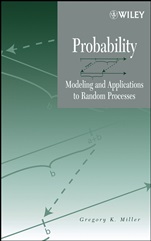
Probability: Modeling and Applications to Random Processes
ISBN 9780471458920
Autor: Gregory K. Miller
Wydawca: Wiley
Dostępność: 3-6 tygodni
Cena: 935,55 zł
Przed złożeniem zamówienia prosimy o kontakt mailowy celem potwierdzenia ceny.
ISBN13: |
9780471458920 |
ISBN10: |
0471458929 |
Autor: |
Gregory K. Miller |
Oprawa: |
Hardback |
Rok Wydania: |
2006-09-19 |
Ilość stron: |
488 |
Wymiary: |
236x156 |
Tematy: |
PB |
Improve Your Probability of Mastering This Topic
This book takes an innovative approach to calculus–based probability theory, considering it within a framework for creating models of random phenomena. The author focuses on the synthesis of stochastic models concurrent with the development of distribution theory while also introducing the reader to basic statistical inference. In this way, the major stochastic processes are blended with coverage of probability laws, random variables, and distribution theory, equipping the reader to be a true problem solver and critical thinker.
Deliberately conversational in tone, Probability is written for students in junior– or senior–level probability courses majoring in mathematics, statistics, computer science, or engineering. The book offers a lucid and mathematicallysound introduction to how probability is used to model random behavior in the natural world. The text contains the following chapters: ModelingSets and FunctionsProbability Laws I: Building on the AxiomsProbability Laws II: Results of ConditioningRandom Variables and Stochastic ProcessesDiscrete Random Variables and Applications in Stochastic ProcessesContinuous Random Variables and Applications in Stochastic ProcessesCovariance and Correlation Among Random Variables
Included exercises cover a wealth of additional concepts, such as conditional independence, Simpson′s paradox, acceptance sampling, geometric probability, simulation, exponential families of distributions, Jensen′s inequality, and many non–standard probability distributions.
Spis treści:
Preface.
To the Student.
To the Instructor.
Coverage.
Acknowledgments.
Chapter 1. Modeling.
1.1 Choice and Chance.
1.2 The Model Building Process.
1.3 Modeling in the Mathematical Sciences.
1.4 A First Look at a Proba
bility Model: The Random Walk.
1.5 Brief Applications of Random Walks.
Exercises.
Chapter 2. Sets and Functions.
2.1 Operations with Sets.
2.2 Functions.
2.3 The Probability Function and the Axioms of Probability.
2.4 Equally Likely Sample Spaces and Counting Rules.
Rules.
Exercises.
Chapter 3. Probility Laws I: Building on the Axioms.
3.1 The Complement Rule.
3.2 The Addition Rule.
3.3 Extensions and Additional Results.
Exercises.
Chapter 4. Probility Laws II: Results of Conditioning.
4.1 Conditional Probability and the Multiplication Rule.
4.2 Independent Events.
4.3 The Theorem of Total Probabilities and Bayes′ Rule.
4.4 Problems of Special Interest: Effortful Illustrations of the Probability Laws.
Exercises.
Chapter 5. Random Variables and Stochastic Processes.
5.1 Roles and Types of Random Variables.
5.2 Expectation.
5.3 Roles, Types, and Characteristics of Stochastic Processes.
Exercises.
Chapter 6. Discrete Random Variables and Applications in Stochastic Processes.
6.1 The Bernoulli and Binomial Models.
6.2 The Hypergeometric Model.
6.3 The Poisson Model.
6.4 The Geometric and Negative Binomial.
Models.
Exercises.
Chapter 7. Continuous Random Variables and Applications in Stochastic Processes.
7.1 The Continuous Uniform Model.
7.2 The Exponential Model.
7.3 The Gamma Model.
7.4 The Normal Model.
Chapter 8. Covariance and Correlation Among Random Variables.
8.1 Joint, Marginal and Conditional Distributions.
8.2 Covariance and Correlation.
8.3 Brief Examples and Illustrations in Stochastic Processes and Times Series.
Exercises.
Bibliography.
Tables.
Index.
Nota biograficzna:
GREGO
RY K. MILLER, PHD, is Associate Professor of Statistics in the Department of Mathematics and Statistics at Stephen F. Austin State University in Nacogdoches, Texas. He is a coauthor, with U. Narayan Bhat, of Elements of Applied Stochastic Processes, Third Edition (Wiley).
Okładka tylna:
Improve Your Probability of Mastering This Topic
This book takes an innovative approach to calculus–based probability theory, considering it within a framework for creating models of random phenomena. The author focuses on the synthesis of stochastic models concurrent with the development of distribution theory while also introducing the reader to basic statistical inference. In this way, the major stochastic processes are blended with coverage of probability laws, random variables, and distribution theory, equipping the reader to be a true problem solver and critical thinker.
Deliberately conversational in tone, Probability is written for students in junior– or senior–level probability courses majoring in mathematics, statistics, computer science, or engineering. The book offers a lucid and mathematicallysound introduction to how probability is used to model random behavior in the natural world. The text contains the following chapters: ModelingSets and FunctionsProbability Laws I: Building on the AxiomsProbability Laws II: Results of ConditioningRandom Variables and Stochastic ProcessesDiscrete Random Variables and Applications in Stochastic ProcessesContinuous Random Variables and Applications in Stochastic ProcessesCovariance and Correlation Among Random Variables
Included exercises cover a wealth of additional concepts, such as conditional independence, Simpson′s paradox, acceptance sampling, geometric probability, simulation, exponential families of distributions, Jensen′s inequality, and many non–standard probabilit
y distributions.
Koszyk
Książek w koszyku: 0 szt.
Wartość zakupów: 0,00 zł
Informacje


Kontakt
Gambit
Centrum Oprogramowania
i Szkoleń Sp. z o.o.
Al. Pokoju 29b/22-24
31-564 Kraków
Siedziba Księgarni
ul. Kordylewskiego 1
31-542 Kraków
+48 12 410 5991
+48 12 410 5987
+48 12 410 5989
Subskrypcje
Administratorem danych osobowych jest firma Gambit COiS Sp. z o.o. Na podany adres będzie wysyłany wyłącznie biuletyn informacyjny.
Autoryzacja płatności

Informacje na temat autoryzacji płatności poprzez PayU.

© Copyright 2012: GAMBIT COiS Sp. z o.o. Wszelkie prawa zastrzeżone.
Projekt i wykonanie: Alchemia Studio Reklamy