


Wydawcy
Katalog tematyczny
- Archeologia (109)
- Ekonomia, finanse, business (13704)
- Filozofia (1445)
- Historia (3040)
- Języki i językoznawstwo (2356)
- Lifestyle, hobby i rozrywka (475)
- Medycyna (9704)
- Nauki humanistyczne (4)
- Nauki o Ziemi i środowisku (2638)
- Nauki ścisłe (20412)
- Nauki społeczne (8486)
- Nauki techniczne (13450)
- Prawo (1696)
- Publikacje informacyjne i interdyscyplinarne (1288)
- Religia i wierzenia (917)
- Technika komputerowa (4067)
- Bazy danych (75)
- Bezpieczeństwo komputerowe (454)
- Certyfikacja komputerowa (1)
- Grafika i media cyfrowe (32)
- Informatyka (779)
- Komputery, ogólnie (74)
- Programowanie (351)
- Programy komercyjne (49)
- Sieci komputerowe (350)
- Sprzęt komputerowy (4)
- Systemy operacyjne (32)
- Technika cyfrowa na co dzień (7)
- Zdrowie, relacje międzyludzkie i rozwój osobisty (657)





Informacje szczegółowe o książce
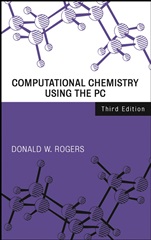
Computational Chemistry Using the PC
ISBN 9780471428008
Autor: Donald W. Rogers
Wydawca: Wiley
Dostępność: 3-6 tygodni
Cena: 617,40 zł
Przed złożeniem zamówienia prosimy o kontakt mailowy celem potwierdzenia ceny.
ISBN13: |
9780471428008 |
ISBN10: |
0471428000 |
Autor: |
Donald W. Rogers |
Oprawa: |
Hardback |
Rok Wydania: |
2003-10-14 |
Numer Wydania: |
3rd Edition |
Ilość stron: |
350 |
Wymiary: |
235x167 |
Tematy: |
uz |
The bestselling computational chemistry text, newly updated and expanded
Because of advances in technology, PC users can now model chemical phenomena which only a few years earlier required a supercomputer. With processing capabilities moving forward so rapidly, a current introduction to computational chemistry should utilize today’s generally available machines.
Computational Chemistry Using the PC, Third Edition takes the reader from a basic mathematical foundation to beginning research–level calculations, avoiding expensive or elaborate software in favor of PC applications. Geared toward an advanced undergraduate or introductory graduate course, this Third Edition contains revised and expanded coverage of molecular mechanics, molecular orbital theory, molecular quantum chemistry, and semi–empirical and ab initio molecular orbital calculations. Features of the text include:A mathematical introduction emphasizing matrix algebra Practice problems, lab exercises, and small research projects suitable for a one–semester courseInstruction on conducting research–level calculations using readily available softwareLearning tools available on an accompanying Web siteExtensive bibliography with references ranging from the historically significant to contemporary research
With significant changes made to adjust for improved technology and increased computer literacy of today’s student, Computational Chemistry Using the PC, Third Edition gives its readers the tools they need to translate theoretical principles into real computational problems, then proceed to a computed solution. Students of computational chemistry, as well as professionals interested in updating their skills in this fast–moving field, will find this book to be an invaluable resource.
Spis treści:
Preface to the Third Edition.
Preface to the Second Edition.
Preface to the First Ed
ition.
Chapter 1. Iterative Methods.
Iterative Methods.
An Iterative Algorithm.
Blackbody Radiation.
Radiation Density.
Wien’s Law.
The Planck Radiation Law.
COMPUTER PROJECT 1–1: Wien’s Law.
COMPUTER PROJECT 1–2: Roots of the Secular Determinant.
The Newton–Raphson Method.
Problems.
Numerical Integration.
Simpson’s Rule.
Efficiency and Machine Considerations.
Elements of Single–Variable Statistics.
The Gaussian Distribution.
COMPUTER PROJECT 1–3: Medical Statistics.
Molecular Speeds.
COMPUTER PROJECT 1–4: Maxwell–Boltzmann Distribution Laws.
COMPUTER PROJECT 1–5: Elementary Quantum Mechanics.
COMPUTER PROJECT 1–6: Numerical Integration of Experimental Data Sets.
Problems.
Chapter 2. Applications of Matrix Algebra.
Matrix Addition.
Matrix Multiplication.
Division of Matrices.
Powers and Roots of Matrices.
Matrix Polynomials.
The Least Equation.
Importance of Rank.
Importance of the Least Equation.
Special Matrices.
The Transformation Matrix.
Complex Matrices.
What’s Going On Here?
Problems.
Linear Nonhomogeneous Simultaneous Equations.
Algorithms.
Matrix Inversion and Diagonalization.
COMPUTER PROJECT 2–1: Simultaneous Spectrophotometric Analysis.
COMPUTER PROJECT 2–2 j Gauss–Seidel Iteration: Mass Spectroscopy.
COMPUTER PROJECT 2–3 j Bond Enthalpies of Hydrocarbons.
Problems.
Chapter 3. Curve Fitting.
Information Loss.
The Method of Least Squares.
Least Squares Minimization.
Linear Functions Passing Through the Origin.
Linear Functions Not Passing Through the Origin.
Quadratic Functions.
Polynomials of Higher Degree.
Statistical Criteria for Curve Fitting.
Reliability of Fitted Parameters.
COMPUTER PROJECT 3–1: Linear Curve Fitting: KF Solvation.
COMPUTER PROJECT 3–2: T
he Boltzmann Constant.
COMPUTER PROJECT 3–3: The Ionization Energy of Hydrogen.
Reliability of Fitted Polynomial Parameters.
COMPUTER PROJECT 3–4 j The Partial Molal Volume of ZnCl<sub>2</sub>.
Problems.
Multivariate Least Squares Analysis.
Error Analysis.
COMPUTER PROJECT 3–5: Calibration Surfaces Not Passing Through the Origin.
COMPUTER PROJECT 3–6: Bond Energies of Hydrocarbons.
COMPUTER PROJECT 3–7: Expanding the Basis Set.
Problems.
Chapter 4. Molecular Mechanics: Basic Theory.
The Harmonic Oscillator.
The Two–Mass Problem.
Polyatomic Molecules.
Molecular Mechanics.
Ethylene: A Trial Run.
The Geo File.
The Output File.
TINKER.
COMPUTER PROJECT 4–1: The Geometry of Small Molecules.
The GUI Interface.
Parameterization.
The Energy Equation.
Sums in the Energy Equation: Modes of Motion.
COMPUTER PROJECT 4–2: The MM3 Parameter Set.
COMPUTER PROJECT 4–3: The Butane Conformational Mix.
Cross Terms.
Problems.
Chapter 5. Molecular Mechanics II: Applications.
Coupling.
Normal Coordinates.
Normal Modes of Motion.
An Introduction to Matrix Formalism for Two Masses.
The Hessian Matrix.
Why So Much Fuss About Coupling?
The Enthalpy of Formation.
Enthalpy of Reaction.
COMPUTER PROJECT 5–1: The Enthalpy of Isomerization of cis– and trans–2–Butene.
Enthalpy of Reaction at Temperatures &ne; 298 K.
Population Energy Increments.
Torsional Modes of Motion.
COMPUTER PROJECT 5–2: The Heat of Hydrogenation of Ethylene.
Pi Electron Calculations.
COMPUTER PROJECT 5–3: The Resonance Energy of Benzene.
Strain Energy.
False Minima.
Dihedral Driver.
Full Statistical Method.
Entropy and Heat Capacity.
Free Energy and Equilibrium.
COMPUTER PROJECT 5–4: More Complicated Systems.
Problems.
C
hapter 6. Huckel Molecular Orbital Theory I: Eigenvalues.
Exact Solutions of the Schroedinger Equation.
Approximate Solutions.
The Huckel Method.
The Expectation Value of the Energy: The Variational Method.
COMPUTER PROJECT 6–1 j Another Variational Treatment of the Hydrogen Atom.
Huckel Theory and the LCAO Approximation.
Homogeneous Simultaneous Equations.
The Secular Matrix.
Finding Eigenvalues by Diagonalization.
Rotation Matrices.
Generalization.
The Jacobi Method.
Programs QMOBAS and TMOBAS.
COMPUTER PROJECT 6–2: Energy Levels (Eigenvalues).
COMPUTER PROJECT 6–3: Huckel MO Calculations of Spectroscopic Transitions.
Problems.
Chapter 7. Huckel Molecular Orbital Theory II: Eigenvectors.
Recapitulation and Generalization.
The Matrix as Operator.
The Huckel Coefficient Matrix.
Chemical Application: Charge Density.
Chemical Application: Dipole Moments.
Chemical Application: Bond Orders.
Chemical Application: Delocalization Energy.
Chemical Application: The Free Valency Index.
Chemical Application: Resonance (Stabilization) Energies.
LIBRARY PROJECT 7–1: The History of Resonance and Aromaticity.
Extended Huckel Theory—Wheland’s Method.
Extended Huckel Theory—Hoffman’s EHT Method.
The Programs.
COMPUTER PROJECT 7–1: Larger Molecules: Calculations using SHMO.
COMPUTER PROJECT 7–2: Dipole Moments.
COMPUTER PROJECT 7–3: Conservation of Orbital Symmetry.
COMPUTER PROJECT 7–4: Pyridine.
Problems.
Chapter 8. Self–Consistent Fields.
Beyond Huckel Theory.
Elements of the Secular Matrix.
The Helium Atom.
A Self–Consistent Field Variational Calculation of IP for the Helium Atom.
COMPUTER PROJECT 8–1: The SCF Energies of First Row Atoms and Ions.
COMPUTER PROJECT 8–2: A High–Level ab initio Calculation of SCF First IPs of the First Row
Koszyk
Książek w koszyku: 0 szt.
Wartość zakupów: 0,00 zł
Informacje


Kontakt
Gambit
Centrum Oprogramowania
i Szkoleń Sp. z o.o.
Al. Pokoju 29b/22-24
31-564 Kraków
Siedziba Księgarni
ul. Kordylewskiego 1
31-542 Kraków
+48 12 410 5991
+48 12 410 5987
+48 12 410 5989
Subskrypcje
Administratorem danych osobowych jest firma Gambit COiS Sp. z o.o. Na podany adres będzie wysyłany wyłącznie biuletyn informacyjny.
Autoryzacja płatności

Informacje na temat autoryzacji płatności poprzez PayU.

© Copyright 2012: GAMBIT COiS Sp. z o.o. Wszelkie prawa zastrzeżone.
Projekt i wykonanie: Alchemia Studio Reklamy