


Wydawcy
Katalog tematyczny
- Archeologia (109)
- Ekonomia, finanse, business (13704)
- Filozofia (1445)
- Historia (3040)
- Języki i językoznawstwo (2356)
- Lifestyle, hobby i rozrywka (475)
- Medycyna (9704)
- Nauki humanistyczne (4)
- Nauki o Ziemi i środowisku (2638)
- Nauki ścisłe (20412)
- Nauki społeczne (8486)
- Nauki techniczne (13450)
- Prawo (1696)
- Publikacje informacyjne i interdyscyplinarne (1288)
- Religia i wierzenia (917)
- Technika komputerowa (4067)
- Bazy danych (75)
- Bezpieczeństwo komputerowe (454)
- Certyfikacja komputerowa (1)
- Grafika i media cyfrowe (32)
- Informatyka (779)
- Komputery, ogólnie (74)
- Programowanie (351)
- Programy komercyjne (49)
- Sieci komputerowe (350)
- Sprzęt komputerowy (4)
- Systemy operacyjne (32)
- Technika cyfrowa na co dzień (7)
- Zdrowie, relacje międzyludzkie i rozwój osobisty (657)





Informacje szczegółowe o książce
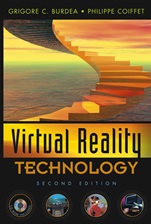
Virtual Reality Technology
ISBN 9780471360896
Autor: Grigore C. Burdea, Philippe Coiffet
Wydawca: Wiley
Dostępność: 3-6 tygodni
Cena: 892,50 zł
Przed złożeniem zamówienia prosimy o kontakt mailowy celem potwierdzenia ceny.
ISBN13: |
9780471360896 |
ISBN10: |
0471360899 |
Autor: |
Grigore C. Burdea, Philippe Coiffet |
Oprawa: |
Hardback |
Rok Wydania: |
2003-07-25 |
Numer Wydania: |
2nd Edition |
Ilość stron: |
464 |
Wymiary: |
263x243 |
Tematy: |
UA |
A groundbreaking Virtual Reality textbook is now even better
Virtual reality is a very powerful and compelling computer application by which humans interact with computer–generated environments in a way that mimics real life and engages various senses. Although its most widely known application is in the entertainment industry, the real promise of virtual reality lies in such fields as medicine, engineering, oil exploration, and the military, to name just a few. Through virtual reality, scientists can triple the rate of oil discovery, pilots can dogfight numerically superior "bandits," and surgeons can improve their skills on virtual (rather than real) patients.
This Second Edition of the first comprehensive technical book on virtual reality provides updated and expanded coverage of the technology such as:Input and output interfaces including touch and force feedbackComputing architecture (with emphasis on the rendering pipeline and task distribution)Object modeling (including physical and behavioral aspects)Programming for virtual reality (WorldToolKit, Java 3D, GHOST, and PeopleShop)An in–depth look at human factors issues, user performance, and sensorial conflict aspects of VRTraditional and emerging VR applications
The new edition of Virtual Reality Technology is specifically designed for use as a textbook. Thus, it includes definitions, review questions, and a CD–ROM with video clips that reinforce the topics covered. The CD–ROM also contains a Laboratory Manual with homework and programming assignments in VRML and Java 3D, as follows:Introduction to VRML and Java 3DSensor and Event ProcessingVRML and JavaScriptScene Hierarchy, Geometry, and TextureVRML PROTO and Glove DevicesViewpoint Control, Sound, and Haptic Effects
The Second Edition will serve as a state–of–the–art resource for both undergraduate and graduate studen
ts in engineering, computer science, and other disciplines.
Spis treści:
BOOK VERSION:
FOREWORD.
PREFACE.
1 INTRODUCTION.
1.1 The Three I’s of Virtual Reality.
1.2 A Short History of Early Virtual Reality.
1.3 Early Commercial VR Technology .
1.4 VR Becomes an Industry.
1.5 The Five Classic Components of a VR System.
1.6 Review Questions.
References.
2 INPUT DEVICES: TRACKERS, NAVIGATION, AND GESTURE INTERFACES.
2.1 Three–Dimensional Position Trackers.
2.1.1 Tracker Performance Parameters.
2.1.2 Mechanical Trackers.
2.1.3 Magnetic Trackers.
2.1.4 Ultrasonic Trackers.
2.1.5 Optical Trackers.
2.1.6 Hybrid Inertial Trackers.
2.2 Navigation and Manipulation Interfaces.
2.2.1 Tracker–Based Navigation/Manipulation Interfaces.
2.2.2 Trackballs.
2.2.3 Three–Dimensional Probes.
2.3 Gesture Interfaces.
2.3.1 The Pinch Glove.
2.3.2 The 5DT Data Glove.
2.3.3 The Didjiglove.
2.3.4 Th e CyberGlove.
2.4 Conclusion.
2.5 Review Questions.
References.
3 OUTPUT DEVICES: GRAPHICS, THREE–DIMENSIONAL SOUND, AND HAPTIC DISPLAYS.
3.1 Graphics Displays.
3.1.1 The Human Visual System.
3.1.2 Personal Graphics Displays.
3.1.3 Large–Volume Displays.
3.2 Sound Displays.
3.2.1 The Human Auditory System.
3.2.2 The Convolvotron.
3.2.3 Speaker–Based Three–Dimensional Sound.
3.3 Haptic Feedback.
3.3.1 The Human Haptic System.
3.3.2 Tactile Feedback Interfaces.
3.3.3 Force Feedback Interfaces.
3.4 Conclusion.
3.5 Review Questions.
References.
4 COMPUTING ARCHITECTURES FOR VR.
4.1 The Rendering Pipeline.
4.1.1 The Graphics Rendering Pipeline.
4.1.2 The Haptics Rendering Pipeline.
4.2 PC Graphics Architecture.
4.2.1 PC Graphics Accelerators.
4.2.2 Graphics Benchmarks.
4.3 Workstation–Based Architectures.
4.3.1 The Sun
Blade 1000 Architecture.
4.3.2 The SGI Infinite Reality Architecture.
4.4 Distributed VR Architectures.
4.4.1 Multipipeline Synchronization.
4.4.2 Colocated Rendering Pipelines.
4.4.3 Distributed Virtual Environments.
4.5 Conclusion.
4.6 Review Questions.
References.
5 MODELING.
5.1 Geometric Modeling.
5.1.1 Virtual Object Shape.
5.1.2 Object Visual Appearance.
5.2 Kinematics Modeling.
5.2.1 Homogeneous Transformation Matrices.
5.2.2 Object Position.
5.2.3 Transformation Invariants.
5.2.4 Object Hierarchies.
5.2.5 Viewing the Three–Dimensional World.
5.3 Physical Modeling.
5.3.1 Collision Detection.
5.3.2 Surface Deformation.
5.3.3 Force Computation.
5.3.4 Force Smoothing and Mapping.
5.3.5 Haptic Texturing.
5.4 Behavior Modeling.
5.5 Model Management.
5.5.1 Level–of–Detail Management.
5.5.2 Cell Segmentation.
5.6 Conclusion.
5.7 Review Questions.
References.
6 VR PROGRAMMING.
6.1 Toolkits and Scene Graphs.
6.2 WorldToolKit.
6.2.1 Model Geometry and Appearance.
6.2.2 The WTK Scene Graph.
6.2.3 Sensors and Action Functions.
6.2.4 WTK Networking.
6.3 Java 3D.
6.3.1 Model Geometry and Appearance.
6.3.2 Java 3D Scene Graph.
6.3.3 Sensors and Behaviors.
6.3.4 Java 3D Networking.
6.3.5 WTK and Java 3D Performance Comparison.
6.4 General Haptics Open Software Toolkit.
6.4.1 GHOST Integration with the Graphics Pipeline.
6.4.2 The GHOST Haptics Scene Graph.
6.4.3 Collision Detection and Response.
6.4.4 Graphics and PHANToM Calibration.
6.5 PeopleShop.
6.5.1 DI–Guy Geometry and Path.
6.5.2 Sensors and Behaviors.
6.5.3 PeopleShop Networking.
6.6 Conclusion.
6.7 Review Questions.
References.
7 HUMAN FACTORS IN VR.
7.1 Methodology and Terminology.
7.1.1 Data Collection and Analysis.
7.1.2 Usability Engineering Methodology.
7.2 User Performance Studies.<
br>7.2.1 Testbed Evaluation of Universal VR Tasks.
7.2.2 Influence of System Responsiveness on User Performance.
7.2.3 Influence of Feedback Multimodality.
7.3 VR Health and Safety Issues.
7.3.1 Direct Effects of VR Simulations on Users.
7.3.2 Cybersickness.
7.3.3 Adaptation and Aftereffects.
7.3.4 Guidelines for Proper VR Usage.
7.4 VR and Society.
7.4.1 Impact on Professional Life.
7.4.2 Impact on Private Life.
7.4.3 Impact on Public Life.
7.5 Conclusion.
7.6 Review Questions.
References.
8 TRADITIONAL VR APPLICATIONS.
8.1 Medical Applications of VR.
8.1.1 Virtual Anatomy.
8.1.2 Triage and Diagnostic.
8.1.3 Surgery.
8.1.4 Rehabilitation.
8.2 Education, Arts, and Entertainment.
8.2.1 VR in Education.
8.2.2 VR and the Arts.
8.2.3 Entertainment Applications of VR.
8.3 Military VR Applications.
8.3.1 Army Use of VR.
8.3.2 VR Applications in the Navy.
8.3.3 Air Force Use of VR.
8.4 Conclusion.
8.5 Review Questions.
References.
9 EMERGING APPLICATIONS OF VR.
9.1 VR Applications in Manufacturing.
9.1.1 Virtual Prototyping.
9.1.2 Other VR Applications in Manufacturing.
9.2 Applications of VR in Robotics.
9.2.1 Robot Programming.
9.2.2 Robot Teleoperation.
9.3 Information Visualization.
9.3.1 Oil Exploration and Well Management.
9.3.2 Volumetric Data Visualization.
9.4 Conclusion.
9.5 Review Questions.
References.
Index.
CD–ROM VERSION:
Chapter 1. Introduction to VRML & Java 3D.
Objectives.
1. Overview of the VRML language.
2. The VRML Browser.
3. Examples of VRML Worlds
4. The Basic VRML Syntax.
5. Objects Creation in VRML.
6. Introduction to Java 3D [Advanced].
7. VRML & Java 3D [Advanced].
Homework.
Project I–0. Install a VRML Browser.
Project I–1. Create a Simple VRML World.
Project I–2. Load VRML files in Java 3D [Advanced].
Chapte
Koszyk
Książek w koszyku: 0 szt.
Wartość zakupów: 0,00 zł
Informacje


Kontakt
Gambit
Centrum Oprogramowania
i Szkoleń Sp. z o.o.
Al. Pokoju 29b/22-24
31-564 Kraków
Siedziba Księgarni
ul. Kordylewskiego 1
31-542 Kraków
+48 12 410 5991
+48 12 410 5987
+48 12 410 5989
Subskrypcje
Administratorem danych osobowych jest firma Gambit COiS Sp. z o.o. Na podany adres będzie wysyłany wyłącznie biuletyn informacyjny.
Autoryzacja płatności

Informacje na temat autoryzacji płatności poprzez PayU.

© Copyright 2012: GAMBIT COiS Sp. z o.o. Wszelkie prawa zastrzeżone.
Projekt i wykonanie: Alchemia Studio Reklamy