


Wydawcy
Katalog tematyczny
- Archeologia (109)
- Ekonomia, finanse, business (13704)
- Filozofia (1445)
- Historia (3040)
- Języki i językoznawstwo (2356)
- Lifestyle, hobby i rozrywka (475)
- Medycyna (9704)
- Nauki humanistyczne (4)
- Nauki o Ziemi i środowisku (2638)
- Nauki ścisłe (20412)
- Astronomia (294)
- Biologia (5119)
- Chemia (6540)
- Fizyka (3309)
- Matematyka (4574)
- Algebra (171)
- Analiza matematyczna (902)
- Filozofia matematyki (1)
- Geometria (237)
- Historia matematyki (57)
- Kombinatoryka, teoria grafów (67)
- Matematyka dyskretna (35)
- Matematyka stosowana (555)
- Optymalizacja (104)
- Podstawy matematyki (129)
- Statystyka, prawdopodobieństwo (296)
- Teoria grup (63)
- Teoria liczb (77)
- Topologia (66)
- Nauki ścisłe, ogólnie (503)
- Nauki społeczne (8486)
- Nauki techniczne (13450)
- Prawo (1696)
- Publikacje informacyjne i interdyscyplinarne (1288)
- Religia i wierzenia (917)
- Technika komputerowa (4067)
- Zdrowie, relacje międzyludzkie i rozwój osobisty (657)





Informacje szczegółowe o książce
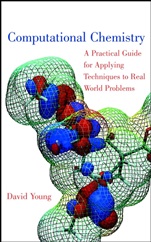
Computational Chemistry: A Practical Guide for Applying Techniques to Real World Problems
ISBN 9780471333685
Autor: David Young
Wydawca: Wiley
Dostępność: 3-6 tygodni
Cena: 784,35 zł
Przed złożeniem zamówienia prosimy o kontakt mailowy celem potwierdzenia ceny.
ISBN13: |
9780471333685 |
ISBN10: |
0471333689 |
Autor: |
David Young |
Oprawa: |
Hardback |
Rok Wydania: |
2001-04-12 |
Ilość stron: |
408 |
Wymiary: |
240x155 |
Tematy: |
PBWD |
A complete bench–top guide to basic and advanced techniques used to solve real world research problems
Thanks to the proliferation of inexpensive, easy–to–use computational chemistry programs, the average laboratory chemist now has access to powerful tools once reserved solely for highly trained specialists. Computational Chemistry was designed specifically to enable chemists to add computational chemistry techniques to their working arsenal.
This book supplies the expert advice and guidance needed to confidently choose and successfully apply the correct computational chemistry techniques to an array of real world scientific problems. Computational chemist David Young provides clear–cut descriptions and step–by–step instructions for solving technical problems. He explores basic techniques in the field with a focus on their relative strengths and limitations. In addition, Young treats a range of advanced techniques from an easy–to–understand, nonmathematical standpoint, including transition structures, reaction coordinates, reaction rates, convergence problems, QM/MM, solvation, nonlinear optical properties, relativistic effects, mesoscale methods, and more.
Computational Chemistry features:
∗ Prioritized lists of methods for attacking difficult computational chemistry problems
∗ Brief critical reviews of most commercially available software packages, assessing each for its overall effectiveness and practical utility
∗ A review of the material from the perspective of various chemical systems (such as organic molecules, inorganics, biomolecules, polymers, liquids, or solids)
Spis treści:
Preface.
Acknowledgments.
Symbols Used in This Book.
Introduction.
BASIC TOPICS.
Fundamental Principles.
Ab initio Methods.
Semiempirical Methods.
Density Functional Theory.
Molecular Mechanics.
Molecular Dynamics and Monte Carlo Simulations.
Pred
icting Molecular Geometry.
Constructing a Z–Matrix.
Using Existing Basis Sets.
Molecular Vibrations.
Population Analysis.
Other Chemical Properties.
The Importance of Symmetry.
Efficient Use of Computer Resources.
How to Conduct a Computational Research Project.
ADVANCED TOPICS.
Finding Transition Structures.
Reaction Coordinates.
Reaction Rates.
Potential Energy Surfaces.
Conformation Searching.
Fixing Self–Consistent Field Convergence Problems.
QM/MM.
Solvation.
Electronic Excited States.
Size Consistency.
Spin Contamination.
Basis Set Customization.
Force Field Customization.
Structure––Property Relationships.
Computing NMR Chemical Shifts.
Nonlinear Optical Properties.
Relativistic Effects.
Band Structures.
Mesoscale Methods.
Synthesis Route Prediction.
APPLICATIONS.
The Computational Chemist′s View of the Periodic Table.
Biomolecules.
Simulating Liquids.
Polymers.
Solids and Surfaces.
Appendix: Software Packages.
Appendix 1: Integrated Packages.
Appendix 2: Ab initio and DFT Software.
Appendix 3: Semiempirical Software.
Appendix 4: Molecular Mechanics/Molecular Dynamics/Monte Carlo Software.
Appendix 5: Graphics Packages.
Apendix 6: Special–purpose Programs.
Glossary.
Bibliography.
Index.
Nota biograficzna:
DAVID YOUNG, PhD, is a scientist with Cytoclonal Pharmaceutics in Dallas, Texas. Prior to joining the team at Cytoclonal, Dr. Young worked as a super–computer analyst for Nichols Research Corporation and Computer Sciences Corporation, and as an affiliate professor of chemistry at Auburn University.
Okładka tylna:
A complete bench–top guide to basic and advanced techniques used to solve real world research problems
Thanks to the proliferation of inexpensive, easy–to–use computational chemistry programs, the average laboratory
chemist now has access to powerful tools once reserved solely for highly trained specialists. Computational Chemistry was designed specifically to enable chemists to add computational chemistry techniques to their working arsenal.
This book supplies the expert advice and guidance needed to confidently choose and successfully apply the correct computational chemistry techniques to an array of real world scientific problems. Computational chemist David Young provides clear–cut descriptions and step–by–step instructions for solving technical problems. He explores basic techniques in the field with a focus on their relative strengths and limitations. In addition, Young treats a range of advanced techniques from an easy–to–understand, nonmathematical standpoint, including transition structures, reaction coordinates, reaction rates, convergence problems, QM/MM, solvation, nonlinear optical properties, relativistic effects, mesoscale methods, and more.
Computational Chemistry features:
∗ Prioritized lists of methods for attacking difficult computational chemistry problems
∗ Brief critical reviews of most commercially available software packages, assessing each for its overall effectiveness and practical utility
∗ A review of the material from the perspective of various chemical systems (such as organic molecules, inorganics, biomolecules, polymers, liquids, or solids)
Koszyk
Książek w koszyku: 0 szt.
Wartość zakupów: 0,00 zł
Informacje


Kontakt
Gambit
Centrum Oprogramowania
i Szkoleń Sp. z o.o.
Al. Pokoju 29b/22-24
31-564 Kraków
Siedziba Księgarni
ul. Kordylewskiego 1
31-542 Kraków
+48 12 410 5991
+48 12 410 5987
+48 12 410 5989
Subskrypcje
Administratorem danych osobowych jest firma Gambit COiS Sp. z o.o. Na podany adres będzie wysyłany wyłącznie biuletyn informacyjny.
Autoryzacja płatności

Informacje na temat autoryzacji płatności poprzez PayU.

© Copyright 2012: GAMBIT COiS Sp. z o.o. Wszelkie prawa zastrzeżone.
Projekt i wykonanie: Alchemia Studio Reklamy