


Wydawcy
Katalog tematyczny
- Archeologia (109)
- Ekonomia, finanse, business (13704)
- Filozofia (1445)
- Historia (3040)
- Języki i językoznawstwo (2356)
- Lifestyle, hobby i rozrywka (475)
- Medycyna (9704)
- Nauki humanistyczne (4)
- Nauki o Ziemi i środowisku (2638)
- Nauki ścisłe (20412)
- Astronomia (294)
- Biologia (5119)
- Chemia (6540)
- Fizyka (3309)
- Matematyka (4574)
- Algebra (171)
- Analiza matematyczna (902)
- Filozofia matematyki (1)
- Geometria (237)
- Historia matematyki (57)
- Kombinatoryka, teoria grafów (67)
- Matematyka dyskretna (35)
- Matematyka stosowana (555)
- Optymalizacja (104)
- Podstawy matematyki (129)
- Statystyka, prawdopodobieństwo (296)
- Teoria grup (63)
- Teoria liczb (77)
- Topologia (66)
- Nauki ścisłe, ogólnie (503)
- Nauki społeczne (8486)
- Nauki techniczne (13450)
- Prawo (1696)
- Publikacje informacyjne i interdyscyplinarne (1288)
- Religia i wierzenia (917)
- Technika komputerowa (4067)
- Zdrowie, relacje międzyludzkie i rozwój osobisty (657)





Informacje szczegółowe o książce
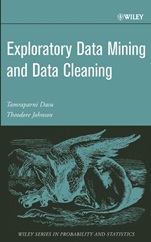
Exploratory Data Mining and Data Cleaning
ISBN 9780471268512
Autor: Tamraparni Dasu, Theodore Johnson
Wydawca: Wiley
Dostępność: 3-6 tygodni
Cena: 681,45 zł
Przed złożeniem zamówienia prosimy o kontakt mailowy celem potwierdzenia ceny.
ISBN13: |
9780471268512 |
ISBN10: |
0471268518 |
Autor: |
Tamraparni Dasu, Theodore Johnson |
Oprawa: |
Hardback |
Rok Wydania: |
2003-06-10 |
Ilość stron: |
204 |
Wymiary: |
243x162 |
Tematy: |
PB |
A unique, integrated approach to exploratory data mining and data quality
Data analysts at information–intensive businesses are frequently asked to analyze new data sets that are often dirty–composed of numerous tables possessing unknown properties. Prior to analysis, this data must be cleaned and explored–often a long and arduous task. Ensuring data quality is a notoriously messy problem that can only be addressed by drawing on methods from many disciplines, including statistics, exploratory data mining, database management, and metadata coding.
Where other books on data mining and analysis focus primarily on the last stage of the analysis procedure, Exploratory Data Mining and Data Cleaning uses a uniquely integrated approach to data exploration and data cleaning to develop a suitable modeling strategy that will help analysts to more effectively determine and implement the final technique.
The authors, both seasoned data analysts at a major corporation, draw on their own professional experience to: Present a brief overview of the main analytical techniques used in data mining practices, such as univariate and multivariate summaries of attributes and their interactions including Q –Q plots, fractal dimension and histograms, nonparametric approaches incorporating data depth, and moreProvide numerous references to the related literature on clustering, classification, regression, and more Focus on developing an evolving modeling strategy through an iterative data exploration loop and incorporation of domain knowledge Address methods of detecting, quantifying (metrics), and correcting data quality issues that significantly impact findings and decisions, using commercially available tools as well as new algorithmic approachesUse case studies to illustrate applications in real–life scenarios Highlight new approaches and methodologies, such as the DataSphere space partitioning a
nd summary–based analysis techniques
A groundbreaking addition to the existing literature, Exploratory Data Mining and Data Cleaning serves as an important reference for data analysts who need to analyze large amounts of unfamiliar data, operations managers, and students in undergraduate or graduate–level courses dealing with data analysis and data mining.
Spis treści:
0.1 Preface.
1 Exploratory Data Mining and Data Cleaning: An Overview.
1.1 Introduction.
1.2 Cautionary Tales.
1.3 Taming the Data.
1.4 Challenges.
1.5 Methods.
1.6 EDM.
1.6.1 EDM Summaries – Parametric.
1.6.2 EDM Summaries – Nonparametric.
1.7 EndtoEnd Data Quality (DQ).
1.7.1 DQ in Data Preparation.
1.7.2 EDM and Data Glitches.
1.7.3 Tools for DQ.
1.7.4 EndtoEnd DQ: The Data Quality Continuum.
1.7.5 Measuring Data Quality.
1.8 Conclusion.
2 Exploratory Data Mining.
2.1 Introduction.
2.2 Uncertainty.
2.2.1 Annotated Bibliography.
2.3 EDM: Exploratory Data Mining.
2.4 EDM Summaries.
2.4.1 Typical Values.
2.4.2 Attribute Variation.
2.4.3 Example.
2.4.4 Attribute Relationships.
2.4.5 Annotated Bibliography.
2.5 What Makes a Summary Useful?
2.5.1 Statistical Properties.
2.5.2 Computational Criteria.
2.5.3 Annotated Bibliography.
2.6 DataDriven Approach – Nonparametric Analysis.
2.6.1 The Joy of Counting.
2.6.2 Empirical Cumulative Distribution Function (ECDF).
2.6.3 Univariate Histograms.
2.6.4 Annotated Bibliography.
2.7 EDM in Higher Dimensions.
2.8 Rectilinear Histograms.
2.9 Depth and Multivariate Binning.
2.9.1 Data Depth.
2.9.2 Aside: DepthRelated Topics.
2.9.3 Annotated Bibliography.
2.10 Conclusion.
3 Partitions and Piecewise Models.
3.1 Divide and Conquer.
3.1.1 Why Do We Need Partitions?
3.1.2 Dividing Data.
3.1.3 Applications of Partitionbased
EDM Summaries.
3.2 AxisAligned Partitions and Data Cubes.
3.3 Nonlinear Partitions.
3.3.1 Annotated Bibliography.
3.4 DataSpheres (DS).
3.4.1 Layers.
3.4.2 Data Pyramids.
3.4.3 EDM Summaries.
3.4.4 Annotated Bibliography.
3.5 Set Comparison Using EDM Summaries.
3.5.1 Motivation.
3.5.2 Comparison Strategy.
3.5.3 Statistical Tests for Change.
3.5.4 Application – Two Case Studies.
3.5.5 Annotated Bibliography.
3.6 Discovering Complex Structure in Data with EDM Summaries.
3.6.1 Exploratory Model Fitting in Interactive Response Time.
3.6.2 Annotated Bibliography.
3.7 Piecewise Linear Regression.
3.7.1 An Application.
3.7.2 Regression Coefficients.
3.7.3 Improvement in Fit.
3.7.4 Annotated Bibliography.
3.8 OnePass Classification.
3.8.1 QuantileBased Prediction with Piecewise Models.
3.8.2 Simulation Study.
3.8.3 Annotated Bibliography.
3.9 Conclusion.
4 Data Quality.
4.1 Introduction.
4.2 The Meaning of Data Quality.
4.2.1 An Example.
4.2.2 Data Glitches.
4.2.3 Gaps in Time Series Records.
4.2.4 Conventional Definition.
4.2.5 Times Have Changed.
4.2.6 Annotated Bibliography.
4.3 Updating DQ Metrics: Data Quality Continuum.
4.3.1 Data Gathering.
4.3.2 Data Delivery.
4.3.3 Data Monitoring.
4.3.4 Data Storage.
4.3.5 Data Integration.
4.3.6 Data Retrieval.
4.3.7 Data Mining/Analysis.
4.3.8 Annotated Bibliography.
4.4 The Meaning of Data Quality Revisited.
4.4.1 Data Interpretation.
4.4.2 Data Suitability.
4.4.3 Dataset Type.
4.4.4 Attribute Type.
4.4.5 Application Type.
4.4.6 Data Quality – A Many Splendored Thing.
4.4.7 Annotated Bibliography.
4.5 Measuring Data Quality.
4.5.1 DQ Components and Their Measurement.
4.5.2 Combining DQ Metrics.
4.6 The DQ Process.
4.7 Conclusion.
4.7.1 Four Complementary Approaches.
4.7.2 Annotated Bibliography.
5 Data Quality: Techni
ques and Algorithms.
5.1 Introduction.
5.2 DQ Tools Based on Statistical Techniques.
5.2.1 Missing Values.
5.2.2 Incomplete Data.
5.2.3 Outliers.
5.2.4 Time Series Outliers: A Case Study.
5.2.5 GoodnessofFit.
5.2.6 Annotated Bibliography.
5.3 Database Techniques for DQ.
5.3.1 What is a Relational Database?
5.3.2 Why Are Data Dirty?
5.3.3 Extraction, Transformation, and Loading (ETL).
5.3.4 Approximate Matching.
5.3.5 Database Profiling.
5.3.6 Annotated Bibliography.
5.4 Metadata and Domain Expertise.
5.4.1 Lineage Tracing.
5.4.2 Annotated Bibliography.
5.5 Measuring Data Quality?
5.5.1 Inventory Building – A Case Study.
5.5.2 Learning and Recommendations.
5.6 Data Quality and Its Challenges.
Nota biograficzna:
TAMRAPARNI DASU, PhD, and THEODORE JOHNSON, PhD, are both members of the technical staff at AT&T Labs–Research in Florham Park, New Jersey.
Okładka tylna:
A unique, integrated approach to exploratory data mining and data quality
Data analysts at information–intensive businesses are frequently asked to analyze new data sets that are often dirty–composed of numerous tables possessing unknown properties. Prior to analysis, this data must be cleaned and explored–often a long and arduous task. Ensuring data quality is a notoriously messy problem that can only be addressed by drawing on methods from many disciplines, including statistics, exploratory data mining, database management, and metadata coding.
Where other books on data mining and analysis focus primarily on the last stage of the analysis procedure, Exploratory Data Mining and Data Cleaning uses a uniquely integrated approach to data exploration and data cleaning to develop a suitable modeling strategy that will help analysts to more effectively determine and implement the final technique.
The authors, both seasoned data analysts at a major cor
Koszyk
Książek w koszyku: 0 szt.
Wartość zakupów: 0,00 zł
Informacje


Kontakt
Gambit
Centrum Oprogramowania
i Szkoleń Sp. z o.o.
Al. Pokoju 29b/22-24
31-564 Kraków
Siedziba Księgarni
ul. Kordylewskiego 1
31-542 Kraków
+48 12 410 5991
+48 12 410 5987
+48 12 410 5989
Subskrypcje
Administratorem danych osobowych jest firma Gambit COiS Sp. z o.o. Na podany adres będzie wysyłany wyłącznie biuletyn informacyjny.
Autoryzacja płatności

Informacje na temat autoryzacji płatności poprzez PayU.

© Copyright 2012: GAMBIT COiS Sp. z o.o. Wszelkie prawa zastrzeżone.
Projekt i wykonanie: Alchemia Studio Reklamy