


Wydawcy
Katalog tematyczny
- Archeologia (109)
- Ekonomia, finanse, business (13704)
- Filozofia (1445)
- Historia (3040)
- Języki i językoznawstwo (2356)
- Lifestyle, hobby i rozrywka (475)
- Medycyna (9704)
- Nauki humanistyczne (4)
- Nauki o Ziemi i środowisku (2638)
- Nauki ścisłe (20412)
- Astronomia (294)
- Biologia (5119)
- Chemia (6540)
- Fizyka (3309)
- Matematyka (4574)
- Algebra (171)
- Analiza matematyczna (902)
- Filozofia matematyki (1)
- Geometria (237)
- Historia matematyki (57)
- Kombinatoryka, teoria grafów (67)
- Matematyka dyskretna (35)
- Matematyka stosowana (555)
- Optymalizacja (104)
- Podstawy matematyki (129)
- Statystyka, prawdopodobieństwo (296)
- Teoria grup (63)
- Teoria liczb (77)
- Topologia (66)
- Nauki ścisłe, ogólnie (503)
- Nauki społeczne (8486)
- Nauki techniczne (13450)
- Prawo (1696)
- Publikacje informacyjne i interdyscyplinarne (1288)
- Religia i wierzenia (917)
- Technika komputerowa (4067)
- Zdrowie, relacje międzyludzkie i rozwój osobisty (657)





Informacje szczegółowe o książce
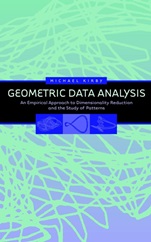
Geometric Data Analysis: An Empirical Approach to Dimensionality Reduction and the Study of Patterns
ISBN 9780471239291
Autor: Michael Kirby
Wydawca: Wiley
Dostępność: 3-6 tygodni
Cena: 648,90 zł
Przed złożeniem zamówienia prosimy o kontakt mailowy celem potwierdzenia ceny.
ISBN13: |
9780471239291 |
ISBN10: |
0471239291 |
Autor: |
Michael Kirby |
Oprawa: |
Hardback |
Rok Wydania: |
2001-01-29 |
Ilość stron: |
384 |
Wymiary: |
240x167 |
Tematy: |
PBM |
An analysis of large data sets from an empirical and geometric viewpoint
Data reduction is a rapidly emerging field with broad applications in essentially all fields where large data sets are collected and analyzed. Geometric Data Analysis is the first textbook to focus on the geometric approach to this problem of developing and distinguishing subspace and submanifold techniques for low–dimensional data representation. Understanding the geometrical nature of the data under investigation is presented as the key to identifying a proper reduction technique.
Focusing on the construction of dimensionality–reducing mappings to reveal important geometrical structure in the data, the sequence of chapters is carefully constructed to guide the reader from the beginnings of the subject to areas of current research activity. A detailed, and essentially self–contained, presentation of the mathematical prerequisites is included to aid readers from a broad variety of backgrounds. Other topics discussed in Geometric Data Analysis include:
∗ The Karhunen–Loeve procedure for scalar and vector fields with extensions to missing data, noisy data, and data with symmetry
∗ Nonlinear methods including radial basis functions (RBFs) and backpropa–gation neural networks
∗ Wavelets and Fourier analysis as analytical methods for data reduction
∗ Expansive discussion of recent research including the Whitney reduction network and adaptive bases codeveloped by the author
∗ And much more
The methods are developed within the context of many real–world applications involving massive data sets, including those generated by digital imaging systems and computer simulations of physical phenomena. Empirically based representations are shown to facilitate their investigation and yield insights that would otherwise elude conventional analytical tools.
Spis treści:
Preface.
Acknowledgments.
INTRODUCTION.
Pattern Analysis as Data Reduction.
Vector Spaces and Linear Transformations.
OPTIMAL ORTHOGONAL PATTERN REPRESENTATIONS.
The Karhunen–Loève Expansion.
Additional Theory, Algorithms and Applications.
TIME, FREQUENCY AND SCALE ANALYSIS.
Fourier Analysis.
Wavelet Expansions.
ADAPTIVE NONLINEAR MAPPINGS.
Radial Basis Functions.
Neural Networks.
Nonlinear Reduction Architectures.
Appendix A Mathemetical Preliminaries.
References.
Index.
Nota biograficzna:
MICHAEL KIRBY is a professor in the Department of Mathematics at Colorado State University in Fort Collins, Colorado. He has worked in the field of data reduction for well over a decade.
Okładka tylna:
An analysis of large data sets from an empirical and geometric viewpoint
Data reduction is a rapidly emerging field with broad applications in essentially all fields where large data sets are collected and analyzed. Geometric Data Analysis is the first textbook to focus on the geometric approach to this problem of developing and distinguishing subspace and submanifold techniques for low–dimensional data representation. Understanding the geometrical nature of the data under investigation is presented as the key to identifying a proper reduction technique.
Focusing on the construction of dimensionality–reducing mappings to reveal important geometrical structure in the data, the sequence of chapters is carefully constructed to guide the reader from the beginnings of the subject to areas of current research activity. A detailed, and essentially self–contained, presentation of the mathematical prerequisites is included to aid readers from a broad variety of backgrounds. Other topics discussed in Geometric Data Analysis include:
∗ The Karhunen–Loeve procedure for scalar and vector fields with extensions to missing data, noisy data, and data with symmetry
∗ Nonlinear metho
ds including radial basis functions (RBFs) and backpropa–gation neural networks
∗ Wavelets and Fourier analysis as analytical methods for data reduction
∗ Expansive discussion of recent research including the Whitney reduction network and adaptive bases codeveloped by the author
∗ And much more
The methods are developed within the context of many real–world applications involving massive data sets, including those generated by digital imaging systems and computer simulations of physical phenomena. Empirically based representations are shown to facilitate their investigation and yield insights that would otherwise elude conventional analytical tools.
Koszyk
Książek w koszyku: 0 szt.
Wartość zakupów: 0,00 zł
Informacje


Kontakt
Gambit
Centrum Oprogramowania
i Szkoleń Sp. z o.o.
Al. Pokoju 29b/22-24
31-564 Kraków
Siedziba Księgarni
ul. Kordylewskiego 1
31-542 Kraków
+48 12 410 5991
+48 12 410 5987
+48 12 410 5989
Subskrypcje
Administratorem danych osobowych jest firma Gambit COiS Sp. z o.o. Na podany adres będzie wysyłany wyłącznie biuletyn informacyjny.
Autoryzacja płatności

Informacje na temat autoryzacji płatności poprzez PayU.

© Copyright 2012: GAMBIT COiS Sp. z o.o. Wszelkie prawa zastrzeżone.
Projekt i wykonanie: Alchemia Studio Reklamy