


Wydawcy
Katalog tematyczny
- Archeologia (109)
- Ekonomia, finanse, business (13704)
- Filozofia (1445)
- Historia (3040)
- Języki i językoznawstwo (2356)
- Lifestyle, hobby i rozrywka (475)
- Medycyna (9704)
- Nauki humanistyczne (4)
- Nauki o Ziemi i środowisku (2638)
- Nauki ścisłe (20412)
- Nauki społeczne (8486)
- Nauki techniczne (13450)
- Prawo (1696)
- Publikacje informacyjne i interdyscyplinarne (1288)
- Religia i wierzenia (917)
- Technika komputerowa (4067)
- Bazy danych (75)
- Bezpieczeństwo komputerowe (454)
- Certyfikacja komputerowa (1)
- Grafika i media cyfrowe (32)
- Informatyka (779)
- Komputery, ogólnie (74)
- Programowanie (351)
- Programy komercyjne (49)
- Sieci komputerowe (350)
- Sprzęt komputerowy (4)
- Systemy operacyjne (32)
- Technika cyfrowa na co dzień (7)
- Zdrowie, relacje międzyludzkie i rozwój osobisty (657)





Informacje szczegółowe o książce
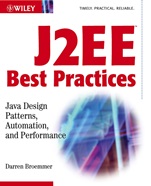
J2EE Best Practices: Java Design Patterns, Automation, and Performance
ISBN 9780471228851
Autor: Darren Broemmer
Wydawca: Wiley
Dostępność: 3-6 tygodni
Cena: 211,05 zł
Przed złożeniem zamówienia prosimy o kontakt mailowy celem potwierdzenia ceny.
ISBN13: |
9780471228851 |
ISBN10: |
0471228850 |
Autor: |
Darren Broemmer |
Oprawa: |
Paperback |
Rok Wydania: |
2002-11-29 |
Ilość stron: |
496 |
Wymiary: |
233x191 |
Tematy: |
UP |
Learn how to apply robust application design to your J2EE projects
There are a number of best practices you need to consider to build highly effective J2EE components and integrate them into applications. These practices include evaluating and selecting the right set of software components and services to handle the job.
In this book, Darren Broemmer supplies you with a set of best practices for J2EE development and then teaches you how to use them to construct an application architecture referred to as the reference architecture. The design and implementation of the reference architecture is based on a set of guiding principles that are used to optimize and automate J2EE development.
In addition to the author′s thorough discussions of the latest technologies for J2EE implementation–including EJB 2, Jakarta Struts, Servlets, Java Server Pages, UML, design patterns, Common Business Logic Foundation components, and XML–Broemmer addresses such topics as:
∗ Understanding J2EE application architecture
∗ Building business applications with J2EE, a business object architecture, and extensible components created with design patterns
∗ Designing and implementing a sample banking Web application
∗ Integrating proven performance–engineering and optimization practices in the development process
∗ Using metadata–driven, configurable foundation components to automate much of the development and processing of Web–based business applications
The companion Web site contains the source code for a Common Business Logic Foundation and sample applications from the book, including a Jakarta Struts project and a banking application. Links to the Jakarta Struts frameworks and J2EE application servers such as BEA WebLogic and IBM WebSphere are also provided.
Spis treści:
Acknowledgments.
About the Author.
Introduction.
Chapter 1. Building Business Applications with J2
EE.
Chapter 2. The Business Object Architecture: Design Considerations.
Chapter 3. Building Business Objects: Managing Properties and Handling Errors.
Chapter 4. Building Business Objects: Persistence, Relationships, and the Template Method Pattern.
Chapter 5. The Service–Based Architecture: Design Considerations.
Chapter 6. Building Service–Based Components.
Chapter 7. The User Interaction Architecture: Design Considerations and an Overview of Jakarta Struts.
Chapter 8. Building the User Interaction Architecture.
Chapter 9. Strengthening the Bank Application: Adding Security and Advanced Functionality.
Chapter 10. Performance.
Chapter 11. Moving toward Reuse in the Reference Architecture.
Bibliography.
Index.
Nota biograficzna:
DARREN BROEMMER is a senior software engineer for Freddie Mac specializing in Java and component–based development.
Okładka tylna:
Learn how to apply robust application design to your J2EE projects
There are a number of best practices you need to consider to build highly effective J2EE components and integrate them into applications. These practices include evaluating and selecting the right set of software components and services to handle the job.
In this book, Darren Broemmer supplies you with a set of best practices for J2EE development and then teaches you how to use them to construct an application architecture referred to as the reference architecture. The design and implementation of the reference architecture is based on a set of guiding principles that are used to optimize and automate J2EE development.
In addition to the author′s thorough discussions of the latest technologies for J2EE implementation–including EJB 2, Jakarta Struts, Servlets, Java Server Pages, UML, design patterns, Common Business Logic Foundation components, and XML–Broemmer addresses such topics as:
∗ Understanding J2EE application a
rchitecture
∗ Building business applications with J2EE, a business object architecture, and extensible components created with design patterns
∗ Designing and implementing a sample banking Web application
∗ Integrating proven performance–engineering and optimization practices in the development process
∗ Using metadata–driven, configurable foundation components to automate much of the development and processing of Web–based business applications
The companion Web site contains the source code for a Common Business Logic Foundation and sample applications from the book, including a Jakarta Struts project and a banking application. Links to the Jakarta Struts frameworks and J2EE application servers such as BEA WebLogic and IBM WebSphere are also provided.
Koszyk
Książek w koszyku: 0 szt.
Wartość zakupów: 0,00 zł
Informacje


Kontakt
Gambit
Centrum Oprogramowania
i Szkoleń Sp. z o.o.
Al. Pokoju 29b/22-24
31-564 Kraków
Siedziba Księgarni
ul. Kordylewskiego 1
31-542 Kraków
+48 12 410 5991
+48 12 410 5987
+48 12 410 5989
Subskrypcje
Administratorem danych osobowych jest firma Gambit COiS Sp. z o.o. Na podany adres będzie wysyłany wyłącznie biuletyn informacyjny.
Autoryzacja płatności

Informacje na temat autoryzacji płatności poprzez PayU.

© Copyright 2012: GAMBIT COiS Sp. z o.o. Wszelkie prawa zastrzeżone.
Projekt i wykonanie: Alchemia Studio Reklamy